OpenAI’s Dots lead on the future of ChatGPT
Sources PodcastYouTube231,099 views as of 8 October 2026
Why it is here
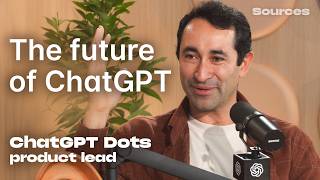
Alex Heath’s Sources podcast with Alexander Embiricos, OpenAI’s Dots product lead, on why Dots ‘have their own computers’, share context across surfaces and ‘ask before taking action by default’. ~231k views. Length 45:29.
Description
Description written by Gemini from the videoGemini 3.8 Flash, 8 October 2026
Summary In this episode of the Sources Podcast, host Alex Heath interviews Alexander Embiricos, Product Lead for Dots at OpenAI, at OpenAI DevDay 2026. Embiricos discusses the origin, product philosophy, safety architecture, and pricing strategy behind “dots”—OpenAI’s persistent, proactive personal AI agents powered by GPT-6 Astra.
What is shown
- [02:39] Promotional clip showing the “dots” identity and UI concept: colorful, embodied animated avatars (such as blobs with berets and sunglasses) displayed on wall-mounted smart screens.
- [02:45] ChatGPT interface screen showing menu options: “Your dot”, “Scheduled”, “Library”, “Customize”, and “Explore”.
- [06:23] Video reel illustrating dot interactions: a dot named “Alfred” updating website designs, “Felipe” updating a board deck on screen, and mobile/smart display interfaces.
- [17:40] Stage presentation clips from OpenAI DevDay 2026 featuring Sam Altman announcing “ChatGPT Space” (“dots in Space”), presenting “Living Pages”, workstreams, and collaborative documents.
- [22:06] Keynote slides showing “Specialist dots” categories (Accounting, Email marketing, Legal analysis, Ticket resolution) and the “Codex Harness”.
Claims & numbers
- Alexander Embiricos joined OpenAI through an acquisition (Multi) slightly over two years prior to work on persistent agents.
- ChatGPT currently serves 1.2 billion weekly active users, while OpenAI’s agent and coding products (Codex and Work) have 35 million users (stated by Alex Heath and Alexander Embiricos).
- Dots are powered by GPT-6 Astra within a modified version of the Codex evaluation and execution harness.
- Safety architecture uses multi-layer defense: base-level alignment in GPT-6 Astra, the sandboxed Codex harness, conservative initial permissioning (requiring confirmation before external actions), an independent “Auto-review” model supervising execution, and audit logging of all sub-agent tasks.
- In team environments like Slack, individual dots are prefixed with their human owner’s handle (e.g.,
AE-dot) to maintain accountability and prevent identity confusion. - Pricing for dots will abandon traditional hard rate limits in favor of a flat monthly structure that manages compute by deprioritizing non-urgent tasks overnight or adjusting model efficiency as usage thresholds near.
- Initial rollout begins with Pro, Business Premium, and Enterprise tiers, with plans to expand to Plus and eventually integrate directly into the free tier of ChatGPT over time.
Notable quotes
- [00:43] Alexander Embiricos: “I joined OpenAI a little over two years ago and I’ve basically been on a mission to ship dots since I joined, and so I’m like thrilled that it’s happening.”
- [13:14] Alexander Embiricos: “So most people will just have one, and that agent should feel like an extension of them.”
- [40:48] Alexander Embiricos: “He looks at me and he says, ‘In two years? That’s an incredibly long period of time. That’s not the right duration to ask about. You should be asking about success in two months.’”
Assessment This is an authentic, in-depth technical interview filmed on-site at OpenAI DevDay 2026, intercut with keynote footage and product announcement reels. The operational details, architecture, and pricing mechanics are directly explained by the product lead, though visual demonstrations within the video consist of staged marketing clips and keynote presentation slides rather than unedited, real-time product screencasts.
Described by gemini-3.8-flash on 2026-10-08 from the video’s audio and frames.