Gemini 4 Argon + Antigravity: 20K-Line Rust App
Telusko YouTube 5,976 views as of 13 October 2026
Why it is here
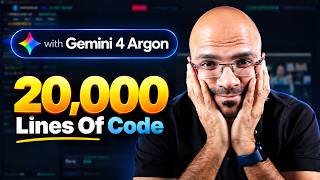
Launch-day test (11:19): Telusko says it used Gemini 4 Argon inside Antigravity to build a 20,000-line recording app (CamStudio Recorder v2.0.8) in Rust, React and WebGL, and discusses the unified 1M-token window (description).
Description
Description written by Gemini from the videoGemini 3.8 Flash, 13 October 2026
Summary
Navin Reddy (Telusko) reviews Google DeepMind’s newly released Gemini 4 Argon model and early access features. He explains how he used Google Antigravity and Gemini 4 Argon to generate a nearly 20,000-line dual-layer screen and camera recorder application in Rust and React. He also examines Gemini 4 Argon’s architecture, 1-million-token output context, API pricing, and performance benchmarks.
What is shown
- [00:50] Demonstration of the “CamStudio Recorder” desktop application built using Rust and React/Tauri, showing simultaneous independent webcam and screen capture feeds.
- [02:37] Slide on “Gemini 4 Argon — Architecture & Analysis”, highlighting 1M/1M unified context, 3 thinking tiers, 77.9% on DeepSWE-v1.1, and $2 / $10 token pricing.
- [03:52] Output token capacity chart comparing previous Gemini models (64k), Claude Sonnet 4.6 (128k), and Gemini 4 Argon (1,000,000 output tokens).
- [05:43] Slide showing benchmark performance across domains, including Embedded Reasoning and Vals Index ranking.
- [05:54] Slide outlining “Thinking Levels & API Token Economics” ($2/M input, $10/M output, $1/M cached input).
- [06:28] Slide detailing the 19,660 LOC architecture of CamStudio Recorder (4,608 LOC React/Tauri UI, 6,156 LOC Rust Native Engine, 1,802 LOC capture pipeline).
- [08:12] Slide detailing technical fixes for eliminating Variable Frame Rate (VFR) and audio drift.
- [08:58] Slide outlining internal engineering benchmarks at Google (Chromium repo, YouTube comments frontend, Google Python SDK import times cut by 21%).
- [09:30] Overview of the Interactions API and platform availability across Google AI Studio, Vertex AI, Google Antigravity, and Gemini apps.
- [10:01] VS Code demonstration executing a multi-turn Python script using the
google.genaiSDK andgemini-4-argonto diagnose WebRTC/MediaRecorder audio-video sync drift.
Claims & numbers
- The presenter and slides state Gemini 4 Argon supports a unified context of 1 million input tokens and 1 million output tokens.
- Gemini 4 Argon features three thinking levels: Low, Medium (default), and High.
- The slides show a DeepSWE-v1.1 benchmark score of 77.9% and #1 rank on the Vals Index.
- Token pricing is listed as $2 per 1M input tokens, $10 per 1M output tokens, and $1 per 1M cached input tokens.
- The presenter states the demo app has 19,660 lines of code generated with Antigravity and Gemini 4 Argon.
- An internal Google benchmark slide claims an overnight Antigravity agent run reduced Python SDK import times by 21%.
- The presenter notes a minor negative experience: working with PDFs did not function properly for his account during testing.
Notable quotes
- [04:27] “But now, with Gemini 4, we got 1 million output tokens.”
- [06:33] “Now this particular project, it has around 20,000 lines of code, and in the vibe coding era, the lines doesn’t matter at this point...”
- [11:13] “And I feel Google is back.”
Assessment
This is an independent hands-on developer review combining presentation slides with a live demo of an app and code execution in VS Code. The code interaction and desktop recording UI are shown working live on screen, while benchmark slides are based on Google’s published specifications and early access materials.
Described by gemini-3.8-flash on 2026-10-13 from the video’s audio and frames.