I Tested Gemini 4 Argon vs Opus 5.5 (No Hype)
The AI Automators YouTube 20,982 views as of 15 October 2026
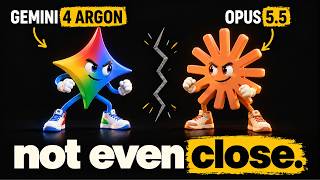
Why it is here
Side-by-side test (18:34) of Gemini 4 Argon and Claude Opus 5.5 on builder tasks.
Description
Description written by Gemini from the videoGemini 3.8 Flash, 15 October 2026
Summary
Daniel Walsh from The AI Automators presents a head-to-head coding and creative benchmark comparing Google’s newly released flagship model, Gemini 4 Argon (tested via the Google Antigravity CLI on the Google AI Ultra plan), against Anthropic’s Claude Opus 5.5 (tested via Claude Code). Both models are tested on identical prompts across six complex software and 3D tasks—a flood simulator, a Canva clone, a 3D bike shop website, an open-world driving simulator, a Blender kitchen design studio, and a 60-second code-rendered launch video—with GPT-6 Astra evaluating the outputs against the technical specifications.
What is shown
- Test Setup [00:41 - 01:16]: Walsh demonstrates the Google Antigravity CLI and setup under Google’s $99/month AI Ultra plan, configuring both Gemini 4 Argon and Claude Opus 5.5 to “high” reasoning effort, with GPT-6 Astra acting as an independent LLM judge on AgenticOps.
- Clonmel Flood Simulator [01:17 - 05:46]: Both models build a real-time 3D shallow-water flood simulator with terrain and flood-wall drawing for Clonmel, Ireland. Gemini 4 Argon produces blocky geometry and starts with submerged buildings before flooding begins [02:27], scoring 5/10 in 74 minutes; Claude Opus 5.5 (“Freeboard”) runs smoothly with GPU acceleration and interactive side-by-side comparison, scoring 7/10 in 54 minutes.
- Canva Clone with Bakery Brand [05:56 - 08:30]: Both models create a browser-based graphic design app with local AI background removal and multi-format resizing. Argon produces a cluttered, courier-font interface scoring 6/10 in 70 minutes [06:08]; Opus 5.5 (“Ember & Rye Studio”) creates a polished, responsive template editor and brand kit scoring 8/10 in 42 minutes [07:04].
- Bespoke Bike Shop Website [08:30 - 10:54]: The brief requires an interactive 3D assembly hero, catalog, and booking wizard. Argon builds an overly technical, text-heavy site (“Aonach”) scoring 5/10 in 74 minutes [08:41]; Opus 5.5 (“Halyard”) builds a cohesive e-commerce site with smooth 3D assembly and multi-step service booking scoring 8/10 in 56 minutes [09:29].
- Westport Driving Test Simulator [11:10 - 13:54]: An open-world driving simulator built on OpenStreetMap data for Westport, Ireland. Argon’s build suffers from severe collision glitches and cars driving through buildings [11:23, 11:53], scoring 5/10 in 51 minutes; Opus 5.5 features multiple test routes, realistic terrain, and examiner feedback scoring 6/10 in 84 minutes, despite minor surface z-fighting/flickering [12:25].
- Blender Kitchen Designer [13:55 - 14:40]: Models generate a 3D kitchen layout in Blender across three aesthetics with lighting variants and costed parts lists. Walsh opens the generated
.blendscene files in Blender, inspecting the mesh topology and rendering quality [14:44, 15:56]. - Launch Film Made in Code [16:41 - 18:24]: A Remotion-style 60-second launch video for the open-source finance app Actual Budget. Argon stalls due to rate limits and produces an unreadable text-dense video scoring 4/10 in 78 minutes [16:46]; Opus 5.5 produces dynamic motion typography and app demos scoring 7/10 in 44 minutes [17:12].
Claims & numbers
- Subscription Pricing: The presenter states he subscribed to the Google AI Ultra plan at $99/month to test Gemini 4 Argon in the Google Antigravity CLI [00:46].
- Flood Simulator: The presenter reports Opus 5.5 scored 7/10 and finished in 54 minutes using 24 million total tokens (mostly cached), while Argon scored 5/10, taking 74 minutes and 9.7 million tokens [05:04, 05:24].
- Canva Clone: The presenter notes Opus 5.5 scored 8/10 in 42 minutes (26M tokens), whereas Argon scored 6/10 in 70 minutes (17M tokens) [08:10, 08:16].
- Bike Shop Website: The presenter states Opus 5.5 won 8/10 vs. Argon’s 5/10; completion times were 56 minutes for Opus 5.5 vs. 74 minutes for Argon [10:31, 10:36].
- Driving Test: The presenter reports Opus 5.5 scored 6/10 (taking 84 minutes and 45M tokens) vs. Argon’s 5/10 (51 minutes and 13M tokens) [13:39, 13:46].
- Launch Film: The presenter states Opus 5.5 scored 7/10 in 44 minutes, while Argon scored 4/10 in 78 minutes after stalling for 21 minutes due to five-hour budget limits [17:50, 17:54].
Notable quotes
- [00:22] “And with this release, there’s a lot of hope that Google are finally coming back to the table in delivering state-of-the-art models.”
- [10:21] “Anthropic has done an amazing job when it comes to front-end design with these models.”
- [16:32] “Argon did a decent job, but just not to this level of polish. That is incredible for a first attempt.”
Assessment
This is a hands-on, authentic third-party benchmark review showing live screencasts of locally run code, interactive web applications, and Blender project files generated by Gemini 4 Argon and Claude Opus 5.5. The presenter demonstrates both the successes and bugs of each model without apparent cherry-picking, noting reproducible flaws such as rate limit stalls, geometry collision failures, and UI rendering glitches.
Described by gemini-3.8-flash on 2026-10-15 from the video’s audio and frames.