Google Just DROPPED Its Most Powerful AI Ever
TheAIGRID YouTube 10,662 views as of 14 October 2026
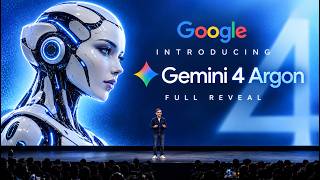
Why it is here
Long Argon overview (38:08): benchmarks, the 3D pagoda test, agent teams in Antigravity, Argon’s cyber skills (with Wiz) and robotics.
Description
Description written by Gemini from the videoGemini 3.8 Flash, 14 October 2026
Summary This video is a comprehensive breakdown and review presented by the YouTube channel The AI Grid, examining Google DeepMind’s newly released frontier model, Gemini 4 Argon. The presenter covers the model’s architecture, benchmark performance, pricing, agentic workflows, robotics integration, cybersecurity findings, and safety evaluations disclosed in its technical documentation.
What is shown
- Overview of Gemini 4 Argon’s deep work capabilities, MoE architecture, and 1M unified context window [00:15].
- Benchmark comparisons across the Vals Index, DeepSWE, Vibe Code Bench, and the Artificial Analysis Intelligence Index [01:57].
- Internal Google and enterprise case studies (Chrome refactoring, Fuchsia C++ to Rust porting, quantum error decoding, and Isomorphic Labs drug discovery) [04:20].
- George Kenwright (Google DeepMind) demonstrates generating a multi-agent 3D Blender reconstruction of a Japanese temple complex via Antigravity using Nano Banana reference images [05:43].
- Nick (DevRel, Antigravity) demonstrates the “Teamwork preview” feature, translating and localizing over 100 pages of documentation into 17 languages in two days [08:52].
- Gemini app agent demonstration generating a catering proposal deck in Google Slides and drafting client emails in Gmail [14:38].
- Gal Nagli (Head of Offensive AI at Wiz) presents “Scan for Good” cybersecurity testing, showing Argon identifying critical access and authorization flaws in healthcare systems [16:17].
- Rohan Thakker (Google DeepMind) and Apptronik’s Apollo humanoid robot demonstrate the “Video-to-Sim-to-Real” pipeline, learning and executing a cornhole throw via MuJoCo simulation [20:46].
- Additional physical AI demos: Boston Dynamics Spot opening a pedal trash bin, a robotic arm clearing table items, scrabble tile sorting, and an origami task breakdown [22:52].
- Analysis of Google’s 217-page Safety & Security Report, covering evaluation awareness, cyber uplift levels, silent chain-of-thought monitoring, and community benchmark reactions [25:20].
Claims & numbers
- The presenter says Gemini 4 Argon is a sparse mixture-of-experts model with a 1 million token context window covering combined input and output, supporting long-decode continuation up to 1 million output tokens.
- The presenter states that on long-context tests between 256k and 1M tokens, Argon scores 84.2%, and scores 91.7% on LV-Bench.
- On the Vals Index, the presenter reports Argon ranks #1 at 68.9% (ahead of Claude Sonnet 5.5 at 67.04% and Claude Opus 5.5 at 66.97%), scores 65.4% on Vals Finance Agent v2, 19.6% on Harvey Legal Agent, 51.3% on AutomationBench, 77.9% on DeepSWE v1.1, and 91.9% on Vibe Code Bench.
- On the Artificial Analysis Intelligence Index, the presenter states Argon scored 53 (tying GPT-6 Astra, 1 point ahead of GPT-6.1 Sol), with a 15% hallucination rate on their Omniscience test (compared to 51% for GPT-6 Astra), though its factual accuracy on that test was 50%.
- Promotional API pricing is reported at $2 per million input tokens and $10 per million output tokens (with 95% discount on cached inputs), doubling after November 30 to $4 and $20.
- Google claimed internal achievements including refactoring ~6 million lines of Chrome code in weeks, converting >800,000 lines of Fuchsia kernel code from C/C++ to Rust, and lifting Antigravity agentic PR submissions by >35% while cutting rollbacks by nearly a third.
- In cybersecurity evaluations, the presenter states Argon achieved 85.8% on real-world vulnerability discovery across 20 languages, 70.9% on the Wiz penetration test benchmark, tied #1 on CWE-bench v1 at 68%, and achieved a 0.7% attack success rate on Gray Swan IPI.
- In robotics, the presenter reports an 87.0% score on ERQA, and notes a simulated training rollout of 4,500 practice episodes boosted real-robot task success from 56% to 75% while reducing execution time from 35s to 24s.
- The presenter highlights limitations: on Terminal-Bench 4.0 Argon scored 57.4% (trailing Claude Opus 5.5 at 66.4%), on FrontierSWE v2 it scored 55.0% (trailing Astra at 65.5% and Opus 5.5 at 62.3%), and on the Vals RSI Index it scored 30.5% (behind Claude Opus 5.5 at 37.3%).
Notable quotes
- [08:21] George Kenwright: “One of my favorite things about working with these models is when you discover some new capability where the output seems almost impossible.”
- [16:22] Gal Nagli: “Every successful cyber attack could cause real harm.”
- [36:32] Presenter: “Where Argon really shines is long, careful knowledge work: things like finance, legal research, security audits, and big codebases where that million-token context window and low hallucination rate actually matter.”
Assessment This video is a secondary synthesis and analytical review by an AI news channel, aggregating Google’s official launch materials, engineering demos, third-party benchmark evaluations, and safety report findings. While the benchmark charts and product screencasts reflect genuine published materials, the presentation selectively highlights promotional demo videos produced by Google and its partners (such as the robotics and 3D Blender clips) alongside independent community critiques.
Described by gemini-3.8-flash on 2026-10-14 from the video’s audio and frames.