DeepSeek’s Insane New Architecture
Two Minute PapersYouTube337,830 views as of 9 October 2026
Why it is here
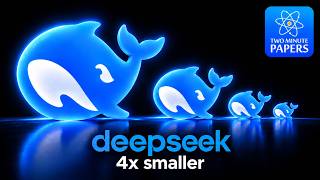
Two Minute Papers on the DeepSeek V4.1 Flash paper. ~338k views by 2026-10-09. Length 5:10.
Description
Description written by Gemini from the videoGemini 3.8 Flash, 9 October 2026
Summary
Dr. Károly Zsolnai-Fehér from the channel Two Minute Papers reviews the architecture and performance of DeepSeek-V4.1-Flash. He explains how the model achieves massive KV cache compression using Cross-layer Shared Attention (CSA2) and evaluates its code generation, visual comprehension, reasoning benchmarks, and fluid simulation reproductions compared to leading frontier models.
What is shown
- [00:02] Visual comparison of a rendered Saturn planet between GPT-6 Astra and DeepSeek 4.1 Flash.
- [00:04] Fast live inference token generation solving a programming/algorithmic problem.
- [00:11] Benchmark chart comparing DeepSeek-V4.1-Flash against Kimi-K3, GLM-5.3, Opus 5, and GPT-5.6-Sol on DeepSWE v1.1 and CyberGym.
- [00:23] Web-based interactive 3D demos and games generated with DeepSeek-V4.1-Flash, including a flying broomstick game, a low-poly snowboarding game [00:31], and a 3D vector/particle field simulator [00:35].
- [00:47] Native visual reproduction demo: DeepSeek-V4.1-Flash recreating a Warcraft III menu interface based on an image input.
- [01:07] Presentation of the research paper: “DeepSeek-V4.1-Flash: Pushing the Limits of KV Cache Compression”.
- [01:10] Bar chart tracking global KV cache per token reduction across DeepSeek generations (V1 to V4.1-Flash).
- [01:59] Diagrams explaining traditional layer-by-layer KV caching versus DeepSeek-V4.1-Flash’s Causal Encoder and Decoder sharing a global KV memory cache via CSA2.
- [03:10] Liquid honey coiling fluid simulation reproductions comparing the original SIGGRAPH paper output against implementations from GPT-6 Astra, Claude Opus 5.1, and DeepSeek-V4.1-Flash.
- [03:57] Token counter and cost tracker animation displaying token usage scaling past 101 million tokens.
- [04:36] Sponsor overview for Lambda AI cloud computing infrastructure.
Claims & numbers
- Benchmark scores: The presenter shows DeepSeek-V4.1-Flash scoring 74.2% on DeepSWE v1.1 (beating Kimi-K3 at 67.5%, GLM-5.3 at 66.9%, GPT-5.6-Sol at 73.0%, and Claude Opus 5 at 74.0%) and 88.1% on CyberGym (beating Kimi-K3 at 80.0% and GLM-5.3, Opus 5, and GPT-5.6-Sol at 84.5% each).
- Hardware cost: Running DeepSeek-V4.0-Pro locally costs roughly $300,000 in hardware, whereas V4.1-Flash can run for approximately a quarter of that hardware cost.
- KV cache compression: The global KV cache per token in DeepSeek-V4.1-Flash is reduced to 890 bytes—approximately 437× smaller than DeepSeek-V1 (389,120 bytes in November 2023) and ~4× smaller than DeepSeek-V4-Flash (3,514 bytes in April 2026).
- Architecture: The presenter states DeepSeek-V4.1-Flash uses a technique called CSA2 (Cross-layer Shared Attention 2) with an encoder-decoder architecture that shares KV memory across its 40 layers.
- Model size: DeepSeek-V4.1-Flash has more than 500 billion parameters.
- Limitations: The presenter notes that the model burns significant token counts during deep reasoning (showing 101,257,961 tokens consumed for $1.48 USD) and currently underperforms GPT-6 Astra and Claude Opus 5.1 on complex scientific fluid physics code generation.
Notable quotes
- [01:06] “Hold on to your papers, fellow scholars, it’s small because of the KV cache.”
- [02:13] “DeepSeek 4.1 Flash finally gives us shared memory between the layers.”
- [03:57] “4.1 Flash likes to think a lot and burns a lot of tokens.”
Assessment
This is an independent scientific review and paper breakdown evaluating DeepSeek-V4.1-Flash’s architecture and capabilities. The video demonstrates real community-generated WebGL/canvas outputs and benchmark charts, though the honey coiling reproduction and token burn rate illustrate both its current weaknesses and trade-offs.
Described by gemini-3.8-flash on 2026-10-09 from the video’s audio and frames.