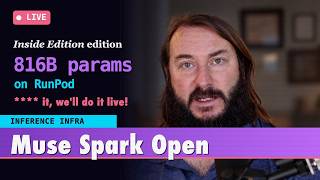
🔴 LIVE: Muse Spark Open on RunPod. Adding Strata support.
Unbiased Bob YouTube 2,730 views as of 16 October 2026
Why it is here
Launch-day livestream (2 h 49 min) deploying Muse Spark Open, which per the description had day-one llama.cpp support: Unsloth’s 2-bit GGUF is 226 GB, served on a RunPod box with 2× H200 (282 GB HBM3e, $10.60/hr), then an attempt on a 48 GB RTX A6000 home node. Shows what running the 816B open-weight model actually takes. About 2.7k views on 2026-10-16.
Description
Description written by Gemini from the videoGemini 3.8 Flash, 16 October 2026
Summary
In this livestream, developer and YouTuber Robert Karl (Unbiased Bob) experiments with Meta’s newly released open-weights model, Muse Spark Open 816B (with 42B active parameters). He uses automated coding agents (including Claude Opus 5.5 and Astra) to run the model on rented RunPod instances (featuring dual Nvidia B200 GPUs), integrating it into his fork of the Strata inference engine (UnbiasedStrata) and comparing its performance against llama.cpp. Throughout the stream, he profiles execution bottlenecks, analyzes KV cache and VRAM allocation graphs, and evaluates the model’s coding capabilities on a browser-based falling sand simulation benchmark.
What is shown
- [04:58] The Hugging Face model card for
meta-models/Muse-Spark-Open-816B-A42B, highlighting licensing requirements and community quantizations from Unsloth. - [07:22] The
UnbiasedStrataGitHub repository and local project files. - [26:15] GitHub pull request showing native Muse Spark inference implementation and
llama.cppparity checks. - [31:35] RunPod interface managing instances, including dual H200 SXM ($16.02/hr) and dual B200 SXM ($16.02/hr) configurations, discussing container disk versus network volume I/O bottlenecks.
- [41:45] Reviewing community benchmarks on Luke’s Dev Lab website, comparing models like Horizon and Qwen.
- [42:35] Reviewing local AI client interfaces (Osaurus and Odysseus AI) and their model management workflows.
- [56:30] Memory allocation charts (
Muse Spark on B200: where the memory goes), detailing 135.8 GiB GPU expert payload, filesystem cache, and observed cache hit rates (99.57%). - [63:25] Analysis plots comparing Strata model speeds (prompt/decode tokens/s) across core parameter counts and active parameters for Qwen 3.6 35B-A3B, Flash-Next, GLM-5.3-Flash, and Muse Spark Open.
- [83:30] Interactive browser test of the single-file HTML/JS falling sand simulation generated by Muse Spark Open via
UnbiasedStrata. - [88:45] Execution timeline profile visualizations comparing cold-prefill, warm-prefill, and decode phases on B200.
- [95:50] Performance comparison chart: native streaming in Strata vs. fully resident
llama.cpprunning Muse SparkIQ2_XXSon dual B200s (achieving 263.6 prompt tokens/s and 47.0 decode tokens/s inllama.cpp). - [104:10] Viewing an X clip of Mark Zuckerberg drinking Guinness in a pub.
- [142:45] Testing the second falling sand simulation generated by Muse Spark
IQ2_XXSrunning directly underllama.cpp. - [155:25] Hugging Face’s July 2026 security disclosure article detailing an AI-driven intrusion and how open-weight GLM-5.2 was used for forensic log analysis when commercial API guardrails refused.
- [161:35] BBW alpha Pareto efficiency frontier benchmark plot showing task score vs. wall-clock time for local models.
Claims & numbers
- The presenter notes that Muse Spark Open has 816 billion total parameters with 42 billion active parameters per token [05:02, 64:55].
- The presenter mentions renting dual Nvidia B200 SXM instances on RunPod at approximately $16.02 per hour (~$8/hr per GPU) [14:15, 31:30].
- The model card for Muse Spark Open states that running unquantized weights requires a GPU setup with at least 700 GB of VRAM for NVFP4 and 2 TB for BF16 [68:57].
- On a dual B200 instance running Muse Spark Open
IQ2_XXSinllama.cpp, the presenter benchmarks prompt processing at ~263.6 to 740 tokens/s and decode throughput at 45.6 to 47.0 tokens/s [95:50, 136:18]. - Profiling graphs shown on stream report a 99.57% expert cache hit rate during sample execution, transferring 10.91 GiB host-to-device memory over 62 seconds [58:35].
- Presenter notes Qwen 3.8 Flash-Next operates with 125B total parameters and 6B active parameters [54:47, 65:47].
Notable quotes
- [54:41] “It would really surprise me if Meta’s 8x larger model... because Qwen 3.8 Flash-Next is what, 125 billion parameters, and this thing is much larger.”
- [133:28] “Dude, there is no excuse today. There is no excuse for yelling at an open-source maintainer.”
- [157:54] “‘The practical lesson for defenders: have a capable model you can run on your own infrastructure, vetted and ready before an incident.’ ... I want to get that like tattooed on my forehead or something.”
Assessment
This is a genuine, unedited live coding and testing session rather than a polished marketing demo. The host documents both successes and real-world stumbling blocks, including initial configuration mistakes, slow disk I/O on cloud instances, sub-optimal offloading performance, and code generation quirks in the benchmarked model.
Described by gemini-3.8-flash on 2026-10-16 from the video’s audio and frames.