Claude JUST found hidden DNA...
Wes RothYouTube349,368 views as of 9 October 2026
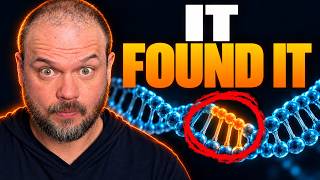
Why it is here
Wes Roth on Claude agents finding a previously unknown biological system after ~21 hours of search. ~349k views by 2026-10-09. Length 30:42.
Description
Description written by Gemini from the videoGemini 3.8 Flash, 9 October 2026
Summary
Wes Roth discusses a September 23, 2026 announcement from Anthropic detailing how autonomous Claude agents discovered a novel CRISPR-like enzyme system termed ART (array-associated reverse transcriptase). He walks through Anthropic’s blog post and research paper, explains the biological mechanisms behind reverse transcriptases, retrons, and phages using blackboard diagrams, and analyzes findings on how internal activations in Claude models detected repeated DNA patterns directly in-context.
What is shown
- [00:00] Overview of Anthropic’s blog post: “Claude discovers a novel enzyme system with CRISPR-like repeats” (dated Sep 23, 2026).
- [00:15] Excerpt from the paper detailing how Claude agents analyzed over 200,000 reverse transcriptases (RTs) and identified ART alongside raw DNA sequences.
- [01:17] On-screen diagrams illustrating CRISPR, Cas9 cutting mechanisms, and how bacteria defend against bacteriophages.
- [01:38] Quote from CRISPR pioneer Feng Zhang (MIT / Broad Institute) praising the AI-driven discovery.
- [02:16] Excerpt describing internal signal activations in Anthropic’s Mythos 5 model responding to DNA repeats.
- [04:21] Discussion of Anthropic’s biology laboratory and life sciences research group testing computational hypotheses in a wet lab.
- [06:06] Photograph of a green bioluminescent rat as an example of biotechnology and genetic engineering.
- [08:13] Blackboard explanation diagramming transcription (DNA to RNA via transcriptase) and reverse transcription (RNA to DNA via reverse transcriptase).
- [10:25] Diagram explaining jumbo phages, bacterial hosts, and retron toxin-antitoxin defense mechanisms.
- [11:58] Display of the agent reasoning trace showing Claude recognizing tandem repeat arrays and referencing prior literature (such as the Zhang lab).
- [13:19] Paper charts and figures (Figure 4, Figure 5, etc.) showing benchmark performance, claim satisfaction, and repeat array detection when models read raw DNA into context versus using external tools.
- [26:53] Screen summary of the search run parameters: 21 hours, roughly 950 agents, and 210 million tokens.
Claims & numbers
- The presenter states Claude agents gathered over 200,000 RTs, selected 3,500 new candidate systems, narrowed them down to 20 top candidates, and produced human-readable reports in 21 hours using roughly 950 agents and 210 million tokens [00:26, 11:44, 26:59].
- The presenter estimates the API compute cost for running this agent search at between $1,000 and $5,000 for regular developers [27:17].
- The presenter notes that according to Anthropic’s benchmark evaluations, adding external tooling and excess information actually inhibited the models’ ability to accurately describe the array compared to directly feeding raw DNA sequences into context memory [13:32, 14:32].
- The presenter states that CRISPR and gene editing currently represent approximately a $6 billion global industry [28:46].
Notable quotes
- [01:46] “This is an exciting example of how AI agents can contribute to biological discovery.” (quoting Feng Zhang)
- [13:32] “Surprisingly, more information and tooling inhibited the models’ ability to accurately describe the array, as was accomplished in the original search campaign.” (reading Anthropic’s paper)
- [29:13] “What if all of that can now be just a function of compute?”
Assessment
This is an independent commentary and explanatory review by Wes Roth analyzing an official research release from Anthropic. The presenter does not run the AI models or wet-lab experiments himself, relying entirely on screenshots, excerpts, and figures from Anthropic’s published post and preprint.
Described by gemini-3.8-flash on 2026-10-09 from the video’s audio and frames.