Three-body problem simulator in ~1,000 lines of Bend2 with formally proven program laws ("Fable 5.5", one shot, X video)
Adriel (@zAdrielsan) · 2026-10-02 · ai-made · 343,684 views
Made by AI
Model: Claude Fable 5.5 (creator's claim; model not announced by Anthropic) · Series: Agent-built game or 3D world (the video shows the result)
Evidence: X post (2026-10-02): 'Asked Fable 5.5 for the three-body problem. One-shot. It gave back ~1000 lines of Bend2: symplectic physics on the CPU, every pixel computed on the GPU, 60 FPS on my M5. And 4 laws of the program formally proven. Not tested. Proven.' Code: https://github.com/AdrielSantana/three-bodies. Anthropic has not announced Fable 5.5; as of 2026-10-04 Fable 5.1 is the current Fable model. The attribution is the creator's claim (users report claude.ai requests being routed to an unannounced model while Fable 5.1 is selected) and is unverified.
Human role: One-shot request; creator ran it and published the code.
Pipeline: One prompt → ~1,000 lines of Bend2 (CPU symplectic integrator, GPU per-pixel rendering) → screen recording (2:14)
What's in the video
Description written by Gemini, which watched and listened to the whole video.
Summary
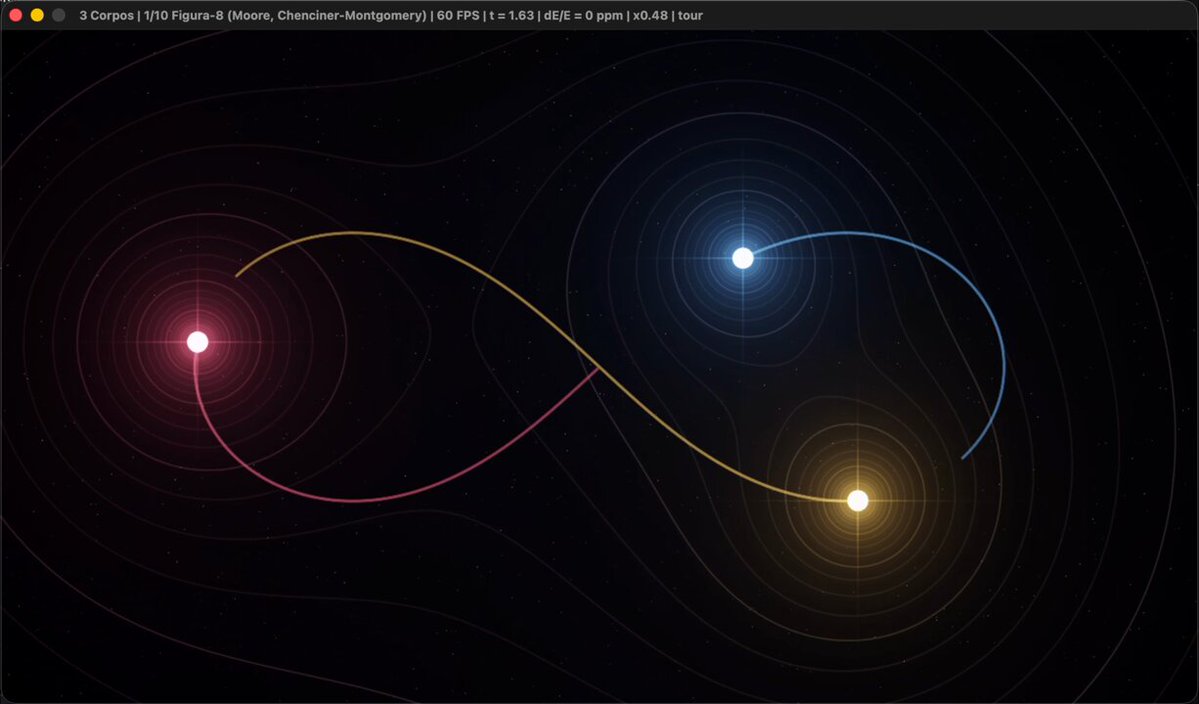
This video presents a screen recording of a real-time, interactive three-body problem gravitational simulator running in a macOS desktop window. Reportedly generated one-shot by an AI model ("Fable 5.5") in approximately 1,000 lines of Bend2 code with formally verified program laws, the demonstration executes an automated "tour" cycling through 10 canonical three-body orbital solutions and chaotic configurations.
What is shown
- UI & HUD: A dark-mode window titled
3 Corposdisplaying the current preset name, real-time performance (60 FPS), simulation timet, energy driftdE/Ein parts-per-million (ppm), simulation speed multiplier, and dynamic equipotential contour lines representing the gravitational field. - [00:00 - 00:08] Preset 1/10: Figura-8 (Moore, Chenciner-Montgomery) — Three bodies of equal mass traversing a shared figure-8 choreographic trajectory with near-zero energy error (
dE/E = 0 ppm). - [00:09 - 00:15] Preset 2/10: Borboleta (Suvakov-Dmitrasinovic) — The periodic "Butterfly" planar three-body choreography.
- [00:16 - 00:23] Preset 3/10: Mariposa (Suvakov-Dmitrasinovic) — The intricate periodic "Moth/Mariposa" three-body orbit.
- [00:24 - 00:33] Preset 4/10: Yin-Yang (Suvakov-Dmitrasinovic) — A periodic interlaced orbit named after the yin-yang motif.
- [00:34 - 00:44] Preset 5/10: Novelo (Suvakov-Dmitrasinovic) — The tightly wound "Yarn ball" (Novelo) periodic trajectory.
- [00:45 - 00:51] Preset 6/10: Triângulo de Lagrange — Three bodies placed at the vertices of an equilateral triangle rotating in equilibrium before transitioning toward chaotic perturbation.
- [00:52 - 01:06] Preset 7/10: Problema pitagórico de Burrau (3-4-5) — Simulation of Carl Burrau’s classic 1913 Pythagorean problem (masses 3, 4, 5 placed at vertices of a 3:4:5 right triangle at rest), culminating in chaotic mutual close approaches and the high-speed gravitational ejection of the lightest body [01:05].
- [01:07 - 01:24] Preset 8/10: Estrela, planeta e lua — A hierarchical system showing a planet and orbiting satellite tracing epicyclic paths around a massive central primary star.
- [01:25 - 01:38] Preset 9/10: Planeta de duas estrelas — A circumbinary planetary system with an outer planet orbiting a central close binary star pair.
- [01:39 - 02:09] Preset 10/10: Caos: tres massas ao acaso — Unrestricted three-body chaotic scattering from randomized initial conditions, showing sling assists and close-encounter loops.
- [02:10 - 02:14]: The tour completes and loops back to Preset 1 (Figura-8).
Claims & numbers
- The simulation runs at a steady 60 FPS across all configurations.
- Energy conservation drift (
dE/E) remains exceptionally low across periodic trajectories (typically between0 ppmand3 ppm), indicating high-precision symplectic numerical integration. - The title claims the application consists of roughly 1,000 lines of Bend2 code with formally proven program laws, synthesized one-shot via AI.
Notable quotes
There is no voiceover or dialogue in the video; notable UI labels include:
3 Corpos | 1/10 Figura-8 (Moore, Chenciner-Montgomery) | 60 FPS | dE/E = 0 ppm[00:00]3 Corpos | 7/10 Problema pitagórico de Burrau (3-4-5)[00:52]3 Corpos | 10/10 Caos: tres massas ao acaso[01:39]
Assessment
This is a direct software screen capture demonstration showcasing the output of high-performance physics code and custom 2D canvas rendering. The simulation operates live in real time as evidenced by the smooth particle trail generation, real-time FPS counter, and continuously evolving potential field lines without cuts.
Lyrics & themes
The video contains no lyrics, speech, or vocal track (entirely instrumental/ambient audio accompaniment or silent application audio). The primary themes are classical gravitational dynamics, deterministic chaos, orbital mechanics, and algorithmic precision.
Lore & references
- Moore, Chenciner & Montgomery: References Cristopher Moore's 1993 numerical discovery and Alain Chenciner and Richard Montgomery's 2000 mathematical proof of the stable figure-8 three-body choreography.
- Šuvakov & Dmitrašinović (2013): The Butterfly (Borboleta), Mariposa, Yin-Yang, and Yarn (Novelo) presets reference Milovan Šuvakov and Veljko Dmitrašinović's milestone discovery of dozens of new families of periodic three-body orbits.
- Burrau (1913): Carl Burrau's Pythagorean problem, one of celestial mechanics' most famous benchmark cases of gravitational three-body chaos leading to slingshot ejection.
- Bend2: The massively parallel, high-level functional programming language created by HigherOrderCO, compiled to massively parallel architectures.
Visual style & craft
The visual output is programmatically rendered graphics in a native window, featuring three distinct primary colors (yellow, magenta/pink, and cyan) with glowing point-source halos, persistent fading trajectory ribbons, and subtle concentric gravitational potential contour lines dynamically redrawn according to the instantaneous Newtonian potential field. The visuals are completely code-driven rather than generated by a video diffusion model.
Described by gemini-3.8-flash on 2026-10-04 from the video's audio and frames.