Zeta Explained #116.5: OpenAI’s Zero-Free Region Re(s)>7/8
Zeta Explained YouTube 47,911 views as of 15 October 2026
Why it is here
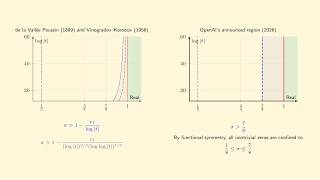
A math-explainer series (9:25) on how OpenAI’s claimed zero-free region Re(s) > 7/8 differs from known zero-free regions and what it implies for the error term of the prime number theorem. 48k views.
Description
Description written by Gemini from the videoGemini 3.8 Flash, 15 October 2026
Summary
This video is an educational breakdown by the creator of the YouTube channel Zeta Explained discussing OpenAI’s claimed mathematical paper on the quasi-Riemann hypothesis. The presenter reviews traditional zero-free regions for the Riemann zeta function, explains what OpenAI’s announced zero-free half-plane $\text{Re}(s) > 7/8$ represents, and outlines its theoretical consequences for bounding the error term in the Prime Number Theorem.
What is shown
- [00:00] Title slide introducing episode 116.5 on OpenAI’s new zero-free region $\text{Re}(s) > 7/8$.
- [00:14] The title and abstract page of OpenAI’s paper titled “The Quasi-Riemann Hypothesis: A Zero-Free Half-Plane $\text{Re},s > 7/8$”, dated 30 September 2026.
- [00:42] Complex plane plots displaying non-trivial zeros along the critical line $\text{Re}(s) = 1/2$ within the critical strip $0 < \text{Re}(s) < 1$, alongside the classical zero-free boundary.
- [02:27] Comparative plots contrasting historical zero-free regions—de la Vallée Poussin (1899) and Vinogradov–Korobov (1958)—with OpenAI’s announced constant boundary at $\sigma > 7/8$ (confining zeros to $1/8 \le \sigma \le 7/8$ by functional symmetry).
- [04:45] Graphs of the prime-counting step function $\pi(x)$ compared against the logarithmic integral $\text{Li}(x)$.
- [05:49] Equivalence theorem between the zero-free region $\text{Re}(s) > B$ and prime error bounds $\pi(x) = \text{Li}(x) + O(x^B \log x)$, displaying error bands comparing Vinogradov–Korobov’s error bound to the tighter $O(x^{7/8} \log x)$ bound implied by OpenAI’s claim.
- [08:38] Slide asking “How does the proof work?”, where the presenter explains that the paper is nearly 200 pages and still being analyzed by the mathematical community.
Claims & numbers
- The presenter notes that OpenAI’s paper is dated September 30, 2026, though the material was made public on October 6, 2026 [00:18].
- The abstract shown claims a proof that all finite-order Hecke $L$-functions over $\mathbb{Q}(\sqrt{-3})$ and all Dirichlet $L$-functions are zero-free for $\text{Re}(s) > 7/8$ (allowing the principal pole at $s = 1$), thereby proving the quasi-Riemann hypothesis [00:14].
- By functional symmetry, the presenter states that this result confines all non-trivial zeros of $\zeta(s)$ to the strip $1/8 \le \sigma \le 7/8$ [04:08].
- The presenter notes the result implies an error bound for the Prime Number Theorem of $E(x) = O(x^{7/8} \log x)$, improving upon the Vinogradov–Korobov error bound [07:13].
- The presenter states that OpenAI’s proof spans nearly 200 pages [04:32, 09:00].
Notable quotes
- “The main thing is that the $L$-functions are kind of extensions or generalizations of the Riemann zeta function... the main thing to know... is that it says the Riemann zeta function is zero-free in this half-plane.” [00:25]
- “So if you believe the result... there can not be any zeros with a real part greater than 7/8ths.” [03:28]
- “How does the proof work? ... the answer is: I have no idea, and I would guess most people have no idea... the proof is nearly 200 pages.” [08:39]
Assessment
This is an independent educational commentary and mathematical explainer video rather than an official product launch or demonstration. The presenter does not verify or independently check OpenAI’s ~200-page proof, explicitly noting that it remains unverified by the presenter and is still being digested by the broader mathematical community.
Described by gemini-3.8-flash on 2026-10-15 from the video’s audio and frames.