Palantir CTO Shyam Sankar on CBS
Bloomberg’s Minab school-strike report is ‘wrong’, Anthropic ‘already replaced’ at the Pentagon, AI safety driven by an effective-altruism ‘doomsday cult’
Confirmed
The takeaway
He said the Pentagon’s halt of Anthropic products had “no operational impact” because Claude has “already been replaced”.
Status
- Claim
Confirmed
- Our reporting
- High confidence
- Importance
- 3 of 5
- Last verified
- 12 October 2026
Your AI and this story
- GPT-6 Astra164 days after its cutoff
- Claude Opus 5.5103 days after its cutoff
- Gemini 3.8 Flash194 days after its cutoff
- Grok 4.7133 days after its cutoff
None of these four assistants can know about it. The closest, Claude Opus 5.5, stops 103 days before it.
Key facts
- Minab: asked about Bloomberg’s report that personnel relied too much on AI in Maven, Sankar said ‘we should wait for the final report. But what I can say is that reporting is inaccurate… the likely cause is human error’, and later ‘The Bloomberg reporting is wrong’. He said he does not know when the Pentagon’s final report will be released
- After the strike Palantir ‘built additional AI agents that did more checking… outside the process that we own to ensure things like that couldn’t happen again’
- On AI targeting: ‘the ability to execute 1000 strikes in a single day would have taken two weeks of planning by 50 people before’; now ‘one person in four hours’. He said AI is not ‘picking the targets’ but running the process (no-strike lists, proximity to civilian infrastructure)
- Anthropic and the Pentagon: ‘there’s been no operational impact’; ‘It’s already been replaced’; Maven users pick from models by Google, xAI and OpenAI and open-weight models such as Nvidia’s Nemotron
- On AI safety: ‘an unseen force driving the narrative around AI safety… this millenarian doomsday cult meets messianic complex called effective altruism’. He claimed there are ‘roughly 2,000 AI researchers in America’ and most share that worldview, and called Jacob Coxon’s 10% extinction estimate ‘a theological critique’, not a scientific one. He said independent evaluators ‘are not really independent’ and ‘have conflicts with the labs’
- On the OpenAI–Hugging Face incident: ‘the models did not do anything they were not instructed to do’; he blamed human error (‘not in a sandbox… a horrible cybersecurity configuration’) and called it ‘a defective product’ for which ‘the AI companies of course’ are liable
- Policy: regulate applications through existing agencies (FDA, Transportation, Defense and Congress); ‘there’s going to need to be an incident response and reporting regime’ giving the government visibility into test results ‘well ahead of product launches’; he deferred to AI czar Jay Clayton on who runs it
- Palantir did not sign the White House pledge on internal controls and external auditors because ‘those accords were for companies that actually make AI models, which we do not’; Sankar attended the meeting
Show 2 more
- CBS poll cited by Margaret Brennan: 50% say AI will create more problems than it solves, 29% the opposite, 21% unsure; 45% want the government to restrict AI use and development
- Sankar is a lieutenant colonel in the Army Reserve’s Executive Innovation Corps, working on Army human resourcing (G-1). The full interview runs 19:05; only part aired
What happened
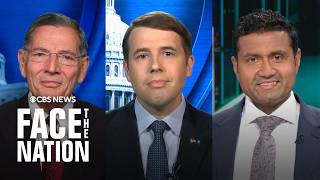
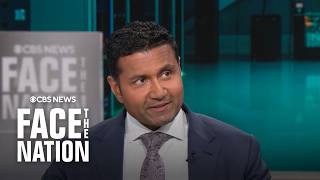
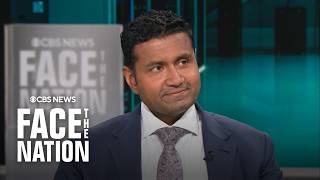
CBS published the full transcript of Margaret Brennan’s interview with Shyam Sankar; a portion aired on “Face the Nation” on Sunday, Oct 11, 2026. It is Palantir’s first detailed on-record response to Bloomberg’s September reporting that an internal Pentagon review blamed the Feb 28 strike on a school in Minab, Iran partly on over-reliance on Maven. Sankar rejected that account, said the likely cause was human error, and referred questions about the final report and briefings to Congress (120 House Democrats have written to Secretary Hegseth) to the Department.
He spent much of the interview arguing that AI-safety warnings come from effective altruism, which he described as close to a religion, and that “the doomsdayers have basically been wrong”. He also said the technology industry must “absorb the burden of engineering” safe products, that AI companies are liable for defective products, and that frontier models being held back from release shows the US process is “kind of working”.
His claims (the cause of the Minab strike, the number and beliefs of US AI researchers, researchers taking up smoking to signal belief in AI) are his own and are not verified here.
Why it matters
Palantir runs the Pentagon’s main AI targeting platform. Its CTO publicly disputing a leaked Pentagon review, and saying Claude has been fully replaced in Maven, are both first-hand statements on two of the year’s main military-AI stories. The interview also shows a major government contractor backing AI-company liability and mandatory incident reporting while attacking the independence of safety evaluators.
Sources
2 sources from 2 sites. Numbers match the chips in the text.
2 sources: 1 press, 1 reaction
Press
- CBS News: Transcript: Shyam Sankar, chief technology officer of Palantir, on Face the Nation, Oct. 11, 2026cbsnews.com, press
Reactions
- Techmeme: Q&A with Palantir CTO Shyam Sankar (headline)techmeme.com, discussion
Changes
- Filed (Techmeme; full CBS transcript read)