Palantir’s Shyam Sankar suggests “human error,” not AI, is cause of Iran school bombing
Face the NationYouTube7,973 views as of 12 October 2026
Why it is here
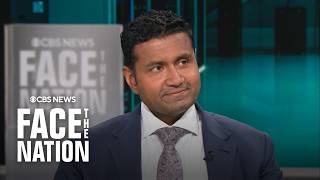
The broadcast cut of the Sankar interview: he defends military AI use and says the final report on the Iran girls’ school bombing will show ‘the likely cause is human error’.
Description
Description written by Gemini from the videoGemini 3.8 Flash, 12 October 2026
Summary
On CBS News’ Face the Nation, host Margaret Brennan interviews Palantir Technologies Chief Technology Officer Shyam Sankar regarding artificial intelligence regulation, model liability, and military AI targeting. Sankar defends applying existing product-liability law to AI applications rather than imposing novel restrictions on base models, while disputing reports that Palantir’s Project Maven software was responsible for a deadly airstrike on an Iranian school in Minab.
What is shown
- [00:16] CBS News / YouGov voter poll graphics displayed on screen showing public opinion on AI risks and government policy.
- [01:40] Discussion of newly appointed DNI and AI czar Jay Clayton and federal oversight efforts.
- [03:47] Still photographs of President Donald Trump meeting with AI industry leaders at the White House.
- [03:52] Document shown on screen titled “White House Accord on Super Intelligence: Joint Commitment on Frontier Responsibilities,” bearing the signatures of Donald J. Trump, Sundar Pichai (Google), Dario Amodei (Anthropic), Mark Zuckerberg (Meta), Greg Brockman (OpenAI), Elon Musk (xAI), and Jensen Huang (Nvidia).
- [07:19] News footage dated February 28 showing rescue efforts and rubble following an airstrike in Minab, Iran.
Claims & numbers
- According to the CBS News / YouGov poll shown [00:16], 50% of respondents believe AI will create more problems than it solves, 29% believe it will solve more problems than it creates, and 21% do not know; 45% want the U.S. government to restrict AI use and development, 28% want promotion, and 27% want no position taken.
- Sankar states that the narrative around existential AI risk is being driven by an effective altruism “millenarian doomsday cult meets messianic complex” [01:03].
- Regarding the Hugging Face agent incident, Sankar claims the models operated within instructions, citing human error, open internet access, and a lack of sandboxing rather than autonomous loss of control [02:37].
- Sankar explains that Palantir did not sign the White House Accord on Super Intelligence because the accord was exclusively intended for frontier model developers, not application platforms [04:06].
- Sankar states that AI military targeting processes reduce tasks previously requiring 50 people two weeks of planning down to one person in four hours, allowing up to 1,000 strikes in a single day [06:30].
- Brennan notes that Defense Secretary Hegseth and the Pentagon made decisions altering civilian impact mitigation, and that an airstrike in Minab, Iran, killed at least 123 schoolchildren [07:13].
- Sankar claims Bloomberg reporting blaming Palantir’s Project Maven for the Minab strike is “inaccurate,” attributing the likely cause to human error, and states Palantir built additional AI agents to double-check targeting workflows outside its direct purview [07:38].
Notable quotes
- [01:02] “It’s really this millenarian doomsday cult meets messianic complex called effective altruism.” — Shyam Sankar
- [02:24] “The narrative is this technology is a total difference of kind. I don’t think so. I think it’s a difference of degree.” — Shyam Sankar
- [07:44] “That reporting is inaccurate... and actually the likely cause is human error.” — Shyam Sankar
Assessment
This is a broadcast news interview discussing AI policy, corporate liability, and military ethics. No live software demonstration is conducted; all technical capabilities and battlefield operational details are verbal claims and policy arguments made by Sankar and Brennan.
Described by gemini-3.8-flash on 2026-10-12 from the video’s audio and frames.