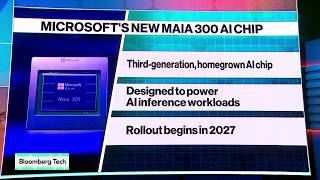
Microsoft announces Maia 300, its third in-house AI chip, and plans multi-gigawatt Maia deployments from 2027
Confirmed
The takeaway
On Oct 12, 2026 Microsoft announced Maia 300, the third generation of its Azure Maia AI accelerator, built for inference (long-context reasoning and agentic tasks).
Status
- Claim
Confirmed
- Our reporting
- High confidence
- Importance
- 3 of 5
- Last verified
- 13 October 2026
Your AI and this story
- GPT-6 Astra165 days after its cutoff
- Claude Opus 5.5104 days after its cutoff
- Gemini 4 Argon195 days after its cutoff
- Grok 4.7134 days after its cutoff
None of these four assistants can know about it. The closest, Claude Opus 5.5, stops 104 days before it.
Key facts
- Announced Oct 12, 2026 by Scott Guthrie, Microsoft EVP Cloud + AI; production deployments of Maia 300 begin in 2027
- Plan: ‘We will scale our Azure Maia family to multi-gigawatt deployments starting in 2027, making Maia the primary inference system for Microsoft products and services’
- Microsoft’s claims (not independently measured): 40% more tokens per megawatt than ‘leading GPU-based systems’; up to 7x the rack-scale token throughput of Maia 200 in the full 96-accelerator configuration; more than 2.5x Maia 200’s performance per watt
- Chip: multi-chiplet design; compute chiplets on TSMC’s N2P process; eight HBM4 stacks with 288 GB and 18 TB/s of memory bandwidth per accelerator within a 950-watt TDP; support for enhanced MXFP4 and sub-3-bit storage formats
- Rack: 96 accelerators in 24 four-accelerator trays within 167 kW (double Maia 200’s density), 27.6 TB of HBM; liquid cooling removes more than 80% of the heat
- Network: Ethernet-based custom transport; up to 128 racks form a ‘superpod’ of 12,288 accelerators
- Maia 200 (announced January 2026) now serves Microsoft Copilot and the MAI model team; GitHub Copilot and Microsoft Foundry follow by the end of 2026. It runs OpenAI models, Microsoft’s MAI models and open-source model families
- Microsoft says Maia 200 delivers up to 1.7x more tokens per watt than leading GPU infrastructure for AI features in Teams, Copilot and Cowork, and is deployed in the US, Europe and Australia
Show 8 more
- Mustafa Suleyman (Microsoft AI CEO), to The Verge: ‘At that scale we need a platform that we own, and that we co-design with our models.’
- Reactions on X (Oct 12): Mustafa Suleyman: ‘Our new silicon is 🔥 40% more tokens per watt!’; Ed Zitron argued that ‘multi gigawatt deployments’ is worded to suggest gigawatts of Maia chips when it may mean installing them across data centers with that combined capacity, and claimed ‘Microsoft only has 2gw of ai data centers’ (his figure, not verified)
- Aaron Holmes of The Information said the announcement confirms his August report that Microsoft was ‘aiming for >300k chip productions next yr’ and hoped to ‘win Anthropic and other big customers over’ (his X post; the article is paywalled and was not read)
- The 40% baseline is unnamed: Bloomberg’s Ed Ludlow noted that ‘Microsoft hasn’t identified the specific GPU system used for the 40% comparison’, only ‘leading GPU-based systems’. Analyst Austin Lyons inferred that, since Maia 300 uses HBM4, the comparison is with an HBM4 system such as Nvidia’s Vera Rubin (his reading, not Microsoft’s statement)
- Analysts (X, Oct 12): Patrick Moorhead: ‘We haven’t tested it, and GPUs won’t stand still before 2027. At this scale, Maia is primarily a margin lever, not a benchmark story.’ Ben Bajarin relayed further Microsoft projections: 1.4 times more tokens per gigawatt and 30% better tokens per dollar (he does not state the baseline for these two), with ‘Current deployments … centered on 64- to 128-accelerator clusters, with 12,000 accelerators representing a current plan of record’
- Brendan Burke (Futurum) described how Maia is used: ‘agentic kernel generation with Maia silicon in the loop’, and Microsoft’s Superintelligence team running RL rollouts and synthetic data generation on Maia 200 while pretraining stays on NVIDIA (analyst’s account, not checked against Microsoft’s documents)
- Scott Guthrie, in a live interview with Deirdre Bosa on Oct 12: ‘In a world where power is constrained, land is constrained, and materials are constrained... everything you can do to achieve more with less ultimately helps in the build out phase that we’re in right now’
- Reach on X (fxtwitter, Oct 13): Chamath Palihapitiya’s ‘everyone competes with everyone’ post about 335k views; Elon Musk replied that the constraint is ‘Scaling power harnessed, along with super fast construction, cooling, networking and batteries. This is hard.’ (about 189k views). ETH Zurich’s Torsten Hoefler linked the architecture paper, arXiv 2608.24664 (‘Our SDLA is a great architecture for LLMs’; paper not read for this entry)
What happened
Scott Guthrie, who runs Microsoft’s Cloud + AI group, announced Maia 300 on the company blog, and the Azure hardware team published an architecture paper. Maia 300 is an inference system, not a training chip. Microsoft describes it as “a complete intelligent system designed for the new types of AI workloads emerging today: Long-context reasoning, latency-sensitive conversational experiences and sustained, multi-step agentic tasks.”
The design splits compute, memory-controller and I/O functions into separate chiplets, with compute on TSMC’s N2P node. Each accelerator has eight HBM4 stacks (288 GB, 18 TB/s). Compared with Maia 200, Microsoft states 36% more compute FLOPs, 2.5 times the memory bandwidth and 33% more memory capacity. A rack holds 96 accelerators in 167 kW, and an Ethernet-based network joins up to 128 racks into one scale-up domain of 12,288 accelerators.
Microsoft says the two Maia generations will serve GitHub coding agents, Microsoft Foundry model serving, inference and data generation for its MAI model team, and Dragon Copilot. The Reuters report was read only as a headline (the site blocks automated access); the numbers here come from Microsoft’s two posts and The Verge.
Why it matters
Microsoft is the largest buyer of Nvidia GPUs among cloud companies, and it now states that its own chip will be its main inference system from 2027. All performance figures are Microsoft’s own and compare against unnamed GPU systems. The announcement came nine months after Maia 200, which shows a faster release rhythm for hyperscaler chips, alongside Google’s TPUs, Amazon’s Trainium and the custom chips Broadcom builds for OpenAI and Anthropic.
Sources
20 sources from 7 sites. Numbers match the chips in the text.
20 sources: 4 primary, 2 press, 14 reactions
Primary
- Official Microsoft Blog: Microsoft to expand Azure Maia system to multi-gigawatt deployments (Scott Guthrie)blogs.microsoft.com, official
- Azure Blog: Deep dive into Azure Maia 300 architectureazure.microsoft.com, official
- Microsoft on X: ‘Introducing Maia 300’x.com, official
- arXiv 2608.24664: Maia 200: A Software Defined Dataflow System for Large-scale AI Acceleration (25 Aug 2026; linked by Hoefler, body not read)arxiv.org, paper
Press
- The Verge: Microsoft’s new AI chip makes it less reliant on Nvidia’s GPUstheverge.com, press
- Reuters: Microsoft plans huge deployment of its own AI chips with an eye on saving costsreuters.com, press
Reactions
- Satya Nadella on X: ‘our biggest bet yet on our own silicon’ (1.39M views on Oct 13)x.com, discussion
- Mustafa Suleyman on X: ‘Our new silicon is 🔥’x.com, discussion
- Ed Zitron on X: on the ‘multi gigawatt deployments’ wordingx.com, discussion
- Aaron Holmes (The Information) on X: announcement confirms August reportx.com, discussion
- Ed Ludlow on X: the GPU baseline for the 40% claim is not namedx.com, discussion
- Patrick Moorhead on X: ‘a margin lever, not a benchmark story’x.com, discussion
- Ben Bajarin on X: rack, networking and tokens-per-dollar detailsx.com, discussion
- Brendan Burke (Futurum) on X: software-configured dataflow and agentic kernel generationx.com, discussion
- Deirdre Bosa on X: Scott Guthrie on the ‘cone of uncertainty’x.com, discussion
- Deirdre Bosa’s live interview with Scott Guthrie (YouTube)youtube.com, video
- Chamath Palihapitiya on X: ‘everyone competes with everyone’ (about 335k views)x.com, discussion
- Elon Musk on X: the constraint is power, construction, cooling, networking and batteriesx.com, discussion
Show all 14 sources
- Torsten Hoefler on X: ‘Our SDLA is a great architecture for LLMs’x.com, discussion
- Andreas Schilling on X: Maia 300 chiplet configurationx.com, discussion
Changes
- Added the unnamed-baseline point (Ludlow, Lyons), analyst assessments (Moorhead, Bajarin, Burke), Guthrie’s interview quote, reach (Chamath, Musk) and Hoefler’s link to arXiv 2608.24664, with post files (X list)
- Added reactions on X (Suleyman, Ed Zitron’s critique, The Information’s August report on a >300k-chip target) and Microsoft’s own post (X posts via fxtwitter)
- Added Satya Nadella’s announcement post (1.39M views, fxtwitter)
- Filed (evening)