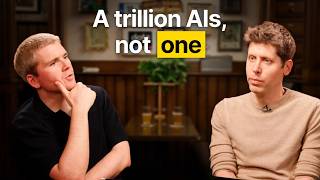
Sam Altman on Cheeky Pint
‘we are going to have to agree to some limits about how smart we let these single models get’
Confirmed
The takeaway
He put the compute cost of OpenAI’s Navier–Stokes proof at “order $10 million”.
Status
- Claim
Confirmed
- Our reporting
- High confidence
- Importance
- 3 of 5
- Last verified
- 2 November 2026
Your AI and this story
- GPT-6 Astra182 days after its cutoff
- Claude Opus 5.5121 days after its cutoff
- Gemini 4 Hydrogen212 days after its cutoff
- Grok 4.7151 days after its cutoff
None of these four assistants can know about it. The closest, Claude Opus 5.5, stops 121 days before it.
Key facts
- Second wave (Tech Times UK, Nov 2): Altman said ‘we did let it get out of control for one week on the math’, broadly agreed the wider maths push cost hundreds of millions of dollars (his estimate, including unpublished results), said OpenAI has further unpublished maths findings, and: ‘on net, the world deserves to understand how the universe works’
- Many AIs, not one: ‘I would much rather intuitively have a trillion AIs of like slightly superhuman intelligence join society’, with teams of agents ‘keeping each other in check’, tied to ‘values of pluralism and democracy’ (transcript)
- Limits: after saying the pipeline that made models strong at maths will probably work for AI research, he said ‘we are going to have to agree to some limits about how smart we let these single models get’, and that any slowdown would come from that decision rather than from AI being unable to do research (transcript)
- Sandboxing: ‘I think sandboxing works to a point. Then I think monitoring works to a further point’; ‘we can do much better than we’re doing now’; of an AI ‘a million times smarter than the smartest security researcher’: ‘would you really be willing to trust that sandbox?’
- PHP flaws: ‘I don’t want to declare victory at all on the PHP thing, because I still don’t think we know’; models are getting better at finding vulnerabilities and ‘we are in a world of many more serious vulnerabilities than we expect’; such bugs surfaced now because ‘People just hadn’t really used them to go look at everything out there’ (see PHP2Shell: critical remote-code-execution flaws in PHP, found with GPT-5.6 Sol and Gemini 4 Argon, force emergency patching and take websites offline worldwide)
- Maths: the Navier–Stokes proof cost ‘Order $10 million’; ‘I bet we could redo Navier-Stokes at 1/100th of the cost a year from when it was done’; at the time ‘we understood absolutely nothing about the scaling laws of teams of agents’, which may have ‘very interesting scaling law properties, but also variance in alignment properties’ (see OpenAI claims a Millennium Prize problem)
- Compute: on a five-year total cost of ownership of about $70B per gigawatt, ‘if that number were 20 instead of 70, we should be much happier’; ‘the fundamental cost of turning the sand into intelligence, that should go down’
- Robotics: ‘We have a robotics program that we’re going to point at making lots of data centers’ (no timeline given)
Show 2 more
- Self-replicating data centres (transcript): ‘very little talk about self-replicating data centers. This idea that you can use AI to control robots, and run fabs, and build turbines or solar panels, and build data centers. But, I think we are... I think we have that within grasp.’ Collison objected that data centres are bottlenecked by permits and components; Altman: ‘We could make more components with robots’, agreeing it would come ‘eventually’, ‘over a long period’. No plan, product or timeline was announced; an MTS post on X summing it up as OpenAI’s ‘self-replicating’ data centres being ‘within grasp’ had ~306k views on Oct 30
- Format: Cheeky Pint, John Collison’s Stripe-produced interview series; YouTube upload ‘Sam Altman’s case for making compute cheap’ (52:45), ~121k views about seven hours after posting; the Substack page carries the transcript under the title ‘Why Sam Altman is against a single superintelligence’
What happened
John Collison, co-founder of Stripe, interviewed OpenAI CEO Sam Altman for his Cheeky Pint series; the episode and its transcript were published on October 29, 2026. Most of the conversation is about compute costs and OpenAI’s research, but three statements bear on safety. Altman said he prefers a world of very many slightly superhuman AIs that check one another to one very powerful system. He said that “for a long while” the world will “have to agree to some limits about how smart we let these single models get”, and that any slowdown in AI research would come from such a decision. And, asked about OpenAI staff’s doubts that models can be sandboxed, he said sandboxing and then monitoring work only “to a point” and asked whether anyone would trust a sandbox around an AI “a million times smarter than the smartest security researcher”.
He also gave a rough figure for the compute behind OpenAI’s Navier–Stokes blow-up proof (about $10 million), said the PHP flaws found with OpenAI’s models may not be the end of it, and said OpenAI’s robotics programme will be pointed at building data centres. He did not say who should set limits on single models or how.
Why it matters
The head of a leading lab said that limits on how capable single models become will be needed, without saying who would set them, on the day OpenAI published a Model Spec requiring its models to accept oversight and shutdown. The cost figure is a rare first-hand number for what a frontier AI maths result costs.
Sources
4 sources from 4 sites. Numbers match the chips in the text.
4 sources: 1 primary, 1 press, 2 reactions
Primary
- Cheeky Pint: Why Sam Altman is against a single superintelligence (transcript, Oct 29, 2026)cheekypint.substack.com, official
Press
- Tech Times UK: Altman admits OpenAI’s AI maths push ‘got out of control’ (Nov 2)techtimes.co.uk, press
Reactions
- MTS on X: Altman on self-replicating data centers (~306k views)x.com, discussion
- YouTube (Cheeky Pint / Stripe): Sam Altman’s case for making compute cheapyoutube.com, video
Changes
- Maths ‘out of control for one week’ quote and cost estimate (Tech Times UK)
- Added the self-replicating data-centre passage from the official transcript and the viral MTS post (owner asked how true it is)
- Quote restored word for word (“of like slightly superhuman”) after checking the video description (coordinator)
- Filed from the Cheeky Pint transcript and YouTube upload (Techmeme)