Sam Altman’s case for making compute cheap
Cheeky Pint YouTube 434,458 views as of 12 November 2026
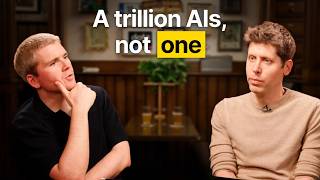
Why it is here
First-hand recording of OpenAI CEO Sam Altman’s Cheeky Pint interview with Stripe co-founder John Collison (52:45), in which he says the world will have to “agree to some limits about how smart we let these single models get”, that sandboxing a far smarter model is unsolved, and that OpenAI’s Navier–Stokes proof cost “order $10 million”. Chapters from the upload: PHP week, Cyber Blue, Sandboxing, Math, Agent swarms, Compute, Revenue per gigawatt, Token pricing is fake. Transcript: https://cheekypint.substack.com/p/why-sam-altman-is-against-a-single
Description
Description written by Gemini from the videoGemini 3.8 Flash, 29 October 2026
Summary
In an episode of Stripe’s “Cheeky Pint” podcast, Stripe co-founder John Collison sits down for beers with OpenAI CEO Sam Altman in a pub booth. The pair discuss the economics of AI compute, the scaling of multi-agent systems and test-time compute in scientific discovery, cybersecurity risks and sandboxing limitations, and the future of agentic computer interfaces.
What is shown
- [00:00] John Collison and Sam Altman pour beers behind the bar before sitting at a pub booth table.
- [00:30] Discussion of automated vulnerability discovery in codebases, referencing recent widespread PHP security issues.
- [08:55] Debate on the viability of sandboxing advanced models versus relying on internal activation monitoring and alignment.
- [16:15] Discussion of test-time compute, agent swarms, and OpenAI’s internal compute allocation for automated mathematical proofs (including Navier–Stokes).
- [25:15] Mid-video sponsor read by John Collison for Stripe Atlas.
- [26:05] Discussion of custom silicon development at OpenAI, data center infrastructure, and robotics automation for server construction.
- [32:00] Conversation on recursive self-improvement and using AI to conduct AI architecture and pre-training research.
- [40:30] Discussion of personal agents (including OpenAI’s dots) and agent-driven computer use replacing traditional web forms.
- [47:30] Discussion regarding benchmark gaming (“benchmaxing”) and model personality shifts across recent releases.
Claims & numbers
- Altman states that OpenAI spent roughly $10 million in compute on their Navier–Stokes proof, and hundreds of millions overall across mathematical discovery runs, before optimization pressure reduced costs significantly [18:05].
- Altman claims OpenAI has built an internal custom chip designed specifically for high performance in units of intelligence per watt [26:05].
- Collison states that Stripe currently spends approximately 1% of its operating expenses on AI tokens and expects that to rise [36:38].
- Altman estimates the 5-year total cost of ownership to install and operate a gigawatt of compute capacity is currently around $70 billion, though he expects supply-chain margin compression and energy efficiencies to drive it toward $20 billion [39:00].
- Altman claims OpenAI tested abandoning token-based API pricing in favor of dynamic per-prompt pricing, but customer pushback forced them to retain token metrics [50:00].
- Altman asserts that frontier labs will likely have to agree on limits regarding the intelligence of individual standalone models [24:45].
Notable quotes
- [24:45] “I kind of think that at least for a while, maybe for a long while, we are going to have to agree to some limits about how smart we let these single models get.”
- [37:47] “I think the problem, even at current costs, for near all companies, is the problem of not using enough AI, rather than using too much AI.”
- [41:18] “I would much rather intuitively have a trillion AIs of like slightly superhuman intelligence join society than one AI of one trillion IQ join society.”
Assessment
This is an authentic long-form executive interview rather than a product demonstration or formal announcement. The video contains casual technical and strategic discussions over drinks, with claims regarding internal chip projects, research compute budgets, and proof discoveries mentioned conversationally without on-screen technical verification.
Described by gemini-3.8-flash on 2026-10-29 from the video’s audio and frames.