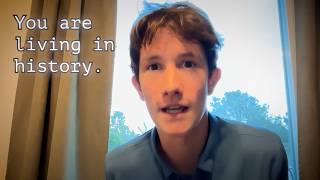
There’s never been a better time to go into math
3Blue1Brown YouTube 2,784,990 views as of 12 November 2026
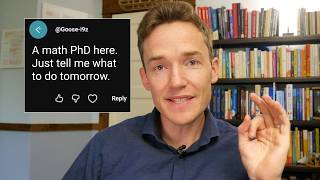
Why it is here
Grant Sanderson (40:44) shares “a few thoughts on the future of math” ten days after OpenAI’s release of 722 AI-written manuscripts: chapters “A proof machine”, “A conjecture machine”, “A theory machine”, “If AI is better at everything” and “The best time to enter math”. The description points to the Proofs and Prompts post “100 reactions to 100 solutions” (Oct 8) for “how mathematicians are feeling right now”. About 2.6M views by Oct 29 (YouTube watch page); a well-known maths communicator on an importance-5 topic, added under the narrowed video rule. Found on 2026-10-29 through Terence Tao’s Oct 26 link post (lead from the science agent).
Description
Description written by Gemini from the videoGemini 3.8 Flash, 29 October 2026
Summary
Grant Sanderson (3Blue1Brown) reflects on the state of mathematical research and education in light of rapid breakthroughs in frontier AI reasoning models. He presents an analytical framework breaking mathematics down into what mathematicians do, why mathematics is valuable, and where funding originates, arguing that theorem-proving automation will not eliminate human mathematics but rather elevate theory-building, teaching, and human aesthetic joy.
What is shown
- [00:12] Montage of viewer comments and questions from math students and researchers asking about the future of a math PhD and career viability amid AI advancements.
- [01:25] A three-column framework diagram breaking down “What mathematicians do” (proving theorems, asking questions, theory building, applying theory), “Why math is valuable” (applications, building problem-solving muscles, aesthetic joy), and “Where funding comes from” (teaching, public funding, private foundations, industry).
- [04:06] Animated mathematical illustrations explaining Cartesian geometry, Galois theory, and Alexander Grothendieck’s “rising sea” analogy of theory-building versus problem-solving.
- [05:43] Historical overview of downstream math applications: cubic equations, imaginary numbers, non-Euclidean geometry leading to general relativity, and Fermat’s Last Theorem leading to algebraic geometry and cryptography.
- [12:14] Graphic and discussion of DeepMind’s AlphaGeometry paper and subsequent benchmarks solving IMO-level geometry problems.
- [12:28] Timeline graphic showing 2024 to 2026 progress: DeepMind, OpenAI, Harmonic, and ByteDance solving IMO problems and automated theorem proving on Erdős problems.
- [12:52] Display of the Erdős Problem website tracker (
erdosproblems.com) showing machine-generated and Lean-verified solutions. - [13:37] News headlines shown regarding OpenAI’s Navier-Stokes and large-scale mathematical result releases.
- [18:14] Video interview clip with mathematician Constantin Kogler discussing his experiences having a major problem (the exact overlaps conjecture for self-similar measures on the real line) resolved with AI assistance.
- [32:24] Diagrams showing the flow of value and funding in a hypothetical “Anything you can do I can do better” scenario where AI out-performs humans across theorem proving, question generation, and theory application.
- [36:20] 3D animated visual representations of complex topological surfaces and manifolds.
Claims & numbers
- The presenter notes that in mid-2025, he began recording interviews with working mathematicians regarding their sentiment toward AI in math [11:43].
- The presenter states that around 2023, systems like AlphaGeometry required brute force, but by 2025/2026, general natural language models could solve IMO-level problems [12:00–12:34].
- The presenter highlights recent milestones including machines generating proofs for Erdős problems and controversies surrounding large-scale theorem releases by OpenAI [12:38–13:39].
- Constantin Kogler states that he had two very serious successes using models, including solving the exact overlaps conjecture for self-similar measures on the real line [18:15–18:24].
- The presenter claims that teaching constitutes the single largest funding source for academic mathematics departments, surpassing direct research grants [09:01].
Notable quotes
- “Good mathematicians prove theorems, great mathematicians make conjectures, the greatest mathematicians write definitions.” [03:31]
- “The position is overrated, but the velocity is not.” [11:55]
- “For so much of the history of math, we have used proof as the proxy for understanding... We should consider proof to be kind of the same as numerical calculation... it’s a form of raw data that is helpful for theory building, but it is certainly not the end in and of itself.” [22:40, 23:14]
Assessment
This is an analytical essay and review video by Grant Sanderson featuring an authentic interview with mathematician Constantin Kogler. It combines conceptual animations, real-world community reactions, and verified recent research developments to construct a philosophical and practical argument regarding the future role of human mathematicians.
Described by gemini-3.8-flash on 2026-10-29 from the video’s audio and frames.
Related
More videos on this
-
Did AI Solve One of Math’s Hardest Problems?
StarTalk8,700,057 views as of 30 Oct
-
You Truly Don’t Understand What Just Happened to Mathematics
Prof Gio | Giordano Scarciotti3,567,850 views as of 6 Nov
-
OpenAI’s biggest math breakthrough is getting ugly...
Fireship3,468,862 views as of 8 Nov
-
The controversy around OpenAI “solving” a $1m math problem (Navier-Stokes)
Physics by Oimeow2,618,881 views as of 12 Nov