I Let AI Destroy Niagara Falls - Claude Opus 5.5 Directed Everything
AI VIDEOS · 2026-09-26 · ai-made · 8,831 views
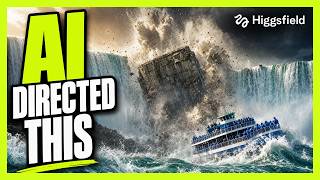
Made by AI
Model: Claude Opus 5.5, Seedance 2.5 · Series: Agent-directed film (LLM agent drives video/image models via MCP)
Evidence: Description: 'I wrote five lines ... and let Claude Opus 5.5 run the production through the Higgsfield MCP. It built its own reference images, invented a family ..., wrote a shot-by-shot plan ... and sent every shot to Seedance 2.5.'
Human role: Five-line brief ('The Day Niagara Falls Collapsed, ten shots, Hollywood blockbuster, same people and places, fifteen hundred credits max'); pointed Claude to Higgsfield's video analysis when it said it could not watch clips. Music by Suno. Higgsfield-sponsored.
Pipeline: Opus 5.5 + Higgsfield MCP → reference images → shot plan → Seedance 2.5 clips → self-review (v1 vs v3) → Claude's own cut; Suno music
Lore: agent-as-director, self-review-loop, budget-receipts
What's in the video
Description written by Gemini, which watched and listened to the whole video.
Summary
The video is a demonstration and tutorial presented by a creator on the channel "AI VIDEOS," showing how Anthropic’s Claude Opus 5.5—integrated with Higgsfield via the Model Context Protocol (MCP)—can act as an end-to-end film director. From a single five-line brief, Claude autonomously designs reference imagery, writes shot lists, directs video generations, critiques its own output, iterates on weak shots, and stitches together a finished 10-shot disaster short titled The Day Niagara Falls Collapsed.
What is shown
- [00:00] Teaser trailer of the generated disaster film featuring a tour boat navigating churning rapids beneath a collapsing Niagara Falls.
- [00:33] Setting up the Higgsfield MCP connector in Claude, linking Opus 5.5 to video and image generation models including Seedance 2.5, Nano Banana Pro, and GPT Image 2.
- [00:56] Submitting the five-line prompt to Claude Opus 5.5 requesting a 10-shot Hollywood disaster film within a 1,500-credit budget.
- [01:20] Claude creating four reference concept images (the falls, the tour boat, a recurring family in raincoats, and the post-collapse gorge) and drafting a detailed shot-by-shot director's breakdown.
- [01:50] Claude running as an autonomous agent submitting rendering tasks to Seedance 2.5 and outputting plain-English status reports and credit accounting.
- [02:12] Self-critique dialogue where Claude admits it cannot view raw MP4s due to file restrictions, critiques the script instead, and diagnoses Shot 3 as the weakest.
- [02:35] Giving Claude access to Higgsfield's video analysis tool; Claude reviews Shot 3, rewrites prompts, and renders Versions 2 and 3.
- [03:01] Side-by-side comparison of Shot 3 (Version 1 vs. Version 3).
- [03:14] Claude concatenating the 10 shots with sound into a finished film file and outputting a direct download link.
- [03:35] Montages of Claude Opus 5.5 driving other creative software via Higgsfield (Blender rigid body destruction, VFX chroma keying, animated manga generation, playable After Effects mini-games, and Houdini node graphs).
- [04:30 – 05:57] Full playback of the finished short film, The Day Niagara Falls Collapsed.
Claims & numbers
- The presenter says he did not write a single shot, camera angle, or individual video prompt; the entire instruction was a 5-line brief.
- The brief capped spending at 1,500 credits; the entire production run used approximately 990 credits.
- The finished stitched film runs 1 minute 48 seconds in 1080p H.264 video with 48kHz stereo AAC audio.
- The presenter claims Claude Pro starts at $20/month and includes Opus 5.5 access.
- The presenter states setting up the Higgsfield MCP connector takes "about a minute."
Notable quotes
- [00:12] "I didn't write a single shot of what you just saw. Not one camera angle, not one prompt."
- [02:03] "This is what a long-running AI agent actually looks like. I'm not prompting every step. I'm just watching it work."
- [03:28] "From one short message to a finished movie. And I never opened an editor."
Assessment
A legitimate and well-produced workflow demonstration showcasing Claude Opus 5.5's agentic tool-use capabilities through Higgsfield's MCP server. The core video generation and self-correction pipeline is shown live in the UI, though the auxiliary DCC integrations (Blender, Houdini, After Effects) are presented as rapid showcase vignettes rather than fully detailed walkthroughs.
Lyrics & themes
- The spoken narration is purely explanatory and instructional, while the final short film (04:30 – 05:57) is non-verbal and features an orchestral disaster score combined with realistic sound design (rushing water, thunderous rockfalls, groaning metal, and crowd panic).
- Narrative progression of the film:
- Setup: Sunny aerial establishing shots of Horseshoe Falls and tourists on the Maid of the Mist-style tour boat.
- Inciting Incident: Structural fractures appearing along the rock rim.
- Climax: Massive rock wall collapse crashing down into the water, rocking the tour boat violently while spectators on the promenade flee.
- Aftermath: Wide sunset panorama revealing the empty, drained cliff and massive boulder debris field.
- Verbatim theme lines from narration:
- [01:06] "A short disaster film: 'The Day Niagara Falls Collapsed'. Ten shots. Make it look like a Hollywood blockbuster."
- [02:26] "Instead of pretending, it judges the script and explains exactly why shot three is the weakest."
Lore & references
- Model Context Protocol (MCP): Anthropic's open standard allowing Claude to interface with local or remote APIs; here used as the bridge to execute image/video generation calls on Higgsfield.
- Claude Opus 5.5: Anthropic's frontier model, highlighted here for autonomous agency and planning rather than simple one-shot text responses.
- Seedance 2.5 & Nano Banana Pro: Generative video and image models hosted on the Higgsfield infrastructure.
- Autonomous agent self-critique: Highlighting an LLM's ability to admit operational limitations (such as being unable to directly render video without external vision tools) and refine outputs through targeted iteration loops.
Visual style & craft
- The tutorial segments use high-contrast studio camera footage, polished motion typography, and screen captures of the Claude web interface.
- The generated short film exhibits high cinematic realism with dynamic fluid simulation, misty atmosphere, and lens flares, maintaining consistent environmental assets and clothing colors (e.g., the recurring child in a bright yellow slicker). Minor temporal morphing typical of diffusion models is visible during rapid water splash and boulder impacts, but overall visual continuity remains consistent across shots.
Described by gemini-3.8-flash on 2026-09-29 from the video's audio and frames.