Five millennia of Chinese history in 2:38: hand-drawn-style recap made by Claude Opus 5.5 (X video, Chinese)
WY (@akokoi1) · 2026-09-23 · ai-made · 162,645 views
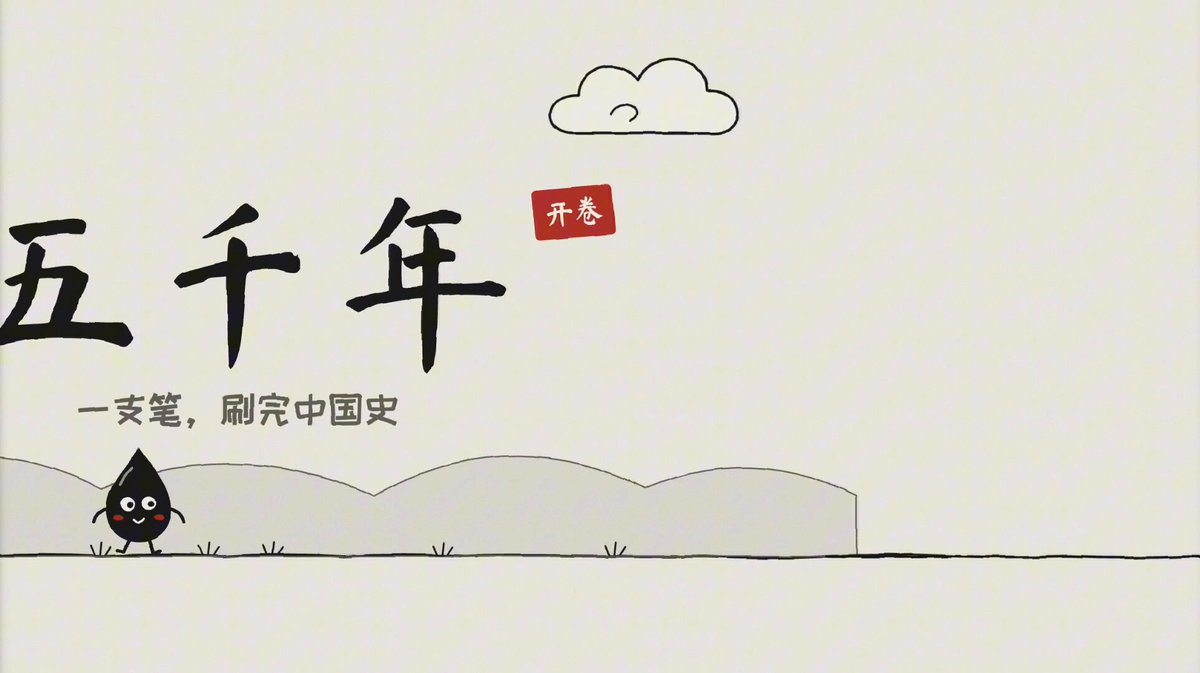
Made by AI
Model: Claude Opus 5.5 · Series: Code-rendered film (LLM writes the program that draws every frame)
Evidence: X post (2026-09-23): '不要再测鹈鹕骑车和Threejs了,Claude Opus 5.5做知识、科普类的视频简直无敌! / 我订阅的是Max (5x),这个2分38秒快速回顾中华上下五千年的视频消耗了5小时额度的3%,周额度的1%,一周理论上能出几十上百条,性价比极高。 / 这一段我没配音,不过给 Claude 接一个 TTS 的 API,配音的问题也能解决。 / 应用场景很多,随便列几个: / 1. 抖音、B站、视频号起号 / 2. 老师的教学视频、课件动画 / 3. 知识付费的课程讲解 / 4. 公司的产品介绍、员工培训'
Human role: Creator made it on a Max (5x) plan and reports it used 3% of the 5-hour quota and 1% of the weekly quota; no voice-over.
Pipeline: Opus 5.5 → code-rendered history explainer (2:38)
What's in the video
Description written by Gemini, which watched and listened to the whole video.
Here is the catalog entry for this video:
Summary
This video is a 2D hand-drawn animated timeline chronicling five thousand years of Chinese history in just over two and a half minutes, reportedly created by Claude Opus 5.5 and published by X user WY (@akokoi1). Guided by a walking ink-drop mascot, the animation journeys chronologically from prehistoric mythical rulers to ancient dynasties, imperial eras, the modern founding of the PRC, and contemporary technological milestones.
What is shown
- [00:00 - 00:08] Prehistoric / Mythological Era (上古 / 三皇五帝, ~3000 BCE): The ink-drop mascot introduces the Yellow Emperor and Yan Emperor shaking hands and forming the Huaxia lineage ("Descendants of Yan and Huang").
- [00:09 - 00:16] Xia Dynasty (夏, ~2070 BCE): Depiction of Yu the Great controlling the floods ("passing his home three times without entering").
- [00:17 - 00:24] Shang Dynasty (商, ~1600 BCE): Divination using turtle shells and fire, illustrating the origins of oracle bone script (甲骨文).
- [00:25 - 00:32] Zhou Dynasty (周, 1046 BCE): Establishing rites and music (礼乐), and King You of Zhou lighting beacon towers to amuse Baosi ("crying wolf").
- [00:33 - 00:41] Spring and Autumn / Warring States (春秋战国, 770 BCE): The "Hundred Schools of Thought" debate featuring Confucius (仁), Laozi (无为), Mozi (兼爱), and Han Feizi (法).
- [00:42 - 00:51] Qin Dynasty (秦, 221 BCE): Qin Shi Huang standardizes writing, currency, and axle widths, alongside building the Great Wall and the Terracotta Army.
- [00:52 - 01:00] Han Dynasty (汉, 202 BCE): Zhang Qian riding a camel across the desert to open the Silk Road.
- [01:01 - 01:08] Three Kingdoms (三国, 220 CE): Zhuge Liang collecting arrows with straw boats on the Yangtze River.
- [01:09 - 01:16] Wei, Jin, Southern and Northern Dynasties (魏晋南北朝, 265 CE): Calligrapher Wang Xizhi writing "之" alongside his geese and Lantingji Xu.
- [01:17 - 01:25] Sui Dynasty (隋, 581 CE): The construction of the Grand Canal and establishment of the imperial examination system (科举).
- [01:26 - 01:33] Tang Dynasty (唐, 618 CE): Prosperity in Chang'an and poet Li Bai raising a wine cup to toast the moon.
- [01:34 - 01:41] Song Dynasty (宋, 960 CE): Cultural advancements including movable type printing, the compass, gunpowder, and Su Shi cooking Dongpo pork.
- [01:42 - 01:51] Yuan Dynasty (元, 1271 CE): Mongol cavalry expanding the empire's vast territory, and Marco Polo arriving to write his travelogue.
- [01:52 - 01:59] Ming Dynasty (明, 1368 CE): Zheng He's voyages with his massive treasure ships, dwarfing Columbus's ship.
- [02:00 - 02:08] Qing Dynasty (清, 1644 CE): High Qing era (population exceeding 300 million) transitioning to the 1840 Opium War gunboats arriving at China's shores.
- [02:09 - 02:17] Xinhai Revolution (辛亥, 1911 CE): The overthrow of the Qing Dynasty, cutting the queue braid, and ending two millennia of imperial rule.
- [02:18 - 02:25] New China (新中国, 1949 CE): Founding ceremony of the People's Republic of China, celebrated with fireworks and red lanterns.
- [02:26 - 02:32] Modern Era (今天 / 现在): China's high-speed rail (CRH) and the lunar exploration space program.
- [02:33 - 02:38] Outro: An enso circle enclosing the phrase "五千年 画不完" ("Five millennia cannot be drawn in one stroke"), inviting the viewer to write the next stroke ("下一笔,你来写!").
Claims & numbers
- ~3000 BCE: The era of the Three Sovereigns and Five Emperors / Yan and Huang (~00:01).
- ~2070 BCE: Xia Dynasty and Yu the Great's 13-year flood control (~00:09).
- ~1600 BCE: Shang Dynasty oracle bone script (~00:17).
- 1046 BCE: Zhou Dynasty founding (~00:25).
- 770 BCE: Spring and Autumn and Warring States periods (~00:34).
- 221 BCE: Qin Dynasty unification (~00:43).
- 202 BCE: Han Dynasty and Zhang Qian's 13-year mission to the Western Regions (~00:52).
- 220 CE: Three Kingdoms period and the borrowing of 100,000 arrows (~01:02).
- 265 CE: Wei, Jin, and Northern/Southern Dynasties; Preface to the Orchid Pavilion Collection remains famous 1,600 years later (~01:10).
- 581 CE: Sui Dynasty, lasting 38 years (~01:18).
- 618 CE: Tang Dynasty (~01:26).
- 960 CE: Song Dynasty (~01:34).
- 1271 CE: Yuan Dynasty (~01:43).
- 1368 CE: Ming Dynasty and Zheng He's 7 voyages (~01:52).
- 1644 CE / 1840 CE: Qing Dynasty founding, population surpassing 300 million, and the 1840 Opium War (~02:01).
- 1911 CE: Xinhai Revolution ending over 2,000 years of imperial rule (~02:10).
- 1949 CE: Founding of the People's Republic of China (~02:19).
Notable quotes
Assessment
This is a creative animated showcase produced with AI assistance demonstrating a concise educational overview of Chinese history. The visuals follow a coherent, continuous single-track side-scrolling format with stick-figure drawings, vector-like line animation, and text overlays, likely generated via scripted vector graphics or an agentic code-to-animation workflow orchestrated by Claude Opus 5.5.
Lyrics & themes
- Audio: The video is set to an upbeat, playful instrumental background music track with no singing or spoken narration.
- Thematic content: On-screen captions provide a comedic and educational recap of major Chinese historical eras, highlighting cultural inventions (oracle bones, rites, examination system, printing, compass, gunpowder), pivotal political transitions (Qin unification, Xinhai Revolution, PRC founding), and iconic cultural figures (Confucius, Li Bai, Su Dongpo, Wang Xizhi).
Lore & references
- The Ink Drop Character: Represents the medium of Chinese ink calligraphy and historical documentation, guiding the audience through millennia.
- Overtime/Workaholic Humor: Refers to Yu the Great as the first recorded "overtime fanatic" (加班狂) in history for skipping his home for 13 years.
- Modern Memes: Uses popular Chinese internet slang, such as "我太难了" ("It's too hard for me") spoken by the Shang divination turtle, and humorous quips about expensing travel for a 13-year business trip (出差13年,能报销吗?).
- "Next stroke" ending: Connects ancient brush-stroke tradition with future generations continuing China's narrative.
Visual style & craft
- Minimalist black-ink line art on an off-white parchment texture background, evoking classical Chinese ink wash painting (shuimohua) adapted into a modern stick-figure webcomic aesthetic.
- Smooth horizontal scrolling timeline punctuated by animated vignettes (e.g., arrows hitting straw targets, steam rising from Dongpo pork, a rocket launching).
- Red accent stamps indicating historical dates and dynasties in standard chronological order.
Described by gemini-3.8-flash on 2026-10-05 from the video's audio and frames.