Jensen Huang | Does AI Revenue Justify Capex, ‘27 AI Bottlenecks, Singularity, Open vs Closed & more
Bg2 Pod YouTube 264,854 views as of 19 October 2026
Why it is here
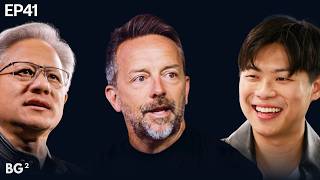
Nvidia CEO Jensen Huang’s third BG2 conversation with Brad Gerstner and Clark Tang (1 h 40 min), recorded, per the description, days after the Xi state dinner, the White House Accord on superintelligence and his receipt of the National Medal of Science. Chapters cover AI capex vs revenue, 2027 compute and power bottlenecks (“50 GW of chips, 35 GW of power”), the singularity, Navier-Stokes and the falling cost of intelligence, safety (“airbags analogy”), America’s superintelligence framework, Elon Musk, Colossus and data centres in orbit. About 265k views in four days; added under the narrowed intake rule as a long-form interview with a central industry leader.
Description
Description written by Gemini from the videoGemini 3.8 Flash, 19 October 2026
Summary In this episode of the BG2 Pod, hosts Brad Gerstner and Clark Tang interview Jensen Huang, founder and CEO of NVIDIA. The discussion covers NVIDIA’s role in the global AI infrastructure buildout, AI safety governance following recent White House accords, physical AI and robotics scaling, energy and datacenter constraints, compute in space with SpaceX Starship, and the financial sustainability of hyperscaler capex and AI lab revenues.
What is shown
- [00:23] Brad Gerstner introduces Jensen Huang, referencing recent White House events, the Accord on Superintelligence, and Huang receiving the National Medal of Science from President Donald Trump.
- [02:22] A photograph is displayed showing Jensen Huang with his parents at the White House National Medal of Science ceremony.
- [08:50] Huang details how inference compute expands exponentially as AI transitions from memorization to multi-step reasoning, tree search, reflection, and agentic workflows (referencing models such as OpenAI’s Astra for CAD generation).
- [26:00] Huang outlines NVIDIA’s physical AI architecture, explaining the three-computer model: supercomputers for training the foundation brain, Omniverse digital twins for simulation and synthetic data, and edge/robotic computers for real-time actuation.
- [35:55] Huang explains his framework for autonomous system safety and containment: zero trust, minimal rights, and out-of-band monitoring with automated kill-switches.
- [47:07] A SemiAnalysis slide is shown: “Labs Dramatically Increasing Compute To Do It”, detailing installed global AI compute projections from 2025 (18 GW) to 2028 (115 GW).
- [57:40] Discussion of deploying orbital datacenters via SpaceX Starship launches, focusing on Vera Rubin platform performance-per-watt economics in space.
- [60:34] An Altimeter chart is shown: “What has to be true? – 2027 and Beyond”, comparing hyperscaler capex projections to AI lab revenue requirements through 2029.
- [72:46] Huang shares a bag of Taiwanese dried plums with the hosts during a brief break in conversation.
- [77:49] An Altimeter chart is shown: “Nvidia DC Revenues ($bn)”, tracking consensus estimates versus actual and bull case projections from 2026 to 2029.
Claims & numbers
- NVIDIA shipment milestones: Jensen Huang states NVIDIA has shipped approximately 1.5 to 1.7 billion units across its product generations since its founding [01:46].
- Physical AI revenue: Huang states NVIDIA generated $10 billion in physical AI revenue in the first six months of 2026, matching its total of $10 billion for all of 2025, which was up from $5 billion the year prior [26:53].
- Cost of compute scaling: Huang states that training the original GPT models cost on the order of $10 million to $20 million, whereas today that same compute can be reproduced for around $100 [19:28].
- Datacenter compute projections: The displayed SemiAnalysis chart estimates global installed AI compute rising from 18 GW in 2025 to 37 GW in 2026, 80 GW in 2027, and 115 GW in 2028 [47:07].
- NVIDIA revenue composition: Huang explains that NVIDIA’s computing business divides roughly into three equal parts: traditional data processing and classical compute/simulation (one-third), frontier AI research labs (one-third), and enterprise/startups/neoclouds utilizing open-source models (one-third) [62:26, 64:42].
- Datacenter investments: Huang notes NVIDIA announced 2 GW of deployment in Australia, representing roughly $80 billion in project scale [52:48].
- Hardware lifecycle and software licensing: Huang projects software licensing for enterprise AI deployment will become a major recurring revenue stream, generating several thousand dollars per GPU per year across millions of deployed chips [88:05].
Notable quotes
- [34:10] Jensen Huang: “You start with containment: zero trust, minimum boundaries, minimum rights, and you expand it as you test and give yourself confidence.”
- [37:48] Jensen Huang: “You can’t separate capability and functionality from safety and security. They go as one.”
- [58:32] Jensen Huang: “The productivity of NVIDIA’s compute is so good... that you could put it out in space, and the launch cost is a small percentage of it.”
Assessment This is a long-form studio video podcast interview featuring real executives discussing authentic products, current market data, and active industry developments. The discussion reflects firsthand industry perspectives without staged product demonstrations or computer-generated fabrications.
Described by gemini-3.8-flash on 2026-10-19 from the video’s audio and frames.
Related
More videos on this
-

Jimmy Kimmel Threatened by FCC Chairman Robert De Niro, Trump Renames A.I. & Guillermo Dances to NY
Jimmy Kimmel Live5,770,187 views as of 13 Oct
-

AI Leaders Sign Trump’s “Self-Policing” Pact & Eric Schmitt’s Ambush Backfires | The Daily Show
The Daily Show3,150,021 views as of 13 Oct
-

AI CEO Interviews (2026)
Kai Lentit652,637 views as of 13 Oct
-
FULL: Elon Musk, Jensen Huang, Tom Brown Discuss the AI Revolution & What’s Next - 09/29/26
Right Side Broadcasting Network650,413 views as of 13 Oct