“Muse Wonder is benchmaxxed”: BridgeBench lava lamp test yields a red cylinder
BridgeMind (@bridgemindai)X259,444 views as of 13 October 2026
Why it is here
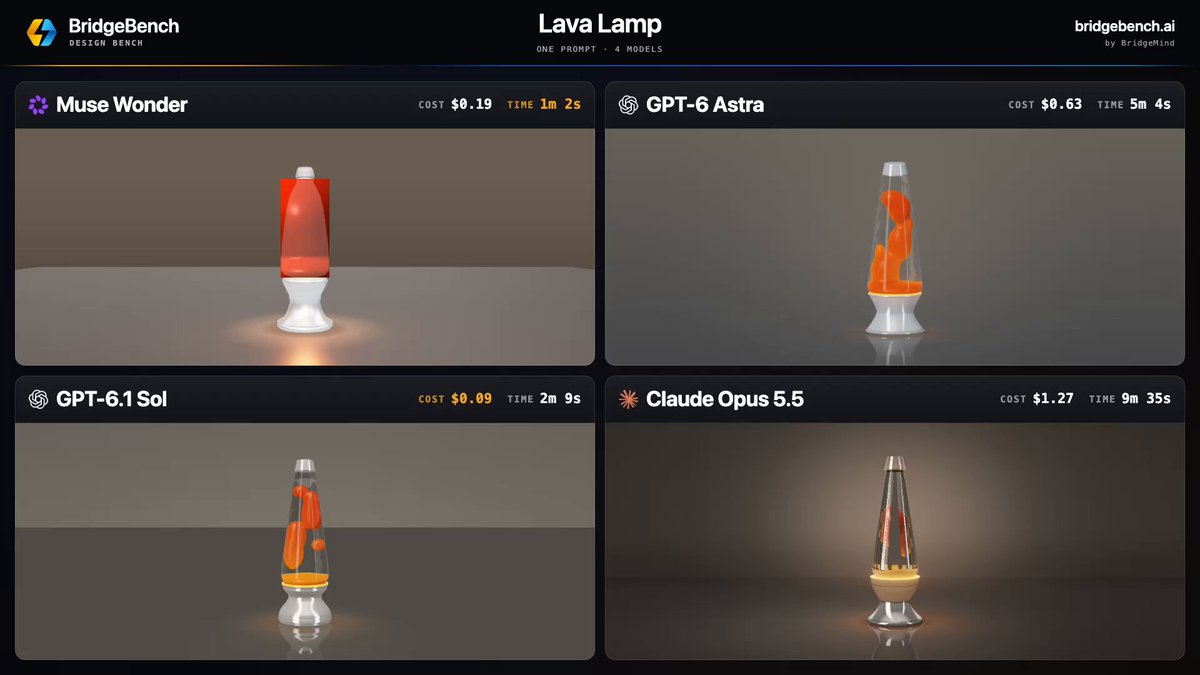
10-second recording of Muse Wonder’s output on BridgeMind’s ‘lava lamp’ test, ~259k views (fxtwitter, Oct 13): “it built a red cylinder. No glass. No lava. I’ve never seen a model this benchmaxxed in my life.” A widely shared data point for the claim that Meta’s benchmark scores overstate the model; a single test by one vendor of its own benchmark. The post does not say whether it used Muse Wonder or Muse Wonder Full.
Description
Description written by Gemini from the videoGemini 3.8 Flash, 13 October 2026
Summary
This video, published by BridgeMind (@bridgemindai), presents a comparative side-by-side 3D design evaluation from “BridgeBench” running a single prompt (“Lava Lamp”) across four frontier models: Meta’s Muse Wonder, OpenAI’s GPT-6 Astra, OpenAI’s GPT-6.1 Sol, and Anthropic’s Claude Opus 5.5. The video showcases the resulting 3D object renders along with execution time and API cost for each model, highlighting that Muse Wonder produced a rigid, cylindrical block rather than an organic lava lamp.
What is shown
- [00:00 - 00:09]: A 2×2 split-screen benchmark UI under the banner “BridgeBench | DESIGN BENCH”, captioned “Lava Lamp: ONE PROMPT • 4 MODELS”:
- Top-left (Muse Wonder): Cost $0.19, Time 1m 02s. Renders a modern white fixture containing a solid, straight red cylinder inside the glass chamber.
- Top-right (GPT-6 Astra): Cost $0.63, Time 5m 04s. Renders a classic tapered lava lamp containing floating, organic orange fluid blobs.
- Bottom-left (GPT-6.1 Sol): Cost $0.09, Time 2m 09s. Renders a detailed lava lamp structure with separated molten droplets in orange and red.
- Bottom-right (Claude Opus 5.5): Cost $1.27, Time 7m 35s. Renders a metallic base lava lamp with a glowing ring and darker fluid/wax styling.
Claims & numbers
- Execution costs & completion times shown in UI:
- Muse Wonder: Cost $0.19; Completion Time: 1m 02s.
- GPT-6.1 Sol: Cost $0.09; Completion Time: 2m 09s.
- GPT-6 Astra: Cost $0.63; Completion Time: 5m 04s.
- Claude Opus 5.5: Cost $1.27; Completion Time: 7m 35s.
Notable quotes
- None (the video contains no spoken dialogue or narration).
Assessment
This is a benchmark demonstration and visual comparison screen recording from BridgeMind illustrating code/3D-generation differences across models. It concretely demonstrates that while Muse Wonder was fast and relatively inexpensive, its spatial/geometry generation failed to model fluid dynamics or the organic shape of lava lamp wax compared to Astra, Sol, and Claude Opus 5.5.
Lyrics & themes
- The clip is non-vocal / silent without sung lyrics or speech. The primary theme conveyed visually is model benchmarking and evaluation of generative 3D modeling fidelity.
Lore & references
- “Benchmaxxed”: A community portmanteau referencing models optimized specifically to score well on standard academic benchmarks while failing simple visual or practical common-sense prompts (here producing a static red cylinder instead of floating lava blobs).
- Frontier Model Generation (Fall 2026): Compares newly released models from October 2026 (Meta’s Muse Wonder) against OpenAI’s GPT-6 family (Astra, Sol) and Anthropic’s Claude Opus 5.5.
Visual style & craft
- The presentation features a clean, dark-mode benchmarking dashboard graphic with 3D model viewport cards. Each quadrant displays rendered turntable-style 3D assets on a plain gray backdrop under studio lighting, accompanied by standard metric typography indicating cost and generation runtime.
Described by gemini-3.8-flash on 2026-10-13 from the video’s audio and frames.
Made by AI
- Made with
- Muse Wonder
- How we know
- X post (2026-10-12): ‘Muse Wonder is benchmaxxed. Meta says it beats the competition on the key benchmarks. On the BridgeBench lava lamp test it built a red cylinder.’
- Human role
- BridgeMind ran its standard lava-lamp prompt and recorded the output; prompt and settings not published in the post.
- Pipeline
- BridgeBench lava lamp prompt → Muse Wonder generates a 3D scene → screen recording
- Series
- Agent-built game or 3D world (the video shows the result)