Anthropic Revealed Their Secret Guide to Mastering Opus 5.5
Brock Mesarich | AI for Non Techies · 2026-09-26 · tutorial · 53,324 views
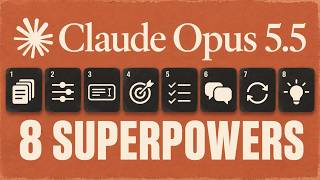
What's in the video
Description written by Gemini, which watched and listened to the whole video.
Summary — In this video, content creator Brock Mesarich (from the channel AI for Non Techies) breaks down Anthropic's official prompting guide for the Claude Opus 5.5 model. He presents eight practical tips and best practices covering default effort settings, system prompts, multi-app context exploration, pasted content formatting, progress updates, task completion, UI design prompting, and visual chart inspection.
What is shown —
- [00:00] Overview slides titled "Anthropic's Prompting Guide: Claude Opus 5.5 - Eight practical tips for everyday work."
- [00:22] Tip 1 (Effort Setting): Explanation of effort slider defaults (Opus 5 defaulting to high vs. Opus 5.5 defaulting to medium), token trade-offs, and documentation slides regarding
max_tokensand prompt caching. - [01:22] Side-by-side prompt comparison example evaluating two proposals at medium versus higher effort levels.
- [01:48] Tip 2 (Thinking Instructions): Review of system prompts, explaining why phrases like "Think carefully before answering" can delay first-word generation without improving output quality.
- [03:13] Tip 3 (Relevant Context): Demonstration of multi-app automation prompting (emails, spreadsheets, docs) and an instruction prompt to inspect external sources before taking action.
- [04:38] Tip 4 (Pasted Material): Mockup showing clear separation between user instructions and pasted external content to prevent prompt injection or confusion.
- [05:15] Tip 5 (Why Claude Seems Silent): Visualizing how background progress updates and thinking blocks can be hidden by custom UIs, and how to request updates at explicit checkpoints.
- [05:57] Tip 6 (Finished Tasks): Illustration showing that a completed response turn does not always mean an end-to-end task is finished; setting explicit checklist criteria for what "done" entails.
- [06:57] Tip 7 (Design Direction): Comparison between vague styling instructions ("make it less generic") versus concrete frontend specifications (colors, spacing, button shapes).
- [07:42] Tip 8 (Small Details): Demonstration of image and chart analysis, illustrating cropping and close-up inspections for dense data labels.
Claims & numbers —
- The presenter states that Claude Opus 5 defaulted to the "high" effort level, whereas Claude Opus 5.5 defaults to "medium" [00:26].
- A slide citation from Anthropic notes that Claude Opus 5 with thinking off supports a
max_tokenssetting of 128,000 [01:11]. - The presenter claims Anthropic's tests showed removing "think carefully" instructions made replies start sooner with no discernible decline in output quality [02:11].
- The presenter notes Anthropic's multi-app automation benchmarks showed higher task completion when explicitly instructing the model to explore sources broadly first, at the cost of slightly more tool calls and tokens [03:59].
- The presenter states that Claude Opus 5.5 interprets visual materials (charts, diagrams, screenshots) noticeably more accurately than Opus 5 without requiring extra tools [07:46].
Notable quotes —
- [00:25] "Opus 5 defaulted to the high effort level, while Opus 5.5 now defaults to medium."
- [04:41] "When you paste an email or web page into a message, there are really two different things present: your request and somebody else's content."
- [05:58] "A finished reply is not a finished task."
Assessment — This is an educational explainer and guide summary reviewing Anthropic's released prompting documentation for Claude Opus 5.5. The video consists of slide presentations, graphic mockups, and excerpted documentation rather than live screen recordings or direct coding demos.
Described by gemini-3.8-flash on 2026-09-29 from the video's audio and frames.