Crazy AI Animation Workflow - Opus 5.5
Can It Code? · 2026-09-27 · ai-made · 52,810 views
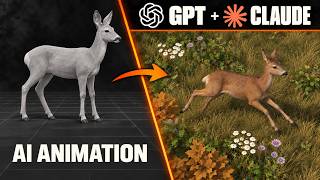
Made by AI
Model: Claude Opus 5.5, Seedance 2.5, Tripo · Series: Agent-built game (video of the result)
Evidence: Description: 'the animals in the game were never animated by hand'; Opus 5.5 built and rigged the deer in Blender, then a script 'the AI wrote' matched the skeleton to a Seedance 2.5 video frame by frame.
Human role: Designed the experiment over three tries; episode 3 of a series building a survival game with AI.
Pipeline: Opus 5.5 (Blender rig + keyframes) → Tripo 3D model → side render → Seedance 2.5 video → AI-written script fits bones to the video outline, 97 frames per clip
Lore: code-not-generated
What's in the video
Description written by Gemini, which watched and listened to the whole video.
Summary
A developer from the channel Can It Code? demonstrates an experimental game-development pipeline for rigging and animating 3D animals using generative AI. Rather than animating by hand, the workflow combines 3D mesh generation (Tripo), video generation (Seedance 2.5), and LLM coding agents (Claude Opus 5.5 and GPT-6 Astra) to extract frame-by-frame skeletal motion from 2D AI videos onto 3D rigs in Blender.
What is shown
- Evolution of animation approaches [00:27–02:30]:
- Approach 1: Claude Opus 5.5 writes Python scripts (
build_deer.py) in Blender to construct procedural 3D animals out of primitives (4 refinement iterations over 37 minutes), adding a 29-bone skeleton and mathematical keyframe walking cycles [00:48–01:46]. - Approach 2: Tripo generates an animal 3D model from a single concept image in ~1 minute, paired with code-driven Blender procedural walk keyframing [01:48–02:30].
- Approach 3: Tripo model orthographic side renders are animated into 4-second reference clips using Seedance 2.5 [02:30–03:15].
- Approach 1: Claude Opus 5.5 writes Python scripts (
- Video-to-Rig Motion Fitting [03:16–03:45]: Opus 5.5 writes
fit_clip.pyto match the 3D rig’s bones to the silhouette and limb positions of the Seedance video frame-by-frame across 97 frames (~30 minutes of compute per clip). - Animal-Specific Fixes & Edge Cases [04:00–04:52]:
- Resolving a 60 fps container vs. 24 fps motion cadence mismatch on the running hare [04:04].
- Correcting overlapping limb tracking on the roe deer gallop by marking hooves [04:15].
- Disentangling near/far leg swapping on a pheasant walk, and replacing painted wing textures with procedural articulated 3D wings [04:27].
- Refining the bear across 14 iterations using GPT-6 Astra and 6 virtual cameras [04:45].
- In-Engine Testing & Gameplay AI [04:53–06:06]: A custom browser-based inspection UI ("Pheasant Lab") for stepping through frame errors, animation sound extraction from Seedance, and a dual-ring proximity behavior system (alert at 12 m, flee at 7 m) in a top-down Unity/Godot-style environment.
- Depth Ambiguity Failures [06:07–08:04]: Showing why single-camera video fitting fails on complex human interactions (e.g., stone lifting and log carrying clipping into the torso), followed by a multi-camera preview on a fantasy troll boss [07:54].
Claims & numbers
- The presenter states that no animal animations were created by hand; every step, hop, and bite originates from an AI video [00:11].
- Claude Opus 5.5 required 4 iterative rounds taking 37 minutes to script and refine the procedural deer model [01:08].
- The deer rig uses 29 bones [01:11].
- Generating the deer model with Tripo took approximately 1 minute, with the whole setup tested in 10 minutes [01:53, 02:22].
- Seedance 2.5 generated 4-second video clips at 16:9 aspect ratio and 480p resolution on the first attempt [02:53, 03:06].
- The fitting script processes 97 frames per clip, requiring approximately 30 minutes of computation per motion clip [03:37].
- The hare video was encoded at 60 fps while the internal AI motion was 24 fps, causing uneven speed fluctuations 12 times a second [04:07].
- Animating the bear with GPT-6 Astra required 14 rounds across 6 camera angles [04:46].
- Animal AI triggers alert behavior at 12 meters and running behavior at 7 meters [05:54].
- The complete pipeline produced 5 animated animals across 21 AI videos within a few days [08:05].
Notable quotes
- "Nobody animated them by hand. Every hop, every step and every bite comes from an AI video." [00:11]
- "Tripo only gives you the model, there is no skeleton. So the AI built one, and then the same walk as before: keyframes written by code." [02:01]
- "A video is flat. It only sees one plane: left and right, up and down. What it can't see is depth." [06:31]
Assessment
This is an authentic developer devlog and technical walkthrough detailing an experimental AI game asset pipeline. The video shows genuine Blender scripting, debugging workflows, and UI tools, transparently highlighting failures such as planar depth ambiguity, mesh penetration, and frame-rate cadence mismatch rather than overhyping the process.
Lyrics & themes
The video is a spoken-word technical devlog (non-musical narration) structured by pipeline iteration:
- Procedural Code Generation: Attempting pure code modeling and animation using LLMs in Blender ("Just let the AI build the deer itself in Blender, from code..." [00:43]).
- Hybrid 3D Mesh + AI Video Motion: Pivoting to Tripo for geometry and Seedance 2.5 for video motion capture ("What if we don't animate the deer at all, but just film it?" [02:33]).
- Computer Vision Rig Fitting: Solving single-camera tracking errors frame-by-frame ("For every frame, a script the AI wrote poses our model, renders it and compares it with the video..." [03:26]).
- Limits of 2D Video Tracking: Explaining monocular depth collapse when handling interactive props ("Whichever side you film from, some depth is always missing" [07:36]).
Lore & references
- Claude Opus 5.5: Anthropic's flagship coding model, used here via API/scripts to generate procedural Blender Python scripts (
build_deer.py,fit_clip.py). - GPT-6 Astra: OpenAI's frontier multimodal model, credited with running a 14-round multi-camera iterative fitting process on the bear asset.
- Tripo & Seedance 2.5: Specialized generative models used respectively for text/image-to-3D mesh generation and image-to-video motion generation.
- The Bestiary: A reference to the creator's ongoing game devlog series constructing hostile forest creatures and fantasy boss encounters.
Visual style & craft
The video blends clean motion graphic diagrams (flowcharts, timeline markers, camera projection rays), screen recordings inside Blender, web UI captures of Seedance 2.5, and stylized split-screen side-by-side comparisons. Real-time engine footage shows a top-down meadow environment with stylized vegetation and dynamic animal behavioral circles. Visual indicators (outlines, skeletal overlays, and callout boxes) cleanly illustrate mesh clipping, frame discrepancies, and joint alignment.
Described by gemini-3.8-flash on 2026-09-29 from the video's audio and frames.