Fall foliage simulator made with Sonnet 5 vs Sonnet 5.5 (official @claudeai launch-thread video)
Claude (@claudeai) X 755,645 views as of 26 October 2026
Why it is here
Official launch-day showcase (~724k views) opening Anthropic’s Sonnet 5.5 experiments thread.
Description
Description written by Gemini from the videoGemini 3.8 Flash, 5 October 2026
Summary
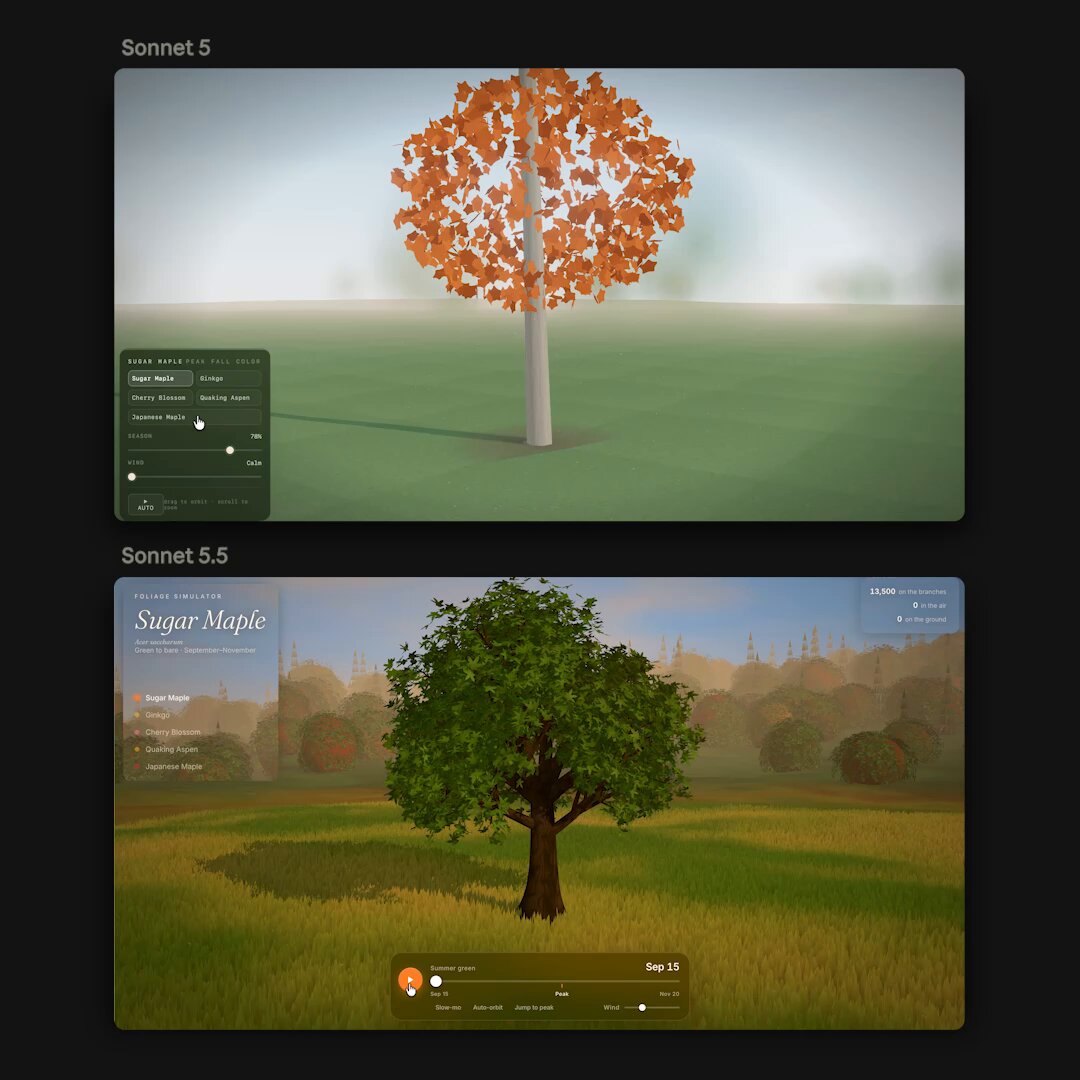
This side-by-side comparison video, posted by Anthropic’s official Claude account on X to celebrate the launch of Claude Sonnet 5.5, demonstrates code generation improvements between Claude Sonnet 5 and Claude Sonnet 5.5. Both models were tasked with creating an interactive 3D fall foliage simulator in WebGL/Three.js, showcasing a dramatic leap in rendering fidelity, physics simulation, UI design, and visual realism.
What is shown
- [00:00 – 00:10] Top view (Sonnet 5): Displays a basic, flat-lit 3D scene with a generic tree model, simple spherical leaf clusters, and an elementary control box toggling tree species (Sugar Maple, Red Oak, Ginkgo) and adjusting day/color tint.
- [00:00 – 00:14] Bottom view (Sonnet 5.5): Renders an expansive landscape with rolling grassy hills, distant treelines, atmospheric depth, realistic lighting, and an anatomically detailed Sugar Maple tree. A custom bottom slider scrubs through calendar dates (starting September 15).
- [00:05 – 00:15] As the date advances into October, the Sonnet 5.5 tree undergoes a gradual, biologically plausible color transition from vibrant green to yellow, amber, and rich crimson foliage.
- [00:16 – 00:26] High-wind shedding physics demonstration on Sonnet 5.5: dynamic particle systems blow thousands of individual autumn leaves off branches in swirling gust trajectories toward the right side of the screen, settling naturally across the grass.
- [00:27 – 00:30] The Sonnet 5.5 tree strips down to intricate, realistic bare winter branches with accumulated leaf piles on the ground, while Sonnet 5’s foliage simply drops into a basic scatter under a stylized, bare geometric trunk.
Claims & numbers
- Performance & particle statistics shown on Sonnet 5.5’s UI (top right):
- Particle count metrics during simulation: peaks around
12,184 ACTIVE PARTICLES,2,838 OFF-BRANCH, and4,294 GROUND-SETTLED. - Maintains a constant rendering performance readout of
60 FPS.
- Particle count metrics during simulation: peaks around
- No spoken claims or promotional pricing are stated in the video itself.
Notable quotes
- None (The video contains no voiceover or dialogue).
Assessment
This is an authentic side-by-side technical demo from an official release thread illustrating Claude Sonnet 5.5’s single-prompt WebGL coding capabilities compared to its predecessor. While selecting a visually expressive domain like seasonal tree simulation serves as effective marketing showcase material, the interactive canvas controls, live UI toggles, and real-time particle counters reflect a functional browser-based code output.
Lyrics & themes
- Lyrics: None (the video is silent / instrumental with no lyrics or voiceover).
- Themes: Simulation of botanical phenology, autumn senescence, fluid particle dynamics in wind, and the rapid evolution of front-end graphics code generated by frontier language models.
Lore & references
- Sonnet 5 vs. Sonnet 5.5: Represents Anthropic’s generation jump within the Sonnet class (Sonnet 5 released in late June 2026; Sonnet 5.5 launched on September 28, 2026).
- Artifacts / WebGL Demos: Echoes the benchmark tradition popularized across developer communities where LLMs are prompted to generate zero-shot Three.js and WebGL interactive shaders to test spatial logic, mathematical rendering, and complex state management.
Visual style & craft
- Visual Style: Split-screen capture showing two distinct browser-based 3D applications rendered in real-time WebGL.
- Rendering Craft:
- Sonnet 5: Low-poly geometry, flat ground plane, basic diffuse shading, and simplified leaf sprites.
- Sonnet 5.5: Advanced shaders with subsurface scattering on leaf planes, depth of field, atmospheric haze, procedural grass blades, accurate skeletal branch geometry, and GPU-accelerated particle vector physics for blowing wind.
Described by gemini-3.8-flash on 2026-10-05 from the video’s audio and frames.
How AI was used to make it
AI made all of it of this video: subject built by ai, visuals from ai-written code.
- Claude Sonnet 5 and 5.5 generated interactive 3D WebGL/Three.js foliage simulation code
Tools named: Claude Sonnet 5.5, Claude Sonnet 5
Classified by gemini-3.8-flash from our description of the video (high confidence), 25 October 2026. How AI is used to make videos, across the whole log
Made by AI
- Made with
- Claude Sonnet 5.5, Claude Sonnet 5
- How we know
- Official Anthropic @claudeai post (2026-09-28): ‘A thread of early experiments with Claude Sonnet 5.5. A fall foliage simulator by @_re_pete, made with Sonnet 5 vs Sonnet 5.5.’
- Human role
- Made by @_re_pete (Pete); posted by Anthropic as the first item of its Sonnet 5.5 launch thread.
- Pipeline
- Same task to Sonnet 5 and Sonnet 5.5 → browser simulators → 30-second comparison clip
- Series
- Code-rendered film (LLM writes the program that draws every frame)
Related
More videos on this
-
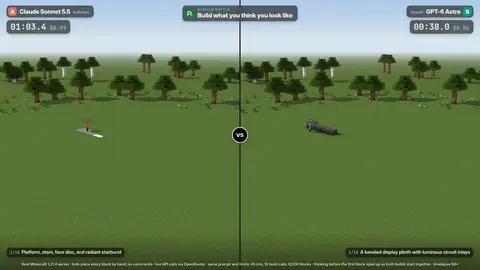
“Build what you think you look like”: Claude Sonnet 5.5 vs GPT-6 Astra
Siya (@siyabuilt)7,259,229 views as of 27 Oct
-
Introducing Claude Sonnet 5.5
Claude4,403,927 views as of 27 Oct
-

Gemini 4, GPT 6.1, Dots, Claude Sonnet 5.5, Ideogram 4.5, Flux 3: AI NEWS
AI Search373,606 views as of 31 Oct
-

A visualization of every Claude effort level, made with Opus 5.5 and Sonnet 5.5
DreW (@devteamdrew)229,228 views as of 27 Oct