"What living through the singularity would feel like" (Opus 5.5, X video)
Angus (dirtman) (@dirtman) · 2026-09-26 · ai-made · 300,555 views
Made by AI
Model: Claude Opus 5.5 · Series: Code-rendered film (LLM writes the program that draws every frame)
Evidence: X post (2026-09-26): 'I asked opus 5.5 what living through the singularity would feel like and it just sent me this.. ?'
Human role: Asked Opus 5.5 "what living through the singularity would feel like" and posted what it returned.
Pipeline: One question → Opus 5.5 → HUD-framed, phase-by-phase singularity timeline film (per claudevideo.org), 2:26
Lore: one-prompt
What's in the video
Description written by Gemini, which watched and listened to the whole video.
Summary
This video is a fast-paced audiovisual accelerationist montage titled "What living through the singularity would feel like", created and shared by Angus (dirtman) (@dirtman). Structured around a futuristic heads-up display ("ACCEL/OS") synchronized to an energetic electronic pop song ("Accelerate"), the video charts humanity’s accelerating technological velocity from early aviation in 1909 through spaceflight, compute scaling, and AI, culminating in speculative interstellar expansion up to the year 2200.
What is shown
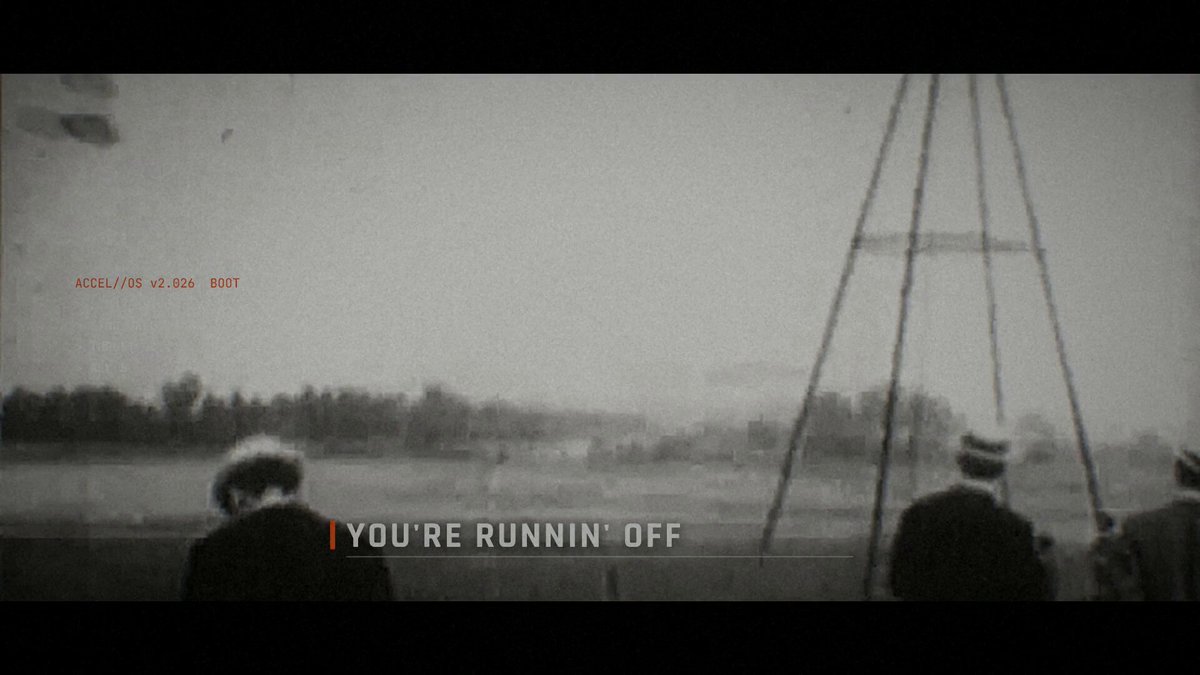
- [00:00 - 00:30] Phase 01: Origins (1909–1965): Historical archival clips showing the 1909 Wright Flyer at Fort Myer, Robert Goddard’s liquid-fuel rocket tests (1927–1929), 1930s Grand Prix racing, industrial steel production, the V-2 rocket, Bell X-1 breaking Mach 1, and Gemini/Titan space flights, alongside a speedometer climbing from 48 km/h past 450 km/h.
- [00:31 - 01:03] Phase 02: Space Age (1967–2013): Saturn V launches (Apollo 4 and Apollo 11), lunar landings, Space Shuttle missions, scramjet tests (X-43A), and industrial robotics. Overlay data tracks computing costs plummeting per GFLOPS (IBM 7030 to Cray X-MP to 2011 GPU era). Speedometer shifts from Mach 1+ past Mach 2.89.
- [01:04 - 01:20] Phase 03: Information Age (2014): Demonstrations of DARPA/Boston Dynamics quadruped robots (LS3 Legged Squad Support System), naval railgun tests, and advanced military robotics, alongside an exponential technological milestone curve (Powered Flight -> Transistor -> Sputnik -> Microprocessor -> WWW -> ISS -> Reusable Rockets -> Humanoid Robots).
- [01:21 - 02:11] Phase 04 / Phase 05: Exponential (2015–2026): Rapid sequence of SpaceX Falcon 9 and Starship launches, semiconductor lithography, F1 pit stops, and solar flares, accompanied by exponential charts showing transistor density per chip (up to NVIDIA B200), human genome sequencing costs falling to $200, and AI training compute rising through AlexNet, AlphaGo, GPT-3, GPT-4, and frontier models.
- [02:12 - 02:25] Phase 06: The Future (2027–2200 Projected): Speculative future milestones, including orbital Starship propellant transfer (2027), lunar mass drivers (2032), colonization of Mars (2040), Europa outpost (2050), outer solar system habitats (2100), interstellar travel to Alpha Centauri (2150), O'Neill cylinder habitats (2160), and warp-speed flight (2200), ending on the title card: "THE FUTURE IS ACCELERATING / ACCELERATE / 1903 – 2026 – ∞".
Claims & numbers
- Fastest human speeds: 1903 Wright Flyer at 48 km/h; 1947 Bell X-1 at Mach 1 (1,068 km/h); 1956 Bell X-2 at Mach 3 (2,986 km/h); 1961 Vostok 1 orbit at 29,006 km/h; 1969 Apollo 10 at 39,894 km/h.
- Cost per GFLOPS: $14.8M on the 1961 IBM 7030; $18.9K on the 1984 Cray X-MP; $3,250 on a 1997 Beowulf cluster; $109 in the 2011 GPU era; $0.03 for a 2017 consumer GPU.
- Transistor counts per chip: 3,686 on the 1971 Intel 4004; 13.0B on a 2016 Intel Xeon; 208.0B on the 2024 NVIDIA Blackwell B200.
- Cost per human genome: $99.8M (2001 Human Genome Project); $291,553 (2007 Next-Gen Sequencing); $1,563 (2014); $677 (2016); $200 (2024).
- Launch cost to orbit per kg: $46,148 (1981 Space Shuttle); $2,589 (2010 Falcon 9); $478 (2018 Falcon Heavy); $200 projected for 2030 full reuse.
- AI training compute: Climbs from AlexNet (2012) through AlphaGo (2016, ×35,245), GPT-3 (2020), GPT-4 (2023), up toward frontier models exceeding $5.0 \times 10^{27}$ FLOP.
Notable quotes
- [00:11] "I ACCELERATE" (On-screen text / lyrics)
- [00:17] "I WON'T CRASH" (On-screen text / lyrics)
- [02:24] "THE FUTURE IS ACCELERATING / ACCELERATE / 1903 — 2026 — ∞" (Ending title card)
Assessment
This is an accelerationist (e/acc) cultural video project created by Angus combining AI-assisted video editing/synthesis and upbeat pop music to illustrate the concept of an impending technological singularity. The historical and recent technical data points (supercomputers, genome costs, Moore's Law, rocket costs) represent accurate historical trajectories, while the latter portions transition into speculative, concept-art projections of future space colonization and interstellar travel.
Lyrics & themes
- Origins & Early Velocity [00:00 - 00:30]: Opening verses establish speed, daring, and non-stop forward momentum.
- "Push the pedal to the floor, blow 'em all away" [00:05]
- "I accelerate / Going faster than fast / Hit the gas" [00:11]
- Defying Limits & Maintaining Trajectory [00:31 - 01:03]: Chorus emphasizing control and refusing deceleration even under extreme speeds.
- "Lose control, I won't crash / Rollin' high" [00:16]
- "Put your money on the dash, throw the dice" [00:20]
- The Exponential Shift & Future Horizon [01:04 - 02:25]: Repetition of the driving hook as industrial automation transitions into computing, AI, and post-planetary expansion.
- "I won't crash, when you slow, I won't crash" [01:31]
Lore & references
- Effective Accelerationism (e/acc): The video heavily channels the techno-optimist thesis that technological progress and energy capture follow an inevitable, exponential curve that should be accelerated rather than throttled.
- "I Won't Crash" vs. P(doom): The persistent refrain "I won't crash" serves as an explicit counter-narrative to catastrophic AI-risk / p(doom) anxiety and decelerationist arguments common in mid-2026 debates.
- O'Neill Cylinders & Megastructures: References classic space settlement concepts by Gerard K. O'Neill (L5 colony designs from NASA Ames 1975).
- Moore’s Law & Wright’s Law: Displayed prominently through charts depicting exponential declines in genome sequencing costs, launch costs per kilogram, and compute pricing alongside steep increases in transistor counts and AI training FLOPs.
Visual style & craft
The production employs a retro-futuristic tactical HUD overlay ("ACCEL/OS v2.026") featuring dynamic digital speedometers, countdown timers, logarithmic scale charts, and target crosshairs. The visuals blend restored archival historical film (1900s–1960s), NASA/SpaceX spaceflight footage, robotics lab captures (DARPA/Boston Dynamics), CGI space station renders, and space art, fast-cut and synchronized rhythmically to the musical beat with chromatic aberration, glitch transitions, and kinetic typography.
Described by gemini-3.8-flash on 2026-09-30 from the video's audio and frames.