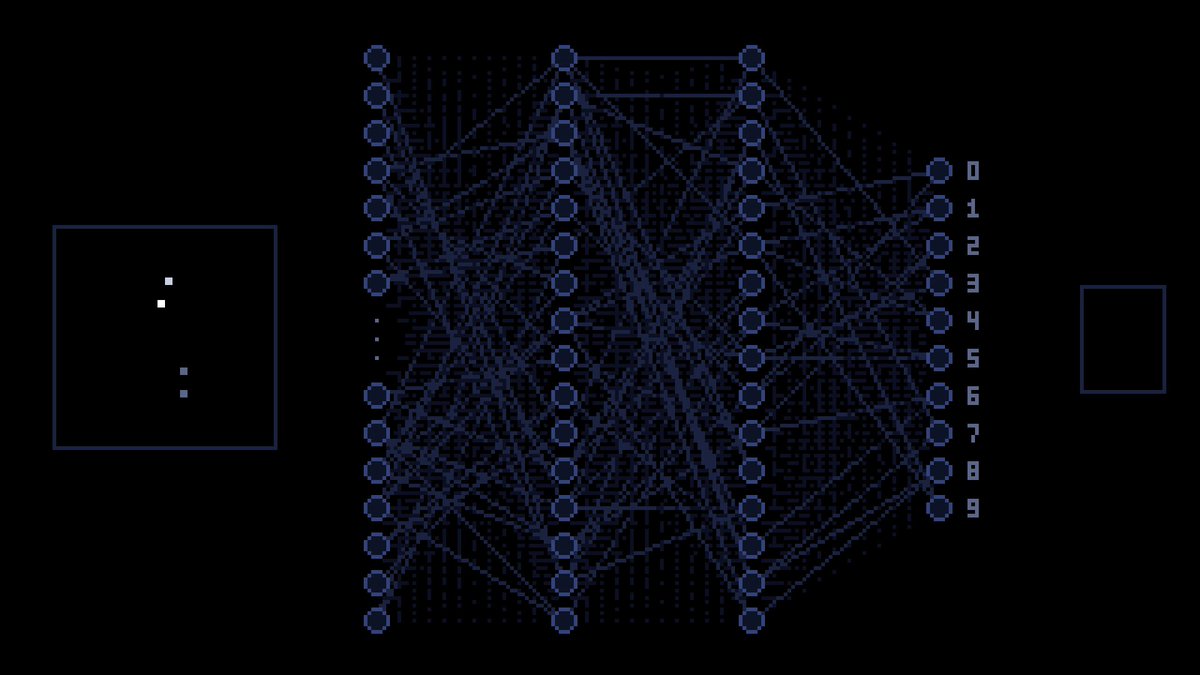
Pixel-art animation of a neural network learning to read a handwritten 2 (DotCSV, X video)
Carlos Santana (@DotCSV) · 2026-09-23 · ai-made · 571,645 views
Made by AI
Model: Claude Opus 5.5 · Series: Code-rendered film (LLM writes the program that draws every frame)
Evidence: X post (2026-09-23): 'QUÉ!? Locura / / Le he pedido a Opus 5.5 que me haga una animación en pixel art de una red neuronal entrenándose. El resultado está por encima de cualquier expectativa! Fuah chavales'
Human role: Carlos Santana (DotCSV, a large Spanish-language AI YouTuber) asked for "a pixel art animation of a neural network training". Prompt otherwise not published.
Pipeline: One request → Opus 5.5 codes a pixel-art explainer animation → 56-second video
Lore: code-not-generated
What's in the video
Description written by Gemini, which watched and listened to the whole video.
Here is the catalogue entry for the video:
Summary This video is a pixel-art animated visualization created and shared by Spanish AI educator Carlos Santana (@DotCSV), illustrating how a simple multi-layer perceptron processes handwritten digits from the MNIST dataset. It demonstrates forward propagation, output prediction, and backpropagation loss calculation through stylized 8-bit visual effects and retro sound design.
What is shown
- [00:00 - 00:07]: A handwritten digit "1" is fed into the input layer. Blue activation pulses propagate forward through hidden layers to output node 1, followed by red backpropagation signals updating the network weights and error gradients.
- [00:08 - 00:15]: An ambiguous symbol resembling the Greek letter lambda ($\lambda$) is evaluated; the network incorrectly or hesitantly classifies it as a "2", followed by a loss and backpropagation pulse.
- [00:16 - 00:23]: A clear handwritten digit "2" is fed into the network, activating node 2, followed by backward error gradient propagation.
- [00:24 - 00:31]: A digit "3" is presented and successfully triggers the "3" output neuron.
- [00:32 - 00:39]: A cursive/looped digit "2" is fed in and correctly triggers class "2".
- [00:40 - 00:47]: A handwritten digit "8" is processed, activating the output node for 8.
- [00:48 - 00:55]: An ambiguous/rotated glyph resembling an inverted or rotated character is tested; the network activates output neuron "4" before backpropagating the error.
Claims & numbers
- None. (The video contains no spoken dialogue, text claims, or benchmarks; it is purely an audiovisual educational animation).
Notable quotes
- None. (Instrumental audio with 8-bit sound effects only).
Assessment This is a stylized educational pixel-art demo illustrating the mechanical fundamentals of neural network forward inference and backpropagation training on handwritten digits. It is an artistic, conceptual visualization rather than a real-time console capture of a raw production model.
Lyrics & themes
- The video is entirely instrumental, accompanied by synthesized chiptune / 8-bit sound effects synchronized to the data pulses and layer activations.
Lore & references
- MNIST Dataset: Features the classic 28x28 grayscale handwritten digit classification problem that serves as the "Hello World" of modern machine learning.
- Feedforward & Backpropagation: Blue pulses represent forward passes (inference/activations), while red pulses flowing backwards from the loss node illustrate gradient descent and backpropagation error updates.
- Misclassifications and Out-of-Distribution Inputs: The inclusion of non-standard symbols (such as $\lambda$ at [00:08]) illustrates edge-case handling and how neural networks attempt to classify unfamiliar inputs into known classes.
Visual style & craft
- The video features custom retro 8-bit pixel-art aesthetics on a black background, with neon blue feedforward lines and pink/red gradient vectors.
- The animation appears to be programmatic/code-rendered graphics (likely built with Processing, Manim, p5.js, or custom canvas scripting) rather than continuous diffusion video generation.
Described by gemini-3.8-flash on 2026-09-30 from the video's audio and frames.