We Need to Talk About OpenAI’s Latest Maths “Breakthrough”
Ellie Sleightholm YouTube 39,484 views as of 18 October 2026
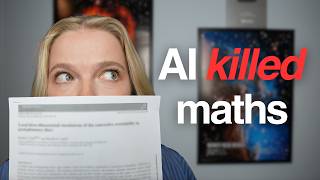
Why it is here
Maths YouTuber Ellie Sleightholm (175k subscribers) on OpenAI’s release of 700+ AI-generated maths manuscripts: the Riemann-hypothesis and Hodge-conjecture items, how many proofs are actually verified, the limits of Lean verification, mathematicians’ reactions, the human cost of AI-generated proofs and Terence Tao’s ‘Mathematics 2.0’ (chapters from the description). ~39k views in 9 hours.
Description
Description written by Gemini from the videoGemini 3.8 Flash, 18 October 2026
Summary
In this video from her “Mathematics in the Age of AI” series, Ellie Sleightholm analyzes OpenAI’s October 6, 2026 release of 722 AI-generated math manuscripts on GitHub. She details the mathematical claims—including partial progress on Millennium Prize problems like the quasi-Riemann hypothesis and the Hodge conjecture for CM abelian varieties—as well as issues with Lean autoformalization and retraction of papers. Finally, she surveys the wide range of reactions across the mathematical community, from excitement about proof abundance to distress and institutional critique.
What is shown
- [00:01] Graphic displaying “6th October 2026” and OpenAI’s
openai/mathGitHub repository announcement. - [00:04] Screen recordings of OpenAI’s research catalog listing manuscripts across various mathematical fields.
- [01:05] Social media reactions and headlines detailing the initial release and discussions.
- [01:17] Lean proof environment code examples, interactive theorem proving interface, and proof-checker diagnostics.
- [02:45] Text excerpts of OpenAI’s claimed proofs for the quasi-Riemann hypothesis (Re(s) > 7/8 and Re(s) > 11/12).
- [02:55] Visual animations explaining the Riemann zeta function, critical strip, trivial/nontrivial zeros, and the quasi-Riemann zero-free half-plane boundary.
- [05:03] Diagrams illustrating the Hodge conjecture, cohomology, and abelian varieties with complex multiplication.
- [06:45] Tweet from Dan Roberts regarding the October 7, 2026 update (3 withdrawals, 19 modifications, 6 new formalizations, ~42% formalized).
- [07:44] The preprint Navier-Stokes Lost in Translation: Why Lean Verification of AI Autoformalisation Does Not Guarantee Correct Natural Language Proofs by Bastounis, Circelli, and Hansen.
- [10:48] Screenshots of blog posts and community responses from Kevin Buzzard, Ryan Alweiss, and Will DePue’s
citedbyagi.comcitation index. - [13:13] Statements from mathematician Tristan Humbert regarding his research on Katok’s entropy conjecture.
- [14:35] Public statement by the Association for Human Mathematics (AHM) and Terence Tao’s blog post.
- [15:22] Slides from Terence Tao’s lecture “Math 2.0” outlining sustainable vs. misaligned AI usage in mathematics.
- [16:48] Demonstration and sponsorship walk-through of the Medly AI revision and exam preparation platform.
Claims & numbers
- The presenter states that on October 6, 2026, OpenAI published 722 AI-written manuscripts organized into 372 families from an evaluation of approximately 4,000 posed problems.
- The presenter notes that most results used an unreleased internal model averaging 3 hours of ChatGPT Pro thinking compute per result.
- The presenter reports that on October 7, 2026, OpenAI withdrew 3 manuscripts and reported that ~42% (about 300 of the remaining 719 manuscripts) were formalized in Lean.
- The presenter states OpenAI claimed a quasi-Riemann hypothesis bound showing no zeros with Re(s) > 7/8 (with an alternate human-edited companion paper showing Re(s) > 11/12).
- The presenter cites other claimed results from the release, including an exact irrationality exponent of $\pi = 2$, integer multiplication below $n \log n$ deterministic worst-case time $O(n (\log n)^{1-\kappa})$ with $\kappa = 2^{-182}$, and matrix multiplication exponent $\omega \le 9/4$.
- The presenter highlights Bastounis et al.’s finding where a natural language proof claimed 4 extra derivatives were sufficient while the corresponding Lean proof required 5 extra derivatives.
Notable quotes
- [10:55] Kevin Buzzard: “I’m very excited about the future. I know that there is chaos today. We are in the eye of the storm. We do not want to read slop papers... But I believe that truth and understanding will bubble to the top.”
- [14:44] Association for Human Mathematics: “Releasing over 700 files at once is not a demonstration of scholarship, but a demonstration of power.”
- [18:15] Terence Tao (quoted by presenter): “The primary bottleneck to achieving ‘Math 2.0’ is not technology, or even institutional culture. It is imagination.”
Assessment
This is an independent analysis and review by a mathematics researcher evaluating a major corporate release and paper drop. The video relies on genuine published preprints, blog statements, and slides to dissect both the technical mathematical nuance and community controversy without making ungrounded claims.
Described by gemini-3.8-flash on 2026-10-18 from the video’s audio and frames.
Related
More videos on this
-
You Truly Don’t Understand What Just Happened to Mathematics
Prof Gio | Giordano Scarciotti3,242,101 views as of 18 Oct
-
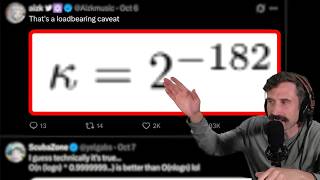
The Mathematics are Mad
The PrimeTime1,321,673 views as of 18 Oct
-

AI Keeps Pissing Off Mathematicians
ColdFusion1,019,362 views as of 17 Oct
-
OpenAI’s “Alien Math” Is Freaking People Out
Wes Roth786,535 views as of 17 Oct