A music video on how to optimize CUDA kernels, one-shot by Opus 5.5 (X video)
Elliot Arledge (@elliotarledge) · 2026-09-27 · ai-made · 522,074 views
Made by AI
Model: Claude Opus 5.5 · Series: Code-rendered film (LLM writes the program that draws every frame)
Evidence: X post (2026-09-27): 'claude opus 5.5 just one-shot a music video on how to optimize CUDA kernels'
Human role: Says Opus 5.5 "one-shot" it; prompt and audio source not published in the post.
Pipeline: One prompt → Opus 5.5 → 3:10 music video with a 3D GPU explaining CUDA kernel optimization (per claudevideo.org)
Lore: one-prompt, code-not-generated
What's in the video
Description written by Gemini, which watched and listened to the whole video.
Summary
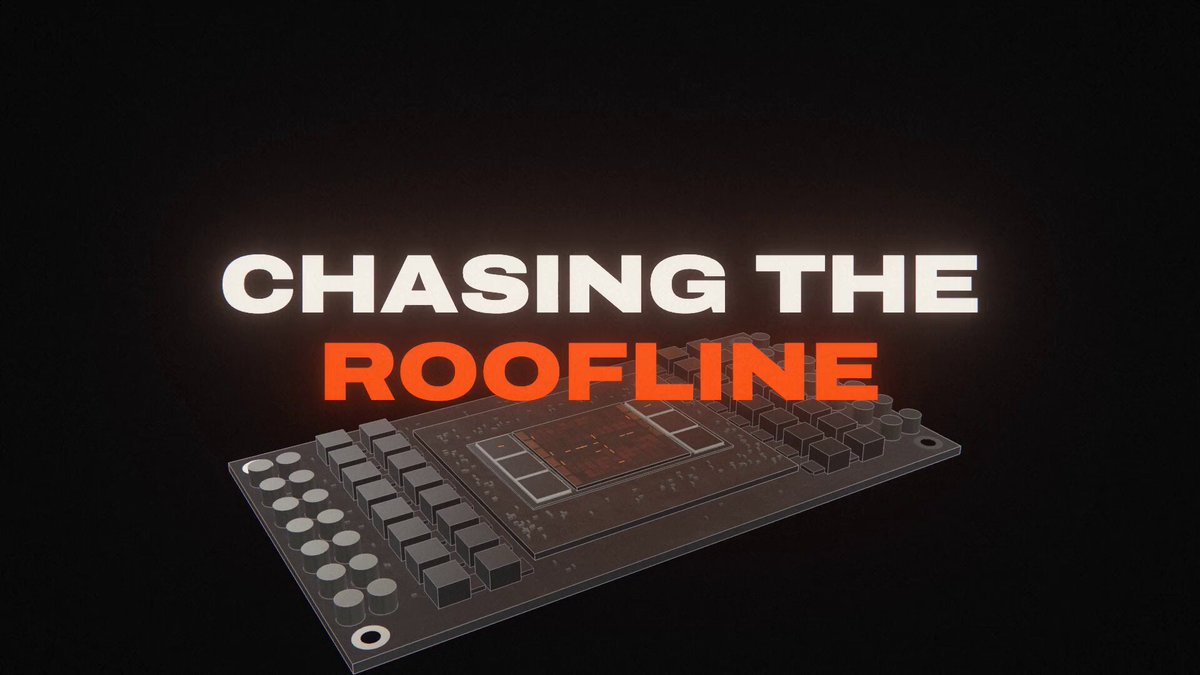
This video is a 3D animated musical explainer titled "Chasing the Roofline", written and produced by Elliot Arledge as a companion piece to the book CUDA for Deep Learning. Set to an upbeat pop track with AI-synthesized female vocals, the animation visually deconstructs GPU architecture, CUDA thread hierarchy, memory bottlenecks, and kernel optimization techniques against the classical Roofline model.
What is shown
- [00:00 - 00:29] Introduction contrasting CPU core architecture (few large cores) with GPU parallelism (thousands of small cores), illustrating 1D thread indexing (
i = block * size + thread/blockIdx.x * blockDim.x + threadIdx.x) and kernel launch syntax (kernel<<<blocks, threads>>>()). - [00:30 - 00:49] Visualization of the Roofline model overlaid on an RTX 3090 board, displaying memory bandwidth slope (936 GB/s limit) and compute ceiling (35.6 TFLOP/s limit), showing a naive kernel stuck at 0.01 of peak performance.
- [00:50 - 01:12] Breakdown of warp execution (32 threads executing SIMT instructions in lockstep) and warp divergence caused by conditional branching (
if (thread < 16)), followed by High Bandwidth Memory (HBM) latency stalls. - [01:13 - 01:30] Roofline progression showing 1D tiling raising performance to 0.26 of peak, still bounded under the memory slope.
- [01:31 - 01:55] Memory coalescing (single 128-byte wide memory transactions vs. up to 32 scattered trips) and shared memory tiling (loading 4×4 tiles to on-chip shared memory in ~30 cycles vs. hundreds of cycles in HBM), synchronizing with
__syncthreads()to increase arithmetic intensity (math-per-byte reuse). - [01:56 - 02:09] 2D tiling optimization pushing kernel performance to 0.70 of peak, crossing the ridge into the compute-bound regime.
- [02:10 - 02:38] Advanced optimization concepts: Tensor Cores executing $16 \times 16$ matrix multiply-accumulate operations in one instruction, FlashAttention tiling avoiding writing full $N \times N$ attention matrices to global memory, 4-bit quantization reducing data movement 8×, and distributed multi-GPU all-reduce across NVLink (900 GB/s per GPU).
- [02:39 - 03:09] Final Roofline climb reaching 0.78 of peak with vectorized loads, concluding with a chapter-by-chapter curriculum summary from CUDA for Deep Learning.
Claims & numbers
- An NVIDIA RTX 3090 has a memory speed limit of 936 GB/s and a compute ceiling of 35.6 TFLOP/s (presenter/graphic notes: Ch. 6).
- A warp consists of exactly 32 threads executing instructions in lockstep.
- The naive GEMM (General Matrix Multiply) kernel spends over 96% of its execution time stalled waiting on memory.
- Accessing shared memory takes approximately 30 cycles, compared to hundreds of cycles for HBM.
- Coalesced memory transactions can read 32 contiguous 4-byte values in a single 128-byte wide read.
- Tensor cores compute a $16 \times 16$ tile in a single instruction.
- An $8192 \times 8192 \times 4\text{ B}$ attention matrix consumes 268 MB if materialized to global memory, which FlashAttention avoids by streaming tiles through on-chip shared memory.
- Quantizing FP32 down to INT4 reduces memory transfer size by 8× (e.g., from 4 GB to 500 MB per billion parameters).
- NVLink bandwidth is listed at 900 GB/s per GPU in an 8-GPU server rack.
- Through progressive optimization (naive $\rightarrow$ 1D tiling $\rightarrow$ 2D tiling $\rightarrow$ vectorized loads), kernel efficiency improves from 0.01 to 0.26, 0.70, and finally 0.78 of hardware peak.
Notable quotes
- [00:30] "I'm chasing the roofline, memory's the slope and the math's the line."
- [00:57] "One little 'if' and the warp splits in two, half of them wait while the others go through."
- [02:10] "Tensor cores eat a matrix whole, sixteen by sixteen in a single go."
Assessment This is a stylized educational animated music video promoting concepts from the technical guide CUDA for Deep Learning. The technical parameters, CUDA architectural models, and Roofline formulations shown are accurate hardware and programming realities rather than simulated or exaggerated benchmarks.
Lyrics & themes The song explains GPU programming principles and kernel performance engineering step-by-step:
- Thread Hierarchy & Indexing [00:07 - 00:20]: Contrasting CPU and GPU thread scales and calculating global indices.
Line: "Block times size plus thread finds its spot" [00:17] - The Roofline Principle (Chorus) [00:30 - 00:44]: Balancing arithmetic intensity against bandwidth and compute ceilings.
Line: "Squeeze more math from every byte, till I'm hitting the ceiling tonight" [00:35] - Warp Divergence & Memory Bottlenecks [00:50 - 01:12]: Explaining SIMT execution penalties and latency stalls.
Line: "Same old code, but it's crawling slow, tell me, where'd all my speed go? Memory!" [01:05] - Shared Memory Tiling & Hardware Features [01:32 - 02:37]: Coalesced reads, reuse in shared memory, Tensor Cores, FlashAttention, and quantization.
Line: "Thirty-two bits down to four, and it's fine, eight times less to move down the line" [02:24]
Lore & references
- The Roofline Model: The central motif refers to the classic performance model (Williams, Waterman, Patterson, 2009) plotting floating-point performance against arithmetic intensity (FLOPs/byte).
- FlashAttention: References Tri Dao's algorithm that tiles softmax computation without materializing the quadratic attention matrix into HBM.
- GEMM & Tensor Cores: Direct nod to NVIDIA WMMA/MMA matrix instructions and high-performance BLAS optimization.
- CUDA Book Indexing: On-screen annotations link directly to textbook chapters (CH02 for thread layout, CH03 for warps, CH06 for tiling/shared memory, CH07 for Tensor Cores, CH08 for FlashAttention, CH09 for quantization, and CH10 for multi-GPU scaling).
Visual style & craft The visuals consist of custom programmatic/3D motion graphics (reminiscent of Blender/Three.js or Manim-style 3D computer graphics) featuring clean isometric hardware models, schematic circuit paths, illuminated voxel-like thread blocks, and dynamic HUD overlays. The audio is a generative pop production (likely created using an AI music system) with polished post-production timing, typography animations, and precise synchronization between visual diagrams and lyrical beats.
Described by gemini-3.8-flash on 2026-09-30 from the video's audio and frames.