Making sure AI chips don’t overheat in space
Google · 2026-09-30 · official · 92,839 views
What's in the video
Description written by Gemini, which watched and listened to the whole video.
Summary
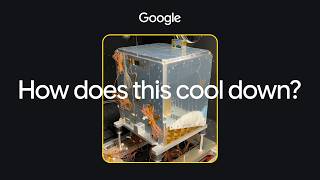
This video highlights Project Suncatcher, Google’s initiative to operate AI computing infrastructure in space powered by solar energy. Google thermal engineer Eddie Farias and Planet director of systems engineering Eric Stevens detail the thermal engineering challenges and solutions for cooling high-power Tensor Processing Units (TPUs) in a vacuum using heat pipes, pumped fluid loops, and radiative cooling panels.
What is shown
- [0:01] Eddie Farias introduces Project Suncatcher and the challenge of cooling AI chips in space.
- [0:15] Laboratory technicians assembling and preparing circuit boards and TPU modules with thermal interface materials.
- [0:25] Eric Stevens describes standard terrestrial cooling versus space environments.
- [0:37] Diagram illustrating radiative heat transfer emitting electromagnetic waves into space.
- [0:47] Close-ups of copper heat spreaders and custom satellite circuit board assemblies labeled "SUNCATCHER".
- [1:10] Graphic comparison contrasting radiator dissipation capacity against TPU heat flux.
- [1:31] Cleanroom technicians loading the integrated satellite payload assembly into a thermal vacuum chamber (TVAC) for space simulation testing.
- [1:47] Conceptual visualization of a satellite constellation in low Earth orbit.
- [2:01] Engineers inspecting and handling multi-chip TPU satellite payload boards in a facility.
Claims & numbers
- Project Suncatcher is Google's moonshot project aiming to put AI compute into orbit running off solar power (Eddie Farias).
- Terrestrial cooling methods relying on convective airflow over heat sinks are impossible in the vacuum of space (Eric Stevens).
- Radiator thermal dissipation in space is approximately ~300 W/m² (displayed on-screen).
- TPU heat dissipation density exceeds >100,000 W/m² (displayed on-screen).
- Individual TPU chip dimensions are approximately ~50 mm × 50 mm (displayed on-screen).
- Each TPU requires roughly ~1.3 m² of radiator area to dissipate its thermal load (displayed on-screen).
- Heat must be transported from the inner core of the spacecraft out to exterior radiators using technologies like heat pipes and pumped fluid loops (Eddie Farias).
- Hardware is validated on Earth inside a thermal vacuum chamber before launch to simulate orbit thermal and vacuum conditions (Eric Stevens).
Notable quotes
- [0:01] "Project Suncatcher is Google's moonshot to put AI compute into space, running off sunlight." — Eddie Farias
- [0:31] "Obviously, air doesn't exist in space, therefore we have to completely change how we cool electronics." — Eric Stevens
- [2:02] "It's an experimental moonshot, and important first step towards moving data centers off planet and into Earth's orbit." — Eric Stevens
Assessment
This is an authentic behind-the-scenes engineering explainer produced by Google in collaboration with Planet. The hardware handling and thermal vacuum chamber tests shown reflect genuine aerospace and hardware development work, accompanied by illustrative animations clarifying thermal flux scales and orbital deployment concepts.
Described by gemini-3.8-flash on 2026-10-06 from the video's audio and frames.