Clear mountain stream in Three.js: water, riverbed light and mossy rocks all in code (Opus 5.5, X video)
ハヤシモン (@hayashimon1) · 2026-09-23 · ai-made · 420,615 views
Made by AI
Model: Claude Opus 5.5 · Series: Agent-built game or 3D world (the video shows the result)
Evidence: X post (2026-09-23, Japanese): 'Opus5.5とThree.js 清流の表現がすごい。透明な水、川底の光、苔むした岩まで全部コード。' (translated: Opus 5.5 and Three.js — the clear stream is amazing; transparent water, light on the riverbed, even the mossy rocks are all code.)
Human role: Prompted; iteration not described.
Pipeline: Opus 5.5 → Three.js scene → 15-second capture
What's in the video
Description written by Gemini, which watched and listened to the whole video.
Summary
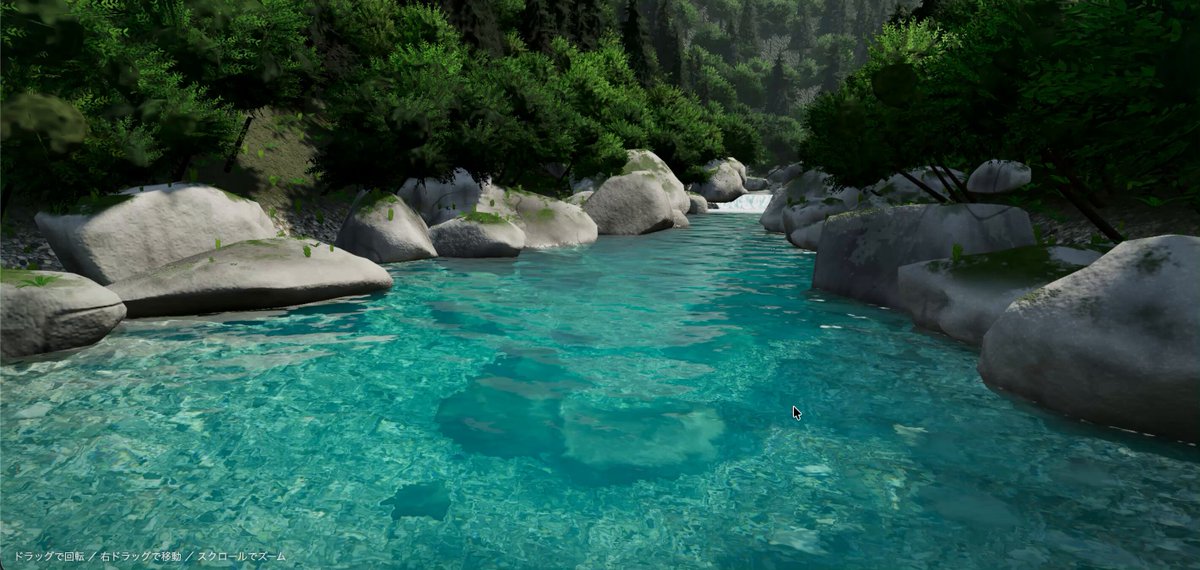
This video showcases an interactive 3D WebGL/Three.js scene of a pristine mountain stream, created via code generated by Claude Opus 5.5 and shared by creator ハヤシモン (@hayashimon1). The demo highlights real-time water rendering, underwater caustic reflections, and moss-covered rocks with full mouse navigation.
What is shown
- A real-time 3D rendering of a clear turquoise river surrounded by moss-covered stones and forested mountains [00:00].
- Japanese on-screen UI control guide at the lower left: "ドラッグで回転 / 右ドラッグで移動 / スクロールでズーム" (Drag to rotate / Right drag to move / Scroll to zoom) [00:00–00:14].
- A mouse cursor orbiting and pitching the camera upward to show an overhead vantage point, revealing caustic light patterns shimmering across the riverbed [00:06–00:09].
- The camera dropping back down near the water's surface, demonstrating water transparency, surface ripple distortion, and depth effects [00:10–00:14].
Claims & numbers
- None.
Notable quotes
- None (the video has no spoken dialogue).
Assessment
This is a genuine screen-recorded demo of an interactive browser-based 3D scene built in Three.js. The camera movement and visible cursor confirm real-time procedural rendering rather than a pre-rendered or AI-generated video file.
Lyrics & themes
- The video is completely non-vocal and contains no lyrics; it focuses purely on technical and aesthetic demonstration of procedural 3D environments.
Lore & references
- Claude Opus 5.5 coding capabilities: Highlights the trend in September 2026 where developers used Claude Opus 5.5 to author complex, end-to-end Three.js applications and custom WebGL shaders directly from natural language prompts.
- Procedural Shader Caustics: Reflects ongoing enthusiast benchmarks testing how well LLMs implement complex graphics mathematics, including animated water surfaces and light refraction on underwater terrain.
Visual style & craft
- Rendered in real-time WebGL using Three.js, featuring stylized photorealism with custom shaders for water refraction, caustic projections on riverbed rocks, and low-to-mid poly foliage.
- The scene is fully interactive and code-rendered, as evidenced by the live mouse-driven camera controls and the interactive helper text overlay.
Described by gemini-3.8-flash on 2026-10-05 from the video's audio and frames.