"Searching for God in India. For more than 5,000 years": 4-minute pencil-line animation made with Opus 5.5 (X video)
HindolSengupta (@HindolSengupta) · 2026-09-26 · ai-made · 275,152 views
Made by AI
Model: Claude Opus 5.5 · Series: Code-rendered film (LLM writes the program that draws every frame)
Evidence: X post (2026-09-26): 'Searching for God in India. For more than 5,000 years. In many names. In 4 minutes. / (Opus 5.5 is still incredible.)'
Human role: Creator credits Opus 5.5; process not described.
Pipeline: Opus 5.5 → animated history film (≈4 min 52 s)
What's in the video
Description written by Gemini, which watched and listened to the whole video.
Summary
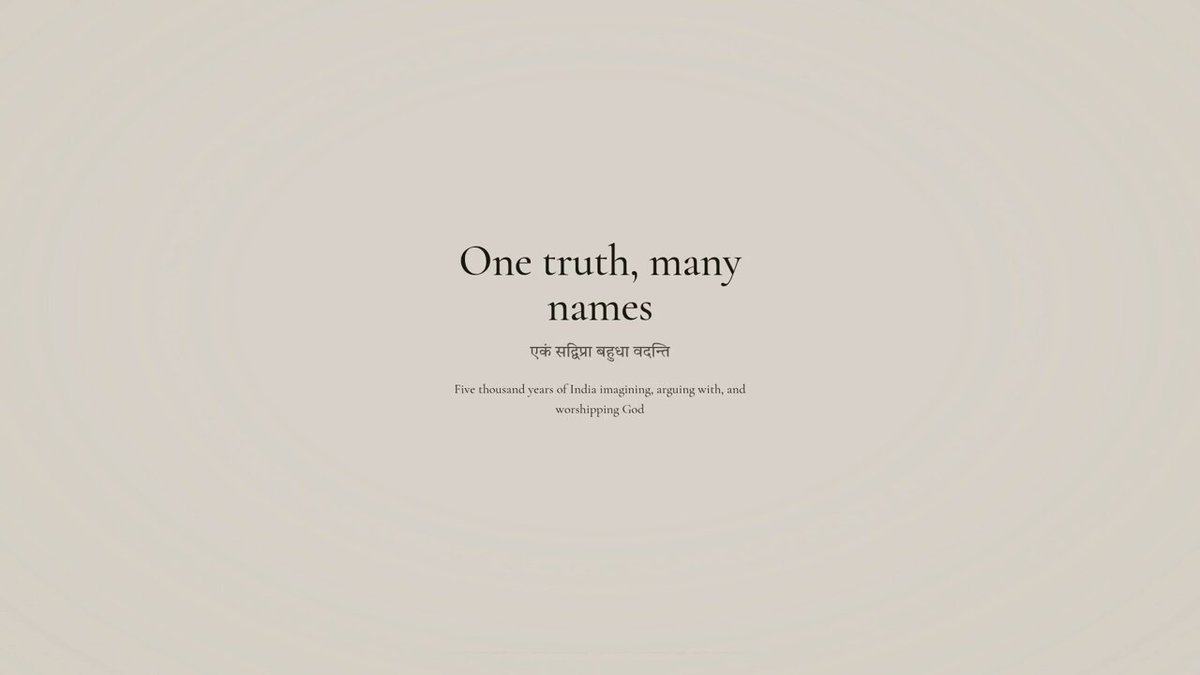
This video is an animated cultural and historical essay titled "One truth, many names" (एकं सद्विप्रा बहुधा वदन्ति), shared by author and commentator Hindol Sengupta (@HindolSengupta) and reportedly generated with Claude Opus 5.5. Across nearly five minutes of pencil-sketch line animations and voiceover narration, it traces five thousand years of philosophical, spiritual, and religious evolution in India from the Indus Valley Civilization to the modern era.
What is shown
- [00:00 - 00:19] Title card ("One truth, many names") introducing the central inquiry ("Who, or what, is God?"), accompanied by expanding concentric circles sketched in charcoal/pencil style.
- [00:20 - 00:43] c. 2600 BCE / The Indus cities: Line drawings of the Pashupati seal (horned seated figure surrounded by an elephant, tiger, rhino, and buffalo) and a clay mother goddess idol.
- [00:44 - 01:05] c. 1500 BCE / The Vedic fire: An animated Vedic sacrificial fire altar (yajna kunda) where ghee is ladled into flames, referencing Agni, Indra, Varuna, and the skeptical creation hymn (Nasadiya Sukta) of the Rigveda.
- [01:06 - 01:23] c. 800 BCE / The Upanishads: An illustration of the two birds in a single tree (Mundaka Upanishad allegory), representing the acting self and the witnessing Atman, concluding with Tat Tvam Asi.
- [01:24 - 01:39] c. 500 BCE / The renunciants: Sketch of the Buddhist dharmachakra (wheel of law) and Jain symbol, narrating the heterodox traditions of Gautama Buddha, Mahavira, and the materialist Charvakas.
- [01:40 - 01:59] c. 400 BCE to 400 CE / The epics: Minimalist sketch of Arjuna and Krishna with a chariot wheel on the battlefield of Kurukshetra, referencing Krishna's universal form (Vishvarupa) and devotion in the Bhagavad Gita.
- [02:00 - 02:16] c. 300 to 1200 CE / Puranas and temples: Formation of a traditional stone temple spire (shikhara), describing Vishnu's avatars, Shiva's cosmic dance (Nataraja), and the concept of darshan.
- [02:17 - 02:34] c. 500 to 1200 CE / The Goddess: A blossoming geometric lotus yantra representing Shakti, Durga, Kali, and Lalita in Tantric worship.
- [02:35 - 02:51] c. 600 to 1000 CE / The Tamil saints: Drawing of a traditional multi-tiered oil lamp (kuthuvilakku), recounting the passionate vernacular Bhakti poetry of the Alvars, Nayanmars, and Andal.
- [02:52 - 03:10] c. 800 to 1500 CE / The great teachers: Three palm-leaf manuscripts inscribed with Sanskrit lines, highlighting the philosophical debates of Shankara (Advaita), Ramanuja (Vishishtadvaita), Madhva (Dvaita), and Chaitanya Mahaprabhu (Achintya Bhedabheda).
- [03:11 - 03:32] c. 1400 to 1700 CE / The poet-saints: Illustrations of Kabir’s weaving loom and Meera’s tambura instrument, noting Tulsidas and Guru Nanak’s tradition of egalitarian community meals (langar).
- [03:33 - 03:47] Across the centuries / Many faiths, one land: Sketches depicting a mosque dome and minaret, a Zoroastrian fire urn, and a Christian church, acknowledging Kerala Christians, Cochin Jews, Parsis, and Sufi shrines.
- [03:48 - 04:07] Always / The village and the forest: Folk and tribal motifs—a sacred banyan tree tied with threads, vermilion stones, serpent, river, sun, and moon.
- [04:08 - 04:29] 1850 onwards / The modern seekers: Multiple paths ascending a mountain toward an illuminating radiant star, symbolizing Ramakrishna Paramahamsa, Swami Vivekananda, Rabindranath Tagore, Mahatma Gandhi, and B.R. Ambedkar.
- [04:30 - 04:51] Five thousand years / One truth, many names: Circles converging to reveal the Devanagari verse एकं सद्विप्रा बहुधा वदन्ति (Ekam sat, vipra bahudha vadanti), closing on the eternal Vedic maxim.
Claims & numbers
- The narrator claims the timeline of continuous spiritual inquiry spans five thousand years [00:06].
- Identifies the horned Indus seal figure as Pashupati, "lord of the beasts" and perhaps the earliest glimpse of Shiva [00:31].
- The narrator quotes the Bhagavad Gita (9.26): "Offer me a leaf, a flower, a fruit, a little water, with love, and I will accept it" [01:53].
- Cites the Rigvedic dictum (Rigveda 1.164.46): "Ekam sat, viprah bahudha vadanti" ("Truth is one; the wise call it by many names") [04:35].
Notable quotes
- [00:13] "Who, or what, is God? India never settled for a single answer. This is the story of all of them."
- [01:14] "Two birds on one tree. One eats the fruit. One simply watches. Not this. Not this. And then, the thunderclap: tat tvam asi. You are That!"
- [04:37] "Ekam sat, viprah bahudha vadanti. Truth is one. The wise call it by many names."
Assessment
This is a polished AI-assisted digital animation and spoken-word presentation created to summarize Indian philosophical history. The visuals feature continuous programmatic/line-drawing vector animations synchronized cleanly to an English narration and ambient musical score.
Lyrics & themes
The spoken narration systematically explores pluralism, non-dogmatism, and continuous questioning in Indian spiritual thought across 14 chronological eras:
- Wonder [00:05]: Introduction to the 5,000-year quest.
- The Indus cities [00:20]: Early iconography and mother goddesses.
- The Vedic fire [00:44]: Ritual fire sacrifices giving way to metaphysical skepticism in the Rigveda.
- The Upanishads [01:06]: Inward search for Brahman and Atman.
- The renunciants [01:24]: Heterodox revolts (Buddhism, Jainism, Charvaka atheism).
- The epics [01:40]: Personal devotion and Krishna's divine revelation in the Gita.
- Puranas and temples [02:00]: Deity worship, cosmic dance, and temple architecture.
- The Goddess [02:17]: Tantra, feminine divinity, and sacred geometry.
- The Tamil saints [02:35]: Vernacular, emotional Bhakti movements in South India.
- The great teachers [02:52]: Medieval philosophical debates across Vedanta schools.
- The poet-saints [03:11]: Socially radical Bhakti and Sikh egalitarianism.
- Many faiths, one land [03:33]: Pluralist coexistence of Islam, Christianity, Judaism, and Zoroastrianism.
- The village and the forest [03:48]: Enduring animist, tribal, and folk nature veneration.
- The modern seekers [04:08]: Modern reformist syntheses from Vivekananda to Ambedkar.
Lore & references
- Ekam Sat Vipra Bahudha Vadanti: Rigvedic verse (1.164.46) framing the entire project's thesis that divergent traditions reflect one underlying truth.
- Tat Tvam Asi ("Thou Art That"): The famous Mahavakya from the Chandogya Upanishad.
- Neti Neti ("Not this, not this"): Upanishadic apophatic theology mentioned at [01:18].
- Pashupati Seal: Artifact 420 from Mohenjo-daro referenced as proto-Shiva.
- World Parliament of Religions (Chicago 1893): Referenced when describing Swami Vivekananda [04:18].
Visual style & craft
- Aesthetic: Minimalist charcoal/pencil sketch line art drawn against a warm parchment/canvas background.
- Transitions: Continuous stroke generation where geometric elements smoothly morph and fade into succeeding symbols (e.g., circles transforming into a seal, chariot wheel, yantra, and mountain paths).
- Execution: Consistent line weights with simulated hand-jitter and sketch effects, typical of prompt-driven generative vector/SVG code workflows or AI animation pipelines orchestrated via Claude Opus 5.5.
Described by gemini-3.8-flash on 2026-10-05 from the video's audio and frames.