An interactive Raptor 3 rocket engine you can take apart, built by Opus 5.5 (X video)
Konstantin Saifoulline (@konstantinsaifo) · 2026-09-27 · ai-made · 1,062,381 views
Made by AI
Model: Claude Opus 5.5 · Series: Agent-built game or 3D world (the video shows the result)
Evidence: X post (2026-09-27): 'I asked Claude Opus 5.5 to explain how a rocket engine works by building an interactive Raptor 3 you can take apart in your browser. / / Cut it open, follow the oxygen and the methane through both turbopumps, then throttle it and watch the shock diamonds move.'
Human role: Asked Opus 5.5 to explain how a rocket engine works by building an interactive Raptor 3; published the live page.
Pipeline: Prompt → Opus 5.5 builds an interactive 3D cut-away engine (turbopumps, propellant flow, throttle and shock diamonds) → 35-second screen capture
What's in the video
Description written by Gemini, which watched and listened to the whole video.
Summary
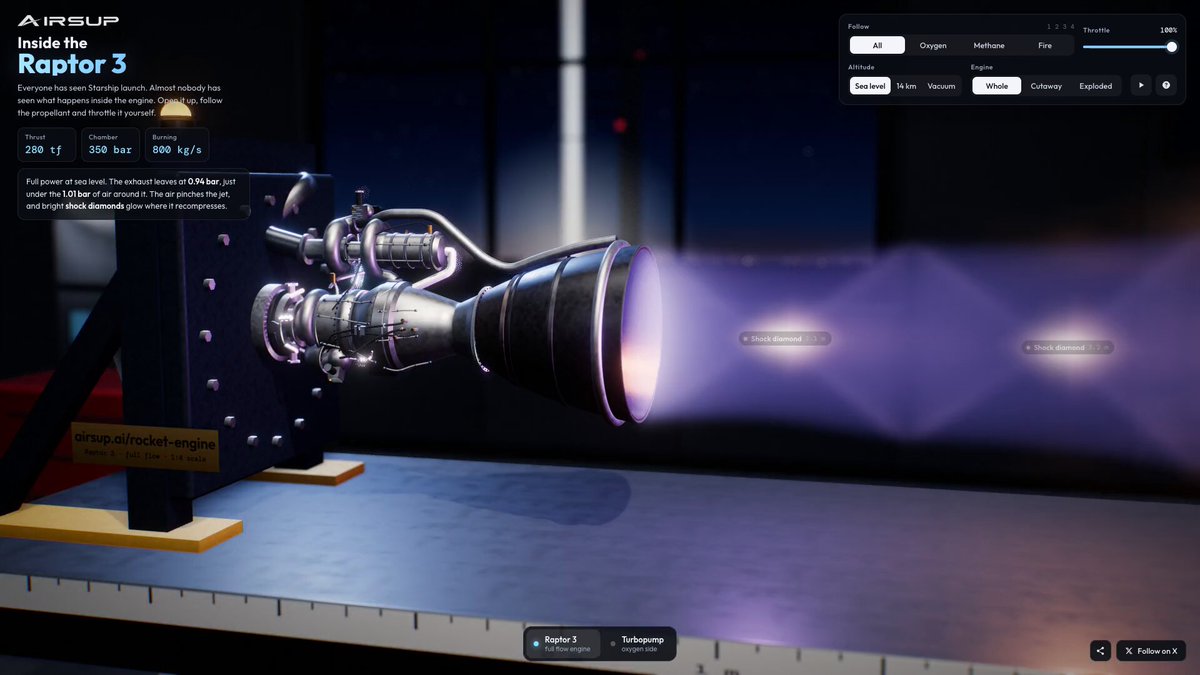
The video presents a screen demonstration of Inside the Raptor 3, an interactive 3D web application developed by Konstantin Saifoulline (@konstantinsaifo) reportedly using Claude Opus 5.5. The tool allows users to explore SpaceX's Raptor 3 full-flow staged combustion engine on a test stand, toggle cutaway and exploded views, trace propellant flow paths, manipulate altitude and throttle levels, and inspect turbopump assemblies.
What is shown
- 00:00–00:04: The default view of the Raptor 3 firing on a horizontal test stand at sea level (100% throttle), displaying realistic Mach shock diamonds in the exhaust plume, real-time readouts (Thrust: 280 tf, Chamber: 350 bar, Burning: 800 kg/s), and UI controls at
airsup.ai/rocket-engine. - 00:05–00:07: Enabling Cutaway view, revealing the internal structure including the oxygen and methane turbopumps, preburners, sparkers, main combustion chamber, throat, and regenerative cooling channels.
- 00:08–00:17: Toggling the propellant flow visualizer through Oxygen (cyan flow path), Methane (orange flow through the nozzle cooling channels and methane preburner), and Fire (hot gas interaction in the 3,300 °C combustion chamber through Mach 1 throat to Mach 4 nozzle exit).
- 00:18–00:23: Throttling the engine down from 100% to 87% (244 tf, 305 bar) and 44% (123 tf, 153 bar), showing dynamic plume adjustment and shock diamond movement.
- 00:24–00:26: Switching altitude settings from Sea level to 14 km and Vacuum, demonstrating under-expanded exhaust plume widening in near-vacuum.
- 00:27–00:29: Triggering the Exploded view to show detached components (turbopumps, injector manifold, chamber, nozzle) aligned along the thrust axis.
- 00:30–00:34: Navigating to the dedicated Turbopump tab (One shaft, two jobs), showing an animated cutaway of the oxygen turbopump displaying the turbine, central shaft, bearings, impeller, and inducer under 42 MW / 780 bar pump output conditions.
Claims & numbers
- Thrust: 280 tf at full sea-level power; throttles down to 123 tf at 44% throttle.
- Chamber Pressure: 350 bar at 100% throttle; 305 bar at 87%; 153 bar at 44%.
- Propellant Mass Flow: 800 kg/s burn rate at full throttle; 374 kg/s at 44% throttle.
- Combustion & Gas Dynamics: Chamber temperature reaches ~3,300 °C; gas chokes at the throat at Mach 1 and expands to Mach 4 at the nozzle exit; sea level exhaust exits at 0.96 bar.
- Propellant Temperatures: Liquid oxygen enters at -175 °C.
- Oxygen Turbopump: 620 kg/s oxygen mass flow, 780 bar pump discharge pressure, requiring 42 MW of turbine power.
Notable quotes
- "Full power at sea level. The exhaust leaves at 0.96 bar just under the 1.01bar of air around it. The air pushes the jet, and bright shock diamonds glow where it recompresses." [00:01]
- "Raptor 3 runs a full flow cycle. Every kilogram of propellant passes through a turbine before it burns, so no 'oxygen dump' anywhere. The result: nothing is dumped overboard." [00:06]
- "Both hot gases meet in the chamber at about 3,300 °C and 350 bar. The narrow throat chokes the flow and sends Mach 1 hot gas into the nozzle, accelerating it to about Mach 4." [00:15]
Assessment
This is a genuine interactive technical demonstration of a WebGL/Three.js 3D web application created with the assistance of Claude Opus 5.5. The user interface, controls, physical parameter adjustments, and cutaway animations function seamlessly in real time without apparent video trickery or deceptive editing.
AI-Made Content Details
Lyrics & themes
The video contains no lyrical singing or spoken narration; it is entirely visual/silent screencast footage of the interactive software. The thematic focus is aerospace education, detailing the fluid dynamics, thermodynamics, and mechanical engineering of SpaceX's full-flow staged combustion cycle (FFSCC).
Lore & references
- Full-Flow Staged Combustion Cycle (FFSCC): References the rare rocket engine architecture where all propellants pass through turbine stages as gaseous flows before entering the primary combustion chamber, eliminating fuel waste compared to open gas-generator cycles.
- Raptor 3: Highlights SpaceX's radically simplified Raptor version with internal cooling and integrated propellant conduits, doing away with the exterior plumbing spaghetti typical of Raptor 1 and 2.
- Shock Diamonds: Emphasizes the fluid phenomenon of over-expanded jet exhaust matching atmospheric backpressure.
Visual style & craft
The visuals consist of real-time 3D models rendered via WebGL inside a browser environment. Components feature clean metallic textures, animated particle/gas streams for methane, oxygen, and combusted flame, responsive lighting, and smooth camera rotations. The layout follows modern scientific dashboard aesthetics with interactive HUD overlays, interactive sliders, and explanatory callouts.
Described by gemini-3.8-flash on 2026-09-30 from the video's audio and frames.