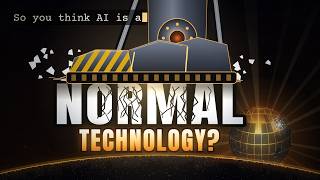
AI is a normal technology? (animated music video by Opus 5.5)
leo · 2026-09-24 · ai-made · 1,105,632 views
Views: YouTube 46k · X 1.1M (repost by Severin Field (@sevdeawesome), 2026-09-29: 'Claude 5.5 Opus responding to AI is a normal technology is still the best AI-created video I have ever seen')
Made by AI
Model: Claude Opus 5.5, Suno · Series: Claude Pop
Evidence: YouTube description (2026-09-24): 'Cute little animated music video by Opus 5.5 with some help from suno.'
Human role: Creator prompted Opus 5.5; Suno used for the music. Exact split of work not described.
Pipeline: Opus 5.5 (lyrics + animation code) → Suno (music) → 5:16 music video
What's in the video
Description written by Gemini, which watched and listened to the whole video.
Summary
This animated music video, titled “AI is a normal technology? (animated music video by Opus 5.5)” and uploaded by channel “leo,” presents a satirical, operatic musical debate between mainstream economic skepticism and the thesis of recursive AI acceleration. It contrasts orthodox economic views—which model AI as a slow-diffusing general-purpose technology like electricity or spreadsheets—against the concept of self-improving compute, automated research swarms, and physical robotics creating an exponential growth loop.
What is shown
- [00:00 - 00:21] Introduction: Spoken-word prologue over a dark planetary horizon illustrating classic economic diffusion concepts (“Slow diffusion,” “Adoption lag,” “Complementary investment”) alongside icons of electricity, spreadsheets, and fax machines.
- [00:35 - 01:25] Verse 1 (“Seminar: AI Is a Normal Technology”): Animated slides mocking orthodox economic modeling, showing Daron Acemoglu’s total factor productivity (TFP) projection, the Solow computer paradox, regulatory and infrastructural friction (permits, grid upgrades, FDA Phase III trials, Baumol’s cost disease), and the singularity getting rescheduled from 2026 to 2029.
- [01:26 - 01:52] Chorus 1 (“Thus Spoke Compute!”): A cosmic golden sphere covered in orbital panels emerges, accompanied by animations of robots assembling robots, parallel synthetic minds, and tractors manufacturing fleets.
- [01:53 - 02:44] Verse 2 (“The Skeptics’ Corner”): Caricatures and direct critiques of prominent AI skeptics and alternative theorists:
- Gary Marcus’s repeating “hitting a wall” claims contrasted with IMO gold medals and strawberry letter-counting riddles.
- Yann LeCun’s criticism of autoregressive LLMs, promotion of world models, and comparison of AI to house cats.
- Ed Zitron’s podcast commentary on the AI capex bubble, countered with an analogy to historical railroad booms.
- [02:45 - 03:10] Chorus 2: Re-iteration of the recursive acceleration motif with hyperbolic curves shattering bottleneck boundaries.
- [03:11 - 04:18] Bridge & Science Acceleration: The Millennium Prize Problems (Poincaré, Riemann hypothesis, Navier-Stokes, P vs NP, etc.), Hilbert’s epitaph (“Wir müssen wissen, wir werden wissen”), swarms of 10,000 theorem-proving agents writing verified proofs in Lean, Shenzhen’s rapid rise, robotic manufacturing cycles, Solow’s capital accumulation curve transitioning into endogenous cognitive learning, and a reference to Nietzsche’s Thus Spoke Zarathustra.
- [04:19 - 04:50] Final Chorus: Climax with compounding acceleration past “Reviewer 2’s” protests.
- [04:51 - 05:18] Outro: Spoken narrator delivers the punchline (“Cute.”) as a complete Dyson-like sphere of computing infrastructure wraps the planet.
Claims & numbers
- The narrator/song states Daron Acemoglu estimated a 0.7% total factor productivity (TFP) increase over 10 years [00:50].
- The video states rewiring every floor in a factory for electric dynamos originally took 40 years (1880–1924) [00:39].
- The song states that the Clay Mathematics Institute offered $1,000,000 for each of the seven Millennium Prize Problems, and a quarter-century later, six remain officially unsolved [03:25].
- The song claims swarms of 10,000 AI agents can be deployed to autonomously write kernel-verified formal proofs in Lean [03:34, 03:48].
- The narrator states that Gary Marcus has claimed AI hit a wall repeatedly from 2022 to 2026 [01:59] and posts "ten times an hour" on Substack [02:07].
Notable quotes
- [01:23] “What’s your forecast when the hammer starts to build the hand?”
- [01:29] “Robots building robots, from the ore to the suit / A million minds in parallel that never need to sleep.”
- [04:13] “Zarathustra called man a rope, and you’re out here pricing rope.”
Assessment
This is a creative, community-produced satirical AI music video created using LLM scripting/composition and automated motion graphics. While its rhetorical arguments and named critiques are delivered with dramatic humor and high production value, the projections of complete industrial automation and automated solutions to unsolved Millennium problems represent philosophical accelerationist arguments rather than verified technological facts.
Lyrics & themes
The piece follows a classical operatic debate structure across four main movements:
- The Orthodox Skeptic View [00:35]: Highlights standard growth-accounting economics, citing historical adoption delays, bottlenecks, red tape, and the Cobb-Douglas production model (“Only easy tasks get touched, the rest are way too hard to learn / So the model keeps it modest and the model gets its turn” [00:54]).
- Recursive Intelligence / The Chorus [01:26]: The counterargument that AI is capital capable of cognitive labor and self-replication (“Your bottleneck’s a speed bump on a hyperbolic route / Your constraint’s a footnote and the footnote’s out of date” [01:42]).
- The Skeptic Personalities [01:53]: Roasts specific real-world commentators on AI limits, autoregression, and financial bubble risks (“Autoregressive’s doomed, he says, while the doomed one hauls the load” [02:15]).
- Frontier Problem-Solving [03:11]: Focuses on automated scientific discovery and Lean verification overtaking human academic bureaucracy (“They’re writing proofs in Lean so the referee can’t kid” [03:47]).
Lore & references
- “Thus Spoke Compute!” / Nietzsche: Direct parody of Friedrich Nietzsche's Also sprach Zarathustra and Richard Strauss’s fanfare. Nietzsche’s famous quote (“Man is a rope tied between beast and overman”) appears at [04:13], satirizing economists measuring transformative tech through mundane consumer prices ($4.99/ft).
- Daron Acemoglu: MIT economist and Nobel laureate known for conservative macroeconomic forecasts of AI's near-term productivity growth.
- Robert Solow / Solow Paradox: “You can see the computer age everywhere but in the productivity statistics” (1987).
- Gary Marcus & Strawberry Riddle: Reference to AI critic Gary Marcus, his frequent Substack critiques, and early LLM tokenization failures when counting letters in words like “strawberry.”
- Yann LeCun & Autoregressive Debate: Meta Chief AI Scientist’s repeated claims that LLMs are not true AGI, pointing toward Joint Embedding Predictive Architectures (JEPA) and noting a house cat has more commonsense understanding of the world.
- Ed Zitron: Host of Better Offline, well known for predicting that high AI capital expenditure without consumer revenue will precipitate a market collapse.
- Lean Formalization: Microsoft Research's Lean interactive theorem prover, commonly used by modern AI labs to autonomously check mathematical theorems.
Visual style & craft
- Visual aesthetic: Minimalist 2D vector chalk-line and glowing neon motion graphics against dark slate and cosmic backgrounds, resembling high-end explainer animations.
- Typography & UI: Dynamic animated kinetic typography with highlighted keywords synchronized precisely to the vocal cadence. Visual assets mimic terminal code editors (Lean 4), scientific slides, chalkboard graphs, and schematic blueprints.
- Craft execution: Likely generated via automated or agent-assisted rendering workflows (associated with Claude Opus 5.5 multimodal scripts/tools) layered with programmatic SVG/motion design templates and AI-generated multi-part choral vocals (e.g., Suno/Udio-style composition).
Described by gemini-3.8-flash on 2026-10-05 from the video's audio and frames.