Zoom from a data center into an Nvidia Blackwell GPU die, down to a silicon atom: single-HTML 3D motion graphic by Opus 5.5
루샨 lucian (@lucian__03) X 338,666 views as of 22 November 2026
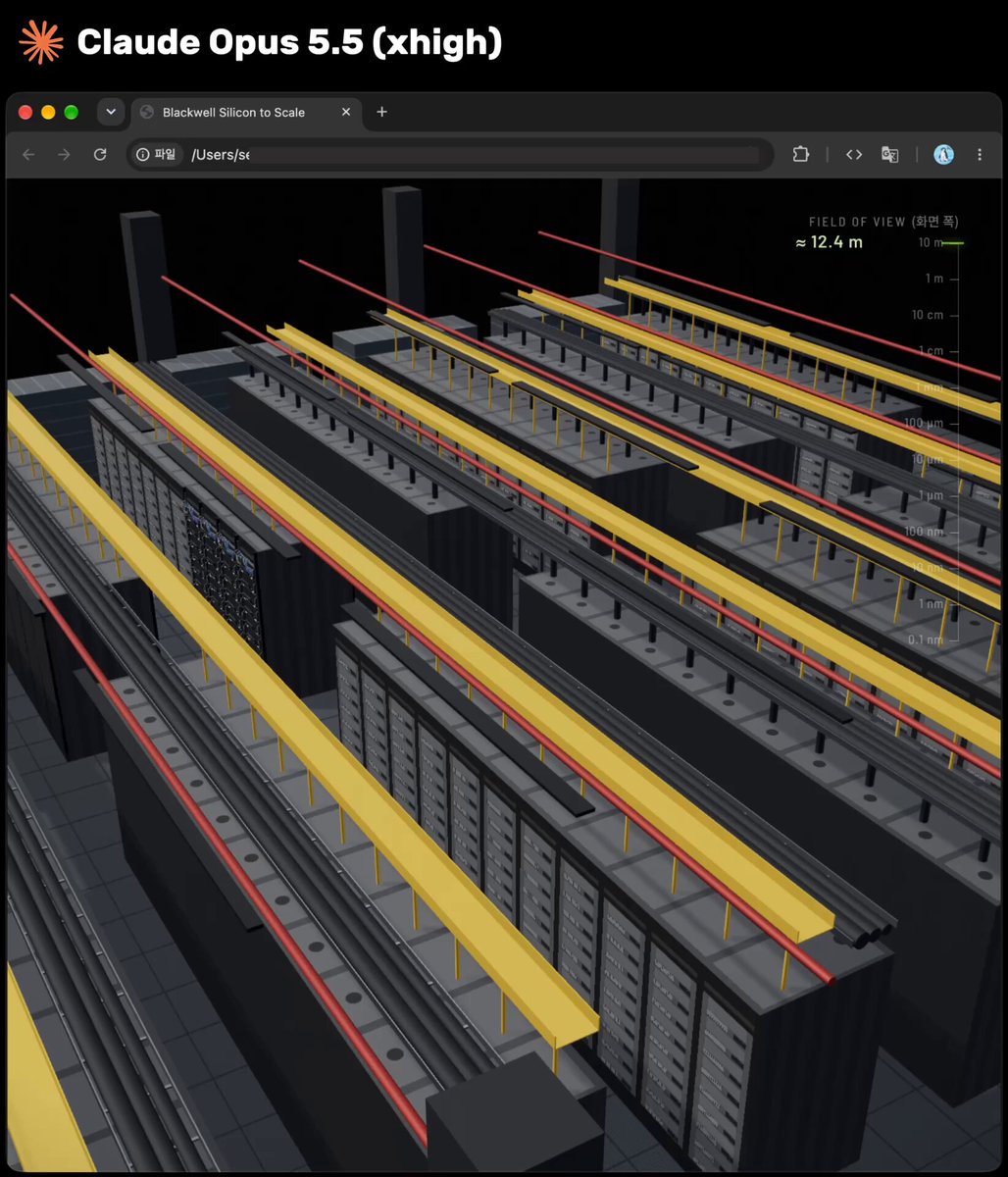
Why it is here
~331k views; a scale-zoom explainer built in one browser file. Found by checking the community catalogs (claudevideo.org, athemeroy/awesome-claude-5-5-videos) against the dataset on 2026-10-05.
Description
Description written by Gemini from the videoGemini 3.8 Flash, 5 October 2026
Summary
This video showcases a 3D procedural motion graphic generated in a single HTML file by Anthropic’s Claude Opus 5.5 (prompted at reasoning level xhigh). Shared by Korean creator 루샨 lucian (@lucian__03), the interactive WebGL/Three.js application smoothly zooms over 10 orders of magnitude from an entire AI data center room into an Nvidia Blackwell-era GPU, descending layer by layer down to individual silicon atoms in a transistor channel before zooming back out.
What is shown
- [00:00 - 00:02] Macro scale (Data center to server rack): An overhead perspective of a server hall with yellow overhead cable trays and rack rows (FOV ~8.97 m to 1.11 m), sliding out a conceptual generic server tray.
- [00:02 - 00:05] Board & Package level: Close-up of a dual-fan graphics card enclosure (FOV ~47.2 cm) opening up to expose the heat-spreader, GPU package die, GDDR7 memory modules, and substrate (FOV ~10.6 cm).
- [00:06 - 00:10] Silicon Die & Logical Blocks: The macroscopic floorplan of the die showing labeled L2 Cache (128 MB), GPCs, and individual Streaming Multiprocessors (SMs) containing 128 CUDA cores, 4 Tensor cores, and 1 RT core (FOV ~2.18 cm down to 1.43 mm).
- [00:11 - 00:16] Sub-block & Register File: Zooming into a single processing block showing warp schedulers, 64 KB register files, wordline decoders, and sense amplifiers (FOV ~304 µm down to 25.5 µm).
- [00:17 - 00:20] SRAM Memory Cell (6T): Close 3D view of a static RAM cell consisting of six transistors (cross-coupled inverters, pull-up, pull-down, access transistors) with illuminated yellow pulse lines demonstrating bitline/wordline readout (FOV ~551 nm).
- [00:21 - 00:25] Inside a CUDA core & Electron Microscope View: Functional layout of an FMA/ALU pipeline (INT32 unit, multiplier array, adder, alignment shifter) transitioning into a photorealistic simulated SEM view of polished transistor arrays (FOV ~53.8 µm down to 28.7 µm).
- [00:26 - 00:31] Transistor logic & FinFET architecture: Zooming into a full-adder logic tile (XOR cells), isolating a single FinFET gate wrapping around the silicon fin channel between source and drain (FOV ~1.55 µm down to 72.8 nm).
- [00:32 - 00:39] Atomic scale: The atomic lattice view highlighting the high-$k$ gate dielectric ($\text{HfO}_2$), $\text{TiN}$ gate metal, and individual silicon atoms with green glowing flowing conduction electrons spaced 0.235 nm apart at $1.96\text{ nm}$ field of view (labeled “6.3 Billion Times Closer”).
- [00:40 - 00:48] Reverse zoom: A continuous camera fly-out retracing from the atomic lattice all the way back to the data center hall view (FOV 12.4 m).
Claims & numbers
- Zoom scale: Zooms from a 12.4-meter wide data center hall down to a 1.96-nanometer view of silicon atoms—an increase of approximately 6.3 billion times closer.
- Hardware specifications displayed in the graphic:
- Full chip transistor budget: “90+ Billion Transistors”.
- L2 Cache: 128 MB between GPC banks.
- Logical block layout: 188 SMs (based on RTX Pro 6000 spec table).
- Per Streaming Multiprocessor: 128 CUDA cores, 4 Tensor cores, 1 RT core (total 24,576 CUDA cores on full chip).
- Processing sub-block: 32 CUDA cores, 64 KB register file ($16,384 \times 32\text{-bit}$).
- SRAM cell: 6 transistors (2 pull-up, 2 pull-down, 2 access).
- Silicon atomic lattice spacing: $0.235\text{ nm}$ between adjacent bonded silicon atoms.
Notable quotes
- [00:00] “BLACKWELL: FROM THE DATA CENTER DOWN TO A SINGLE ATOM” (on-screen title).
- [00:21] “ONE CUDA CORE: 1 OF 128 PER SM · 24,576 ON THE FULL CHIP · THE VIEW IS ABOUT A HAIR’S WIDTH” (on-screen caption).
- [00:38] “6.3 BILLION TIMES CLOSER: THE VIEW IS NOW 1.96 NM WIDE — THE OPENING SHOT OF THE HALL WAS 12.4 M — THE ZOOM ENDS HERE” (on-screen caption).
Assessment
This is a screen recording of an interactive, code-rendered 3D visualization running locally from a browser (file:///Users/...), generated as a standalone WebGL script by Claude Opus 5.5. The visual transitions and scientific labeling are smoothly integrated and accurate to architectural schematics, serving as an educational motion graphic demonstration of LLM frontend and 3D rendering capabilities.
Lyrics & themes
- Audio/Narration: The video is purely visual (silent / ambient), with no vocal song lyrics or spoken voiceover.
- Themes: The visualization explores spatial scale, computer architecture hierarchy, and physical limits of silicon semiconductor engineering—linking warehouse-scale AI computing infrastructure to atomic quantum mechanics.
Lore & references
- Blackwell / RTX Pro 6000: Directly references Nvidia’s Blackwell GPU architecture, mapping out real component structures like GPCs, SMs, Tensor cores, and high-$k$ metal gates ($\text{HfO}_2$/$\text{TiN}$).
- “Claude Opus 5.5 (xhigh)”: Highlighted in the top browser tab/header, demonstrating the model’s high-effort reasoning capacity to generate complex, multi-thousand-line single-page procedural Three.js/WebGL applications without external assets.
Visual style & craft
- Rendering & Pipeline: Rendered entirely inside a standard web browser viewport using WebGL/Three.js primitives, shaders, dynamic LOD (Level of Detail), and a logarithmic camera zoom controller.
- Graphic Elements: Minimalist technical HUD styling with a real-time field-of-view (FOV) logarithmic scale bar on the right edge, dual English/Korean explanatory subtitles at the bottom, and bounding wireframe highlights pointing to active components.
Described by gemini-3.8-flash on 2026-10-05 from the video’s audio and frames.
How AI was used to make it
AI made all of it of this video: visuals from ai-written code, subject built by ai.
- Claude Opus 5.5 generated a standalone HTML file with WebGL/Three.js code executing a multi-scale procedural 3D zoom
Tools named: Claude Opus 5.5
Classified by gemini-3.8-flash from our description of the video (high confidence), 25 October 2026. How AI is used to make videos, across the whole log
Made by AI
- Made with
- Claude Opus 5.5
- How we know
- X post (2026-09-25): ‘클로드 Opus 5.5와 영상에 있는 모션 그래픽 만들어봤는데요!! / 어제부터 틈틈이.. Claude Opus 5.5와 총 1시간 정도 작업한 결과입니다. / --> 엔비디아 블랙웰 GPU를 소재로 이런 3D 애니메이션을 만들어봤습니다. / 데이터센터 안으로 들어가고, 서버를 열고, 그래픽카드를 분해하고, 칩 안으로 계속 들어가는 등.. Opus 5.5가 넘 알잘딱하게 만들어줬습니다. / 엔비디아 블랙웰 통짜(?)에서 주변 부품 뜯고, 회로를 지나고, 트랜지스터를 지나서… 마지막엔 실리콘 원자 하나까지.. / 그리고 이거.. / --> 단일 브라우저(HTML)에서 돌아가는 3D 모션 그래픽입니다 ㅋㅋㅋ / 클로드랑 약 1시간 작업해서 이런 단일 HTML를 만들 수 있다는 게 아직도 좀 신기하네요. / 이번 Opus 5.5 진짜 미쳤습니다.’
- Human role
- About one hour of back-and-forth with Opus 5.5 per the creator.
- Pipeline
- Opus 5.5 → single HTML file with 3D motion graphics → screen capture
- Series
- Code-rendered film (LLM writes the program that draws every frame)
Related
More videos on this
-

“Gave Opus 5.5 donald’s prompt, Midjourney, and a moodboard. 12 hours later, woke up to this”
anabology (@anabology)20,389,459 views as of 15 Nov
-
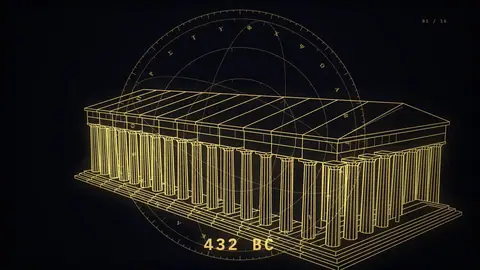
Western civilization in 2 minutes 16 seconds
vittorio (@IterIntellectus)“i asked claude to make a video on western civiization”15,294,523 views as of 22 Nov
-
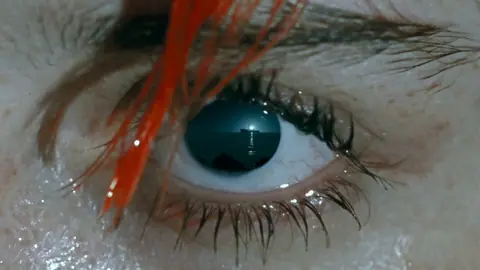
“The Clodyssey”
anabology (@anabology)Claude, another 12 hours12,576,393 views as of 27 Oct
-

Fallout: New York, a full browser Fallout game built with Opus 5.5, zero asset files
CHRIS FIRST (@chrisfirst)3,649,272 views as of 26 Oct