I Tested Sonnet 5.5 vs Opus 5.5. What You Need to Know.
Nate Herk | AI Automation YouTube 160,534 views as of 27 October 2026
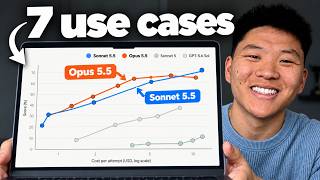
Why it is here
Nate Herk compares Sonnet 5.5 with Opus 5.5 after the Sonnet 5.5 release.
Verified 2026-09-29 from the YouTube watch page (title, channel, publish date 2026-09-28, length 25:48).
Description
Description written by Gemini from the videoGemini 3.8 Flash, 29 September 2026
Summary
Nate Herk from AI Automation Society (AIS) benchmarks Anthropic’s Claude Sonnet 5.5 against Claude Opus 5.5 across seven real-world workflow tasks. He compares both models on execution time, input/output token usage, API cost, and aesthetic/functional output quality. Ultimately, Sonnet 5.5 wins 4 to 3 based largely on cost-efficiency for structured tasks, while Opus 5.5 excels in open-ended creative tasks.
What is shown
- 00:41 — Pricing comparison table between Claude Sonnet 5.5 ($2 input / $10 output per million tokens) and Claude Opus 5.5 ($4 input / $20 output per million tokens).
- 02:07 — Test 1 (Perkform landing page): Web development comparison evaluated in a browser; Sonnet generates a 3D-styled render ($6.78, 28m 1s) while Opus uses real brand assets ($13.71, 52m 49s). Sonnet awarded win on value.
- 07:13 — Test 2 (Glaido motion showreel): Both models script and render a motion design promo video. Opus 5.5 wins for typography, pacing, and sound design ($20.55 vs. $14.37).
- 09:57 — Test 3 (90-day growth roadmap for “How They AI”): Vague prompt outputting an interactive plan; Opus 5.5 wins for clear visualization and actionable phases ($9.25 vs. $4.77).
- 14:15 — Test 4 (Brightpath investor pitch deck and Excel model): Generating 18-slide pitch decks and multi-tab financial models with live Excel formulas. Opus 5.5 wins, being both faster and cheaper ($8.91, 28m 57s vs. $9.27, 30m 29s).
- 17:43 — Test 5 (Local AI hardware explainer HTML): Both build a hardware requirement guide. Sonnet 5.5 wins due to visual quality and cost ($1.58 vs. $3.16).
- 20:24 — Test 6 (AI News Radar interactive dashboard): Scraping and categorizing news feeds into an interactive UI. Sonnet 5.5 wins on value ($2.32 vs. $8.23).
- 23:16 — Test 7 (YouTube video resource guide): Building structured guides from a video transcript. Sonnet 5.5 wins with comparable quality at half the price ($1.47 vs. $2.87).
- 25:01 — Final cumulative scorecard across all 7 sessions comparing total active runtime, token counts, and API costs.
Claims & numbers
- Anthropic states Claude Sonnet 5.5 runs 30%+ faster and costs up to 30% less than Claude Sonnet 5.
- Pricing stated: Sonnet 5.5 is $2.00 / M input tokens, $10.00 / M output tokens, $2.50 5-min cache write, $4.00 1-hour cache write, and $0.20 cache read; Opus 5.5 is $4.00 / M input, $20.00 / M output, $5.00 5-min cache write, $8.00 1-hour cache write, and $0.20 cache read.
- Total cumulative test results across all 7 tasks:
- Claude Opus 5.5: 3 hours 10 minutes active time; 160,719,971 input tokens; 794,098 output tokens; $66.67 API cost.
- Claude Sonnet 5.5: 2 hours 34 minutes active time; 122,095,204 input tokens; 809,080 output tokens; $40.56 API cost.
- Across the 7 tests, Sonnet 5.5 won 4 categories (Landing Page, Hardware Explainer, News Dashboard, Resource Guide) and Opus 5.5 won 3 categories (Motion Showreel, Growth Roadmap, Pitch Deck & Excel Model).
Notable quotes
- 00:49 — “How much does Sonnet 5.5 actually cost versus Opus 5.5? The answer is roughly half.”
- 01:40 — “If you have a task with an objective definition of done, use Sonnet. If you need some more creativity and you’re looking for a thought partner to help you decide what the definition of done is, use Opus.”
- 22:21 — “If you know exactly what you want, Sonnet is probably going to be able to do a good job for you, but if you need the creativity and you send an open-ended, very vague goal, Opus is just going to handle it better.”
Assessment
An authentic hands-on benchmark and comparative review by an independent practitioner running real agentic coding and automation workflows in parallel. The evaluation metrics (tokens, execution time, and exact API costs) are transparently tracked, though qualitative scoring between outputs relies on the presenter’s personal assessment of aesthetic and functional value.
Described by gemini-3.8-flash on 2026-09-29 from the video’s audio and frames.
How AI was used to make it
AI made a small part of this video: subject built by ai.
- Claude Sonnet 5.5 and Claude Opus 5.5 build landing pages, motion showreels, and dashboards shown in benchmark tests
Tools named: Claude Sonnet 5.5, Claude Opus 5.5
Classified by gemini-3.8-flash from our description of the video (high confidence), 25 October 2026. How AI is used to make videos, across the whole log
Related
More videos on this
-

“Gave Opus 5.5 donald’s prompt, Midjourney, and a moodboard. 12 hours later, woke up to this”
anabology (@anabology)20,211,750 views as of 16 Oct
-
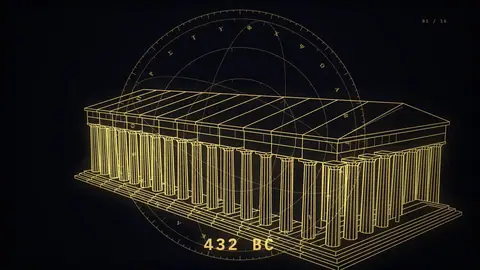
Western civilization in 2 minutes 16 seconds
vittorio (@IterIntellectus)“i asked claude to make a video on western civiization”15,200,735 views as of 23 Oct
-
“The Clodyssey”
anabology (@anabology)Claude, another 12 hours12,576,393 views as of 27 Oct
-
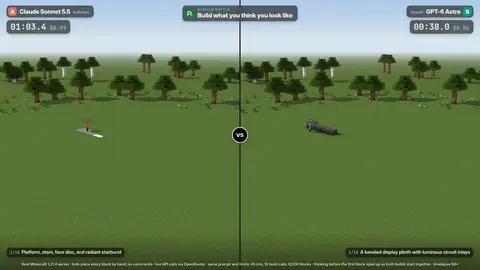
“Build what you think you look like”: Claude Sonnet 5.5 vs GPT-6 Astra
Siya (@siyabuilt)7,259,229 views as of 27 Oct