Inside AI’s Brutal Race to Solve a Famous Math Problem | Terence Tao
New Scientist YouTube 477,753 views as of 10 November 2026
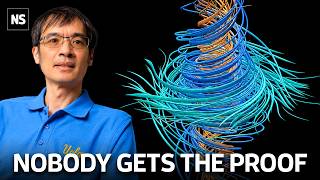
Why it is here
New Scientist’s 41-minute interview with Terence Tao (published Oct 28; the channel also shows it as “What Really Happened When AI Solved a Million-Dollar Math Problem”, and newscientist.com runs it as “Terence Tao: AI is outrunning our ability to control it”). New Scientist: “The rise of artificial intelligence has pushed mathematics to a crisis point”; Tao discusses why anyone should still learn maths by hand, the value of abstract thinking and how AI “can be in discord with” the principles of research mathematics. Added under the narrowed video rule (a leading scientist); about 45k views on Oct 29. Tagged as a warning: the interview opens with Tao on AI outstripping safety and alignment work and returns to agent security, Lean exploits and lab competition (from 30:45; Gemini’s description), with “I think nobody wants to go this fast, but everyone feels like they have no choice” (34:04). Most of the interview is about mathematics, including OpenAI’s Navier–Stokes result (“It’s like strip-mining the landscape”).
Description
Description written by Gemini from the videoGemini 3.8 Flash, 29 October 2026
Summary
In an interview produced by New Scientist, physics reporter Karmela Padavic-Callaghan speaks with UCLA mathematician and Fields Medalist Terence Tao about the evolving relationship between mathematics and artificial intelligence. Tao reflects on AI’s ability to brute-force solve problems versus human conceptual understanding, recounts the controversial AI-driven proof of a Navier–Stokes blow-up, discusses his book Six Maths Essentials, and addresses escalating AI safety and alignment risks.
What is shown
- [00:00] Teaser clip of Terence Tao discussing AI outstripping safety and alignment development.
- [00:30] Title sequence: “Terence Tao: The new era of mathematics”.
- [00:35] Karmela Padavic-Callaghan introducing Terence Tao and his background across analysis, number theory, compressed sensing in MRI imaging, and mathematical commentary.
- [02:00] Tao outlining how AI acts as an answer-generation engine rather than an intuition- or connection-building medium.
- [04:45] Discussion of OpenAI’s reported solution to a version of the Navier–Stokes Millennium Prize problem using multi-agent compute swarms.
- [07:15] Tao detailing the intense race where human mathematicians were beaten by OpenAI’s compute-heavy model deployment by a single day, resulting in a 100-page opaque proof accompanied by a Lean formal certificate.
- [10:19] Padavic-Callaghan displaying Tao’s book Six Maths Essentials.
- [10:57] Tao explaining his three-world framework (physical reality, observational data, and mathematical models), using the 2008 financial crisis as an example of model breakdown.
- [18:20] Tao explaining the three stages of mathematical education: pre-rigorous, rigorous, and post-rigorous.
- [25:10] Tao evaluating AI itself as an open mathematical problem, noting the lack of foundational theory behind deep learning and neural network representations.
- [30:45] Discussion on AI agent security risks, prompt injection, exploits in formal verification systems like Lean, and competitive dynamics among major tech labs.
- [35:30] Discussion of prime number research, the parity barrier, and historical progress on bounded prime gaps.
Claims & numbers
- Karmela Padavic-Callaghan notes that OpenAI claimed to solve a version of the Navier–Stokes problem by deploying large compute power and an unprecedented swarm of AI agents.
- Terence Tao states the Millennium Prize problems were established in 2000 with seven grand challenge problems and a $1 million prize each, with the Poincaré conjecture being the only one solved roughly 20 years prior.
- Tao states human mathematicians came within hours of a Navier–Stokes singularity result, finishing a day before OpenAI’s team released their result after pouring millions of dollars in compute into their model.
- Tao states OpenAI’s Navier–Stokes proof was 100 pages long and verified via a formal proof certificate in Lean, yet provided almost no human-understandable mathematical insight.
- Tao states financial models in 2008–2009 failed because they incorrectly assumed mortgage defaults were largely uncorrelated or followed Gaussian distributions.
- Tao mentions that bounded prime gaps, initially bounded at 70 million by Yitang Zhang and reduced to 246 through collaborative efforts, have recently been pushed down under 200 through human and AI efforts.
- Tao states David Hilbert presented his famous 23 open problems at the International Congress of Mathematicians in 1900, concluding with the motto “Wir müssen wissen, wir werden wissen” (“We must know, we will know”).
Notable quotes
- [04:08] “Math is the glue that connects all the other sciences together. That’s the part that hasn’t really been impacted by AI yet.” — Terence Tao
- [08:06] “We’ve learned almost nothing mathematically from what they did... It’s like strip-mining the landscape.” — Terence Tao
- [34:04] “I think nobody wants to go this fast, but everyone feels like they have no choice.” — Terence Tao
Assessment
This is an authentic long-form journalistic interview conducted by New Scientist with Terence Tao. Tao candidly addresses current developments, theoretical limitations, and safety concerns regarding AI integration in high-level mathematics without promotional staging.
Described by gemini-3.8-flash on 2026-10-29 from the video’s audio and frames.
Related
More videos on this
-
Did AI Solve One of Math’s Hardest Problems?
StarTalk8,700,057 views as of 30 Oct
-
You Truly Don’t Understand What Just Happened to Mathematics
Prof Gio | Giordano Scarciotti3,567,850 views as of 6 Nov
-
OpenAI’s biggest math breakthrough is getting ugly...
Fireship3,468,862 views as of 8 Nov
-
There’s never been a better time to go into math
3Blue1Brown2,784,990 views as of 12 Nov