Why Navier-Stokes Pushes Math and Physics to the Edge
Quanta Magazine YouTube 936,223 views as of 18 October 2026
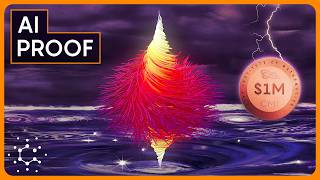
Why it is here
Quanta Magazine’s 14-minute explainer with physicist Steven Brunton (University of Washington) on why the Navier–Stokes equations are hard, what a blowup means, and how the new OpenAI proof could resolve the Millennium Prize problem (per the video description). ~936k views; missed for a month.
Description
Description written by Gemini from the videoGemini 3.8 Flash, 18 October 2026
Summary
This video essay from Quanta Magazine explains the physics and mathematics of the Navier-Stokes equations, their history, and why proving the existence or breakdown of smooth solutions has been one of the seven Millennium Prize Problems. Narrated with expert commentary from physicist Steven Brunton and mathematician Terence Tao, the video covers fluid mechanics from Euler and Stokes to recent mathematical breakthroughs, culminating in September 2026 AI-assisted proofs demonstrating finite-time blowup.
What is shown
- [00:01] Mathematical breakdown and animations of the incompressible Navier-Stokes equations: $\nabla \cdot \mathbf{v} = 0$ and $\rho (D\mathbf{v}/Dt) = -\nabla p + \rho \mathbf{g} + \mu \nabla^2 \mathbf{v}$.
- [01:20] Historical timeline covering Isaac Newton (1687), Leonhard Euler’s vector field formulation and Euler equations (1757), Claude-Louis Navier’s internal friction proposal (1822), and George Stokes’ formalization of viscosity (1845).
- [04:40] Visualizations of numerical fluid dynamics simulations across engineering and natural phenomena (airplanes, pumps, cardiovascular flows, weather patterns).
- [05:58] Mathematical explanation of the material derivative and the convective acceleration term $(\mathbf{v} \cdot \nabla)\mathbf{v}$, highlighting how nonlinear feedback drives turbulence and potential singularities.
- [09:12] Review of key analytical milestones: Jean Leray’s introduction of weak solutions (1934), Terence Tao’s 2016 paper constructing finite-time blowup for averaged Navier-Stokes equations, and Diego Córdoba and Luis Martínez-Zoroa’s 2021–2023 work on Euler singularities.
- [11:28] Tristan Buckmaster and Levent Alpöge’s September 2026 work with AI models achieving Euler blowup with smooth forcing.
- [11:45] OpenAI’s September 8, 2026 announcement and preprint (“On the Navier-Stokes Millennium Prize Problem” / “Finite Time Blowup for Navier–Stokes”), showing diagrams of the inward-spiraling vortex blowup and proof formalization in the Lean interactive theorem prover.
Claims & numbers
- The Clay Mathematics Institute established the Navier-Stokes existence and smoothness problem as one of seven Millennium Prize Problems, each carrying a $1,000,000 award (narrator at [00:59]).
- Weather prediction typically breaks down and becomes unreliable after one or two weeks due to chaotic nonlinear dynamics in fluid flow equations (Terence Tao at [07:23]).
- OpenAI claims to have solved the Navier-Stokes Millennium Prize problem by establishing finite-time blowup/breakdown for 3D incompressible Navier-Stokes equations with smooth forcing (narrator at [11:45]).
- OpenAI used roughly 10,000 AI agents running in parallel, which produced the proposed proof in 88 hours, subsequently formalized in Lean (narrator at [11:51]).
Notable quotes
- [00:21] Terence Tao: “It’s one of the cleanest and simplest models of a supercritical equation um that we don’t understand.”
- [10:04] Terence Tao: “What I showed is that if you cheated, if you turned off some of the non-linear effects, um but you just kept some of them... the non-linearity is still strong enough to create blow-up.”
- [12:38] Steven Brunton: “Navier-Stokes isn’t just about solving a Millennium Prize problem. It’s about understanding the limits of our ability to describe the physical world around us with equations.”
Assessment
This is a polished science journalism explainer by Quanta Magazine summarizing the theoretical foundations of fluid mechanics and recent AI-driven mathematical proofs. The animations, paper excerpts, and interview clips accurately reflect genuine mathematical research and public announcements without hyperbolic dramatization.
Described by gemini-3.8-flash on 2026-10-18 from the video’s audio and frames.
Related
More videos on this
-

Did AI Solve One of Math’s Hardest Problems?
StarTalk7,740,113 views as of 15 Oct
-
OpenAI’s biggest math breakthrough is getting ugly...
Fireship3,424,687 views as of 9 Oct
-
The controversy around OpenAI “solving” a $1m math problem (Navier-Stokes)
Physics by Oimeow2,613,114 views as of 12 Oct
-
AI Solved a Millennium Problem and Everyone’s Angry
Sabine Hossenfelder1,616,209 views as of 9 Oct