Interactive camera-lens lab explaining focus, built by Opus 5.5 in one shot (X video)
Ryan Sael (@RyanSael) · 2026-09-23 · ai-made · 3,451,129 views
Made by AI
Model: Claude Opus 5.5 · Series: Agent-built game or 3D world (the video shows the result)
Evidence: X post (2026-09-23): 'I asked Opus 5.5 to explain camera focus by building an interactive lens lab / / Here's what it came up with after 1 hour 26 minutes in one shot, $25.66 API cost / https://t.co/uqDgUs8H9h / / Move the focus ring and you can see the glass elements shift the sharp plane through the scene'
Human role: One prompt; 1 hour 26 minutes of autonomous work, $25.66 API cost; published the live page.
Pipeline: One prompt → Opus 5.5 builds an interactive exploded-lens web lab → screen recording of moving the focus ring (32 seconds)
Lore: one-prompt, budget-receipts
What's in the video
Description written by Gemini, which watched and listened to the whole video.
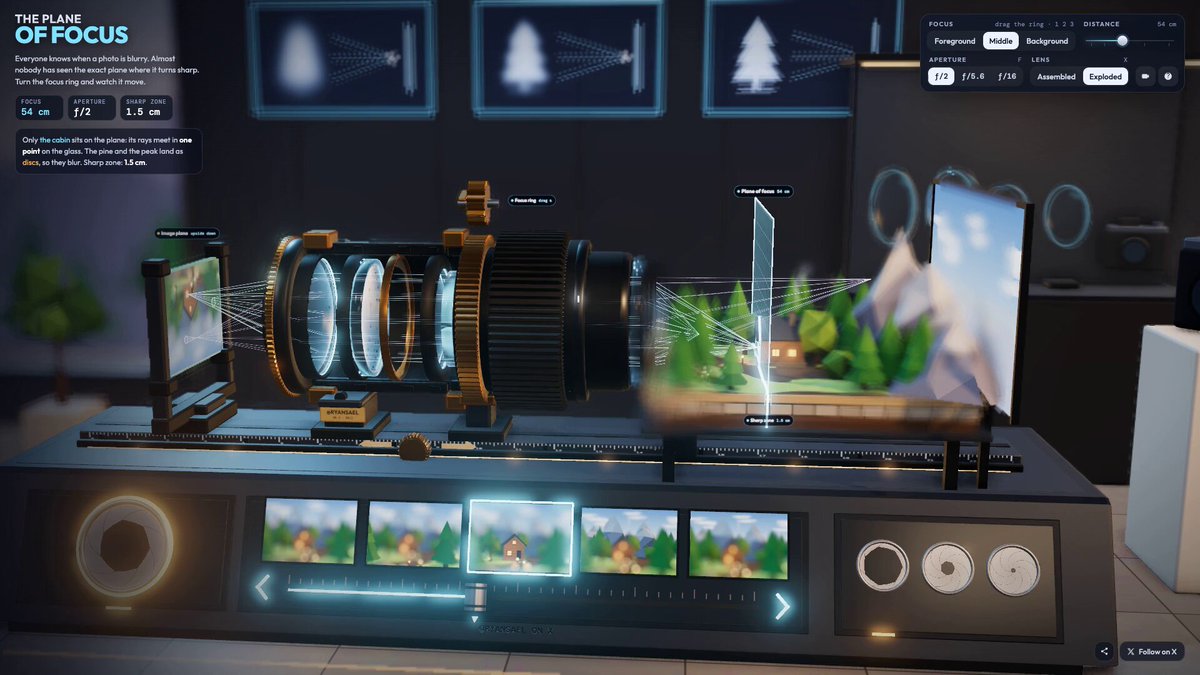
Summary This video demonstrates an interactive 3D camera-lens educational application titled "The Plane of Focus," created in a single generation prompt by Anthropic's Claude Opus 5.5 and shared by developer Ryan Sael (@RyanSael). The simulation visualizes the physics of optics, showing how light rays pass through multiple glass elements, an aperture iris, and onto an image plane focusing on a low-poly diorama.
What is shown
- 00:00 – 00:08: Overview of the full interactive optical bench. The user adjusts the focus ring, causing the translucent "Plane of Focus" grid to travel forward and backward through a miniature low-poly landscape scene.
- 00:09 – 00:14: A close-up view of the cross-sectioned lens assembly, highlighting light ray tracing through multiple convex and concave glass elements, the mechanical gear focus mechanism, and the "@RYANSAEL" baseplate badge.
- 00:15 – 00:20: Perspective view following the focus grid as it slices through foreground pine trees, a cabin, and background mountain peaks, displaying real-time ray lines connecting to the lens pupil.
- 00:21 – 00:25: A view of the rear projection/sensor plate showing the inverted optical image of the scene with circle-of-confusion bokeh circles corresponding to out-of-focus areas.
- 00:26 – 00:31: Return to the full bench overview, showing UI options to toggle between assembled and exploded lens views, aperture presets ($f/2$, $f/4$, $f/8$, $f/16$), and quick-focus presets (Foreground, Middle, Background).
Claims & numbers
- The UI states the lens focal length is $57\text{ mm}$ with an aperture setting of $f/2.0$ [00:00].
- The interface calculates a depth of field ("Sharp zone") of $0.7\text{ cm}$ at the displayed focus distance [00:00].
- The post title claims the entire interactive 3D laboratory was generated in "one shot" by Claude Opus 5.5.
Notable quotes
- [00:00]: "Every time you shoot a photo it's blurry. Almost nobody can see the exact plane where it turns sharp. Turn the focus ring and watch it move." (UI text)
- [00:02]: "Only the points on that plane from the focal point 1 are painted as sharp line. The plane and the post land as discs, so they blur." (UI text)
Assessment This is a screen recording demonstrating an interactive 3D WebGL/Three.js-style educational application built via LLM code generation. The demonstration shows functional interactivity, including dynamic ray tracing, mechanical rotation of gears, live depth-of-field calculation, and correct optical image inversion.
Lyrics & themes The video contains no audio track or narration. Its informational themes focus on optical physics education—specifically ray tracing, focal distance, circle of confusion/defocus blur, and depth of field in photography.
Lore & references
- Claude Opus 5.5: Represents the September 2026 release in Anthropic's Claude 5.5 series, widely cited in developer communities for complex single-prompt frontend engineering and 3D graphics generation.
- @RYANSAEL: The handle of developer Ryan Sael, watermarked directly onto the 3D-modeled lens mounting bench.
Visual style & craft The scene uses real-time 3D graphics (likely WebGL/Three.js) featuring metallic PBR textures, glowing vector ray lines, volumetric-style translucent planes, and low-poly diorama assets. The UI consists of clean, responsive sci-fi/educational overlays, slider gauges, and interactive filmstrip thumbnails along the bottom rail.
Described by gemini-3.8-flash on 2026-09-30 from the video's audio and frames.