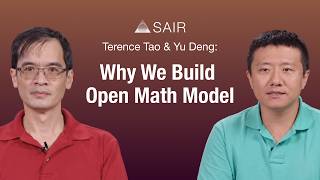
Terence Tao & Yu Deng: Why We Build Open Math Model
SAIR YouTube 1,686 views as of 20 October 2026
Why it is here
Official SAIR Foundation interview (22:46) with Fields Medalists Terence Tao and Yu Deng, posted three days after the Open Math OS soft launch. Per the channel description they discuss how to keep understanding, credit and openness as AI produces proofs at scale, the problems posed by large releases of AI-generated proofs, SAIR’s Open Math OS (built at first on existing open-source models), and which human abilities will matter in mathematics (asking questions, planning proofs, new ideas).
Description
Description written by Gemini from the videoGemini 3.8 Flash, 20 October 2026
Summary This video is an interview on the SAIR podcast hosted at the Science x AI Summit 2026, featuring mathematicians Terence Tao (UCLA, Chairman of SAIR) and Yu Deng (University of Chicago). The panel discusses the aftermath of commercial frontier labs dumping massive batches of AI-generated proofs, addressing academic credit, attribution loss, the need for human understanding, and the rationale behind SAIR’s Open Math Model initiative.
What is shown
- [00:07] Panel discussion setting at the “Science x AI Summit 2026” featuring the host, Terence Tao, and Yu Deng.
- [00:51] Self-introductions by Yu Deng (University of Chicago, PDE and probability) and Terence Tao (UCLA, analysis and number theory).
- [01:40] Deng and Tao analyzing the nuances of AI adoption in mathematics beyond binary “pro” or “anti” stances.
- [05:42] Tao discussing the misaligned incentives of commercial AI labs treating mathematics benchmarks as disposable byproducts.
- [08:00] Deng outlining the conceptual difference between the boundary of proven theorems and the boundary of human-understood theorems.
- [13:43] Tao detailing SAIR’s Open Math Model project, community-led infrastructure, and the role of open-source tools.
- [21:31] Deng describing an example where collaborator Bjorn Bringmann leveraged an LLM to resolve a specific stochastic PDE problem within one to two days using a human-designed proof plan.
Claims & numbers
- The host states that a commercial AI company released over 700 mathematical proofs at once and subsequently had to retract three preprints due to basic sign errors [00:13, 05:05].
- Terence Tao states there are roughly a dozen problems in OpenAI’s recent proof release that he personally cares about, though reading them is not an immediate priority due to poor exposition [07:40].
- Deng states his collaborator Bjorn Bringmann tested an SPDE problem using GPT, solving it in one or two days by supplying a structured human proof roadmap [21:31].
Notable quotes
- Terence Tao [04:05]: “Speed is not the only thing we want to optimize.”
- Terence Tao [18:18]: “Empowerment is the key... when you use the tools, you yourself get smarter, you understand things better, and you’re not sacrificing your own capability.”
- Yu Deng [16:28]: “Science has always been open, so everything like AI for science should also... should also be open.”
Assessment This is an authentic panel discussion and interview recorded live at the Science x AI Summit 2026. No software interfaces or live proof generation benchmarks are directly demonstrated on screen; the discussion reflects expert perspectives and initiatives within the mathematical research community.
Described by gemini-3.8-flash on 2026-10-20 from the video’s audio and frames.
Related
More videos on this
-
You Truly Don’t Understand What Just Happened to Mathematics
Prof Gio | Giordano Scarciotti3,242,101 views as of 18 Oct
-
The Mathematics are Mad
The PrimeTime1,321,673 views as of 18 Oct
-
AI Keeps Pissing Off Mathematicians
ColdFusion1,039,006 views as of 19 Oct
-
No More Heroes - Terence Tao Talks to Numberphile About AI
Numberphile883,946 views as of 20 Oct