This Is What $2,175 of Opus 5.5 Tokens Can Do...
Stefan 3D AI · 2026-09-28 · ai-made · 137,420 views
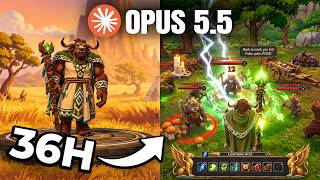
Made by AI
Model: Claude Opus 5.5 · Series: Agent-built game (video of the result)
Evidence: Description: gave Claude Max 'full access to my laptop, my Unity and gamedev workflows, and every 2D and 3D AI API I normally use, then stepped away for 36 hours'; 'almost 8 billion tokens'.
Human role: Wrote the brief and stepped away; the video reviews the result. Higgsfield-sponsored.
Pipeline: Opus 5.5 (Claude Max) → Unity + 2D/3D generation APIs over 36 hours → MMO-style game with races, zones, combat, quests and hundreds of generated 3D models
Lore: budget-receipts, long-run
What's in the video
Description written by Gemini, which watched and listened to the whole video.
Summary
In this video, 3D and AI artist Stefan Vaskevich (channel Stefan 3D AI) documents an end-to-end experiment using Anthropic’s Claude Opus 5.5 via Claude Code on a Claude Max subscription to autonomously build a playable fantasy MMORPG prototype titled World of Oldcraft in Unity. Over approximately 36 hours of continuous operation connected via Model Context Protocol (MCP) to Unity and Blender alongside generative APIs, the model planned, coded, generated 3D models, textured environments, rigged animations, and produced a playable prototype complete with multiple races, combat, quests, and cities.
What is shown
- [00:00 - 02:44] Experiment setup and brief: Stefan outlines his preparation, including a 6,415-word design specification (
TASK.md), 70 reference images, 25 race concepts, and MCP integrations (Unity MCP, Blender MCP) and generative tool APIs (Higgsfield, Tripo, Fal.ai). - [02:45 - 03:44] Launching Claude Code: Setting up the Asus ROG gaming laptop near midnight, configuring Claude Code CLI v2.1.201 with Opus 5.5, setting the effort level to
ultracode, pasting the kickoff prompt, and initiating the autonomous build loop. - [03:45 - 05:42] Autonomous iteration & visual progression: Time-lapse and progress tracking demonstrating the game world developing from initial greybox geometry to textured rolling hills, roads, church structures, and animated models, supported by automated screenshot captures.
- [05:43 - 07:11] Asset generation & human-in-the-loop steering: Stefan reviews Claude’s character asset generation (human warrior, undead mage, bull-folk healer), rig adjustments, and terrain detail passes (such as the town square and Gloamwood).
- [07:12 - 09:24] Session statistics and costs: Stefan reviews the detailed session dashboard detailing runtime, token volume, API costs, model invocations, and asset production totals.
- [09:25 - 10:57] Agent-generated cinematic fly-through: A 100-second cinematic video reel captured and sequenced by the agent showcasing diverse biomes, bandit camps, mills, and castle gates.
- [10:58 - 14:57] Live gameplay – Character creation & Healer: Stefan launches the compiled Unity build, explores the parallax Dark Portal-style login screen, tests character customization (skin, hair, race/class selection), and enters the world as a Bull-Folk Healer to engage in real-time combat at "Candlecap Dig".
- [14:58 - 17:18] Live gameplay – Warrior, UI & Quests: Stefan tests the Human Warrior, opens the inventory/backpack UI, tests the debug admin panel to teleport and adjust level/skills, fights ghouls at Quietbell Chapel, and accepts the quest "Wicked Wicks" from NPC Brother Aldwin.
- [17:19 - 20:33] Live gameplay – Ranger & City exploration: Exploring Goldfurrow Fields and the capital city Highcrest as a Night Elf Ranger, viewing ambient NPC pathfinding, animated flocking pigeons, water canals, and entering the fully modeled inn "The Gilded Sheaf".
Claims & numbers
- Runtime: The full build session lasted 36 hours and 45 minutes elapsed wall-clock time, with approximately 30 hours and 14 minutes of active agent working time after factoring in an overnight laptop crash and driver reinstallation [07:14 - 07:32].
- Token volume: The session consumed 7.85 billion tokens in total, with a 98.7% prompt cache read rate [07:46 - 07:54].
- Equivalent API pricing vs. subscription: Stefan states the equivalent Claude API cost would have been $2,175, but it was entirely covered within his flat-rate Claude Max subscription, utilizing 100% of a single weekly usage allowance [08:00 - 08:12].
- Asset generation volume:
- 303 3D models generated via Tripo H3.1 [08:54 - 08:58].
- 609 2D images generated via Nano Banana Pro and GPT Image 2.5 [08:59 - 09:04].
- 6,866.5 Higgsfield credits consumed (valued at ~$227 at the Ultra tier) [08:33 - 08:37].
- Model comparison: Stefan claims Claude Opus 5.5 consumes tokens significantly more efficiently and manages multi-step agentic game tasks more stably than GPT-6 Astra or Claude Fable 5.1 [05:04 - 05:41].
Notable quotes
- [01:09]: "I even generated hundreds of images and chose right images that I want. I mean, I haven't developed any piece of the game; I was just specifying, like, what I expect it to do."
- [07:46]: "7.85 billion tokens spent, which is of course almost 99% of it is a cache read, but if we try to calculate it in API usage, it will be worth almost $2,200 bucks."
- [13:14]: "It's like everyone can write a book right now, and everyone will be able to create a game. But what game you're going to create, and will other people like to play your game or not?"
Assessment
This video is a hands-on developer project demo and tool workflow showcase, sponsored in part by Higgsfield. While the completed Unity project exhibits noticeable rough edges characteristic of autonomous prototyping (imperfect weapon-gripping sockets, simple animation blending, and minor collision bugs), the compiled build, interactive UI, functional combat loops, and generated environment assets are fully demonstrated running live on screen.
Lyrics & themes
The video contains no lyrical singing; it features developer vlog commentary layered over custom instrumental background music generated for the game:
- Preparation & Prompt Architecture [00:00 - 02:44]: Themes of human intent acting purely as director and spec-writer.
- Autonomous Execution [02:45 - 07:11]: Emphasizing automated feedback loops, self-correction, and tool routing via MCP.
- Economic Viability [07:12 - 09:24]: Comparing subscription model economics (Claude Max) against raw pay-per-token API consumption.
- Democratic Game Creation [12:45 - 20:33]: Exploring whether accessible AI generation shifts the bottleneck of game design from technical production to creative taste and game feel.
Lore & references
- World of Warcraft / Blizzard Homages: The project is explicitly framed as World of Oldcraft, directly recreating classic World of Warcraft tropes: the green-hued Dark Portal login gateway, Northshire Abbey-style starter zones ("Ambervale"), Kobolds obsessed with candles ("Candlecap Diggers"), Defias Brotherhood parallels ("Redkerchief Bandits"), and capital city Stormwind ("Highcrest").
- AI Tooling & Models:
- Claude Opus 5.5 / Claude Code CLI: Anthropic's coding model and terminal interface operating in
ultracodemode. - Model Context Protocol (MCP): Specifically Unity MCP and Blender MCP used as bi-directional bridges to manipulate engine viewports and run Python automation scripts.
- Asset Generators: Tripo H3.1 (image-to-3D mesh generation), Nano Banana Pro / GPT Image 2.5 (concept art and tiling textures), and Higgsfield API (asset orchestration and video rendering).
- Comparative Models: Mentions of Claude Fable 5.1 and OpenAI's GPT-6 Astra regarding token burn rate and multi-agent coordination.
- Claude Opus 5.5 / Claude Code CLI: Anthropic's coding model and terminal interface operating in
Visual style & craft
- Presentation: High-production YouTube tech vlog blending talking-head studio capture (Stefan with desktop microphone and brand neon sign), recorded screen shares of terminal and web dashboards, over-the-shoulder handheld laptop recordings, and direct desktop captures of the Unity game client.
- Game Art Style: Distinct low-to-mid-poly stylized fantasy aesthetic ("hand-painted classic MMO" look), featuring vibrant painted terrain splatmaps, modular stylized foliage, architectural kits with slate roofs and timber framing, and custom 2D gold-bordered fantasy HUD frames.
- Craft Division: Prompts, pipeline architecture, and initial high-level task specifications were written and curated by Stefan; the implementation code, asset generation requests, scene assembly, rig binding, and automated playthrough validation runs were executed autonomously by Claude Code.
Described by gemini-3.8-flash on 2026-09-29 from the video's audio and frames.