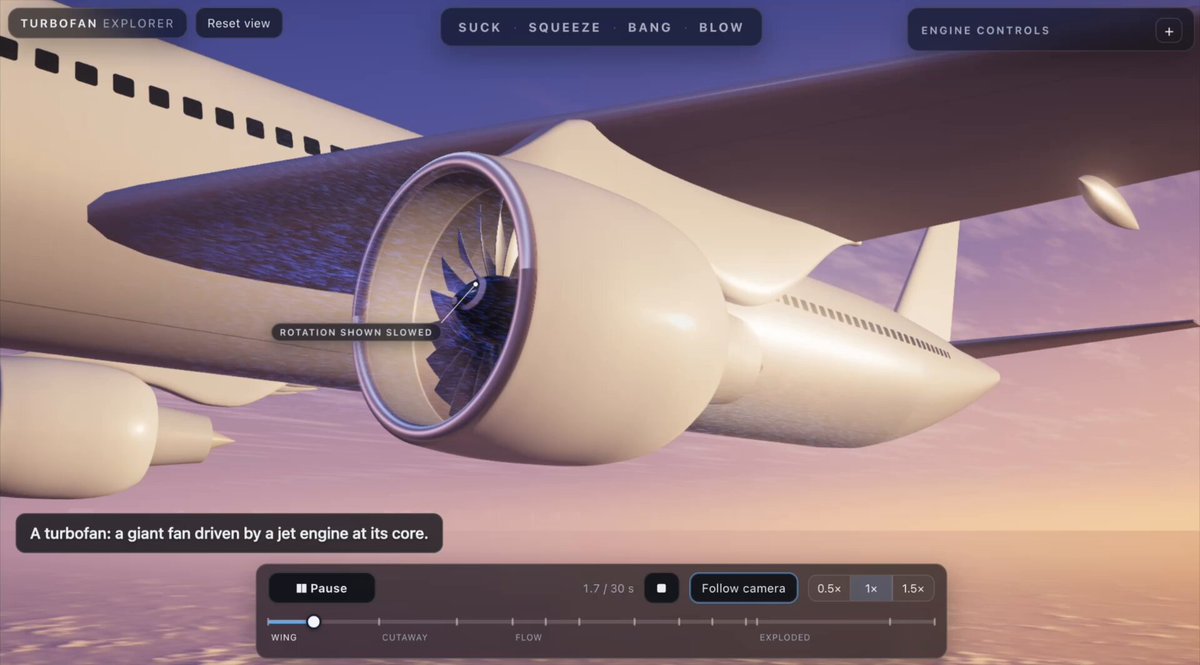
Interactive 3D turbofan jet engine cutaway, intake to exhaust, built with Claude Opus 5.5 and Three.js (X video)
Techartist (@techartist_) · 2026-10-02 · ai-made · 206,085 views
Made by AI
Model: Claude Opus 5.5 · Series: Agent-built game or 3D world (the video shows the result)
Evidence: X post (2026-10-02): 'Engineering doesn't have to be learned from flat diagrams. A jet engine in interactive 3D, from intake to exhaust. Built with Claude Opus 5.5 using Three.js.'
Human role: Creator directed the build (prompts not published) and recorded the interactive result.
Pipeline: Opus 5.5 + Three.js → interactive 3D cutaway → 24-second screen recording
What's in the video
Description written by Gemini, which watched and listened to the whole video.
Summary
This video presents "Turbofan Explorer," an interactive 3D educational web application built with Three.js and code generated using Anthropic's Claude Opus 5.5, shared by Techartist (@techartist_). The demo tours a high-bypass turbofan jet engine mounted on an airliner wing, explaining the four continuous cycles of jet propulsion (suck, squeeze, bang, blow) via cutaways, particle airflow simulations, telemetry overlays, and an exploded assembly view.
What is shown
- Cutaway View and Architecture [00:00–00:04]: The outer nacelle retracts to reveal internal components including the fan, low-pressure (LP) and high-pressure (HP) compressors, bypass duct, combustor, HP and LP turbines, and dual concentric shafts rotating at different speeds.
- Suck Phase [00:05–00:07]: Highlight of incoming ambient airflow through the fan, illustrating bypass ratio where the majority of air flows around the core to provide primary thrust.
- Squeeze Phase [00:08–00:10]: Air entering the core is compressed through multiple stages, showing pressure and temperature climb along the high-pressure compressor.
- Bang Phase [00:11–00:13]: Close-up inside the combustor where fuel is injected and continuously burned, creating hot expanding gases directly entering the high-pressure turbine.
- Blow Phase [00:14–00:16]: High-temperature gas drives the turbines to power the front fan and compressor shafts before leaving through the exhaust nozzle.
- Exploded Assembly Mode [00:17–00:23]: Activation of the "Exploded" slider, disassembling each engine stage along the central spool axis while maintaining rotating component animations and subsystem callouts before reassembling into the exterior nacelle [00:23–00:29].
Claims & numbers
- Intake ambient air pressure ratio (PR): 1:1 [00:02].
- HP Compressor exit temperature and pressure ratio: ~360 °C and PR ~20:1 at initial state [00:02], rising to ~600 °C and PR ~40:1 during peak compression [00:08].
- Combustor gas temperature: ~1,210 °C to >1,500 °C [00:02, 00:11].
- Core air is compressed "about 40 times, heating it" [00:08].
- Combustor fuel combustion temperature is described as "hotter than the turbine metal's melting point" [00:11].
Notable quotes
- "A turbofan: a giant fan driven by a jet engine at its core." [00:00]
- "Suck: the fan pulls in a huge mass of air. Most air bypasses the core, and makes most of the thrust." [00:05]
- "Suck, squeeze, bang, blow: all happening at once, continuously." [00:17]
Assessment
This is a technical demonstration of a procedural/Three.js interactive web graphics application coded with assistance from Claude Opus 5.5. The user interface, smooth camera tweening, interactive cutaway shaders, particle flow paths, and exploded-view kinematics function smoothly without visual glitches.
Lyrics & themes
- Narration / Audio: No sung lyrics; the video is an interactive app demonstration with UI captions following the standard four-stroke jet propulsion mnemonic ("suck, squeeze, bang, blow").
- Themes: Aerospace engineering education, interactive 3D visualization, gas turbine thermodynamics, and multi-spool turbofan design.
Lore & references
- "Suck, Squeeze, Bang, Blow": The classic aviation colloquialism used to describe the four fundamental stages of continuous Brayton-cycle jet engine operation (intake, compression, combustion, exhaust).
- Newton's Third Law: Mentioned in the exploded thrust hub label [00:18], highlighting how momentum change across bypass air and core jet exhaust produces forward thrust.
- Claude Opus 5.5 / WebGL coding: Represents the late-2026 practice of using frontier LLMs to write complex end-to-end 3D Three.js web shaders, interactive sliders, and animated CAD exploded views without manual 3D web-engine scripting.
Visual style & craft
The visual output is a real-time WebGL canvas rendered with Three.js in a web browser. It features realistic physically-based metallic materials, heat bloom inside the combustor, glowing exhaust particles, dynamic text billboarding for component annotations, and synchronized slider controls (Wing, Cutaway, Flow, Exploded). The UI and 3D scene architecture were generated via code, producing clean vector-like precision typical of AI-assisted Three.js development.
Described by gemini-3.8-flash on 2026-10-04 from the video's audio and frames.