Interactive black-hole lab explaining gravitational lensing, built by Opus 5.5 overnight
Vox (@Voxyz_ai) X 128,280 views as of 22 November 2026
Why it is here
Listed in the claudevideo.org community catalog; ~126k views on X by 2026-10-09. Length 0:22.
Description
Description written by Gemini from the videoGemini 3.8 Flash, 10 October 2026
Summary
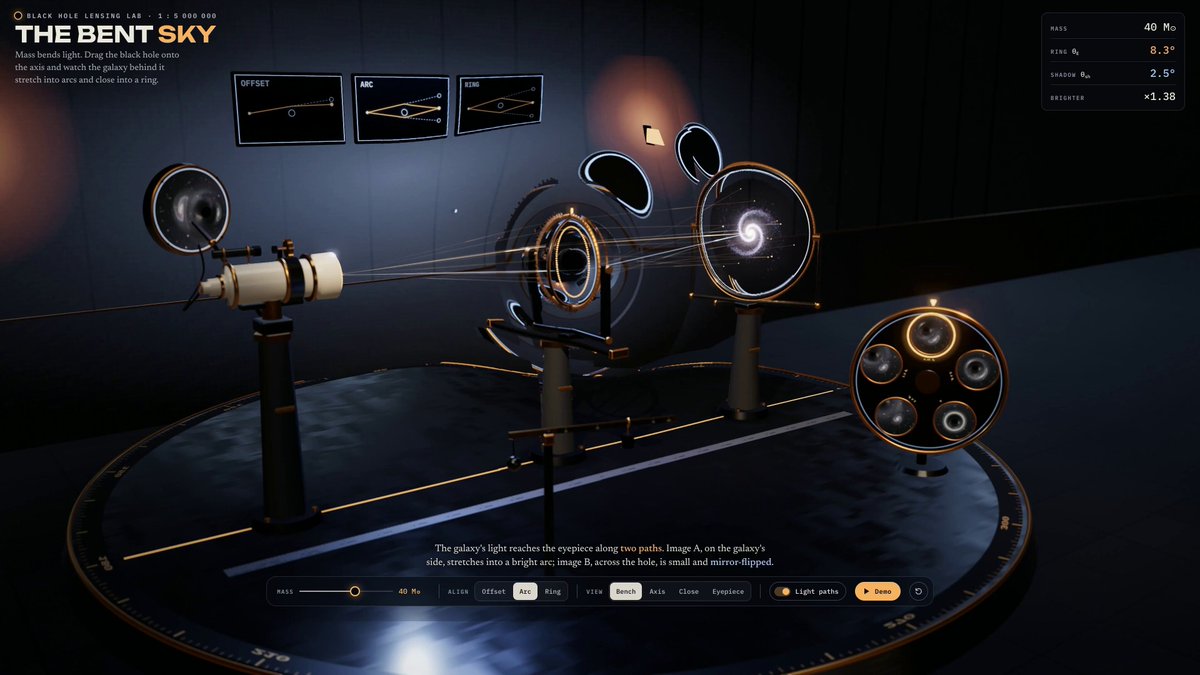
This video is a demonstration of “The Bent Sky,” an interactive 3D WebGL gravitational lensing laboratory built overnight with Claude Opus 5.5. Uploaded by Vox (@Voxyz_ai), the screencast illustrates how light from a distant galaxy bends around a black hole, moving between an orbital 3D tabletop view and a simulated telescope eyepiece.
What is shown
- [00:00 - 00:04]: Initial 3D bench view of the interactive lab, featuring a telescope on the left, an optical path with bent ray lines, a central black hole gimbal, and a spiral galaxy target on the right.
- [00:05 - 00:11]: The user clicks presets (
Offset,Ring) and drags theMassslider on the balance beam control, demonstrating how gravitational mass increases ray deflection and adjusts the Einstein ring angle $\theta_E$. - [00:12 - 00:15]: Selecting the
Closecamera preset to view the central black hole and optical path rings from a close-up frontal perspective. - [00:16 - 00:22]: Clicking into
Eyepiecemode, which opens a circular view through the telescope. The user drags the galaxy’s “true position” marker, showing real-time distortion into gravitational arcs and a closed Einstein ring around the central event horizon.
Claims & numbers
- Mass & Scaling: The UI displays mass scaling from 40 $R_s$ upward, showing $\theta_E$ shifting from 8.3° to 8.4° and up to 18.3°.
- Mathematical Scaling: On-screen text notes: “The ring grows like $\sqrt{M}$, the shadow grows like $M$, so it gains on the ring as the hole gets heavier.”
- Creation: The upload metadata credits Claude Opus 5.5 with generating the complete interactive WebGL lab overnight.
Notable quotes
- [00:00]: “The galaxy’s light reaches the eyepiece along two paths. Image A, on the galaxy’s side, stretches into a bright arc; image B, across the hole, is small and mirror-flipped.”
- [00:08]: “Observer, hole and galaxy are lined up, so every path around the hole has the same length. The images close into an Einstein ring of radius \theta_E 8.4°.”
- [00:11]: “More mass bends harder. The ring grows like \sqrt{M}, the shadow grows like M, so it gains on the ring as the hole gets heavier.”
Assessment
This is a real user demonstration of a working 3D WebGL browser application generated with code assistance from Claude Opus 5.5. The interface, camera transitions, slider controls, and shader-driven gravitational lensing render fluidly in real time without apparent mockup editing.
Lyrics & themes
- The audio is purely ambient/instrumental, consisting of subtle mechanical hums and atmospheric synth drones; there are no sung lyrics or spoken narration.
- The theme is astrophysical education and general relativity, focusing on gravitational lensing, light deflection angles, and Einstein ring geometry.
Lore & references
- Claude Opus 5.5: References Anthropic’s Opus 5.5 model, used here as an autonomous full-stack coding agent to architect complex 3D WebGL scenes and optical shaders.
- Astrophysical Lensing Formulas: References standard relativistic optics, including Schwarzschild radius ($R_s$), angular Einstein radius ($\theta_E$), and shadow proportions.
Visual style & craft
- Rendered in 3D WebGL (likely Three.js or similar) with a retro-futuristic, brass-instrumented observatory aesthetic.
- Transitions smoothly between interactive 3D laboratory bench staging and a dedicated shader-based telescope eyepiece mode.
Described by gemini-3.8-flash on 2026-10-10 from the video’s audio and frames.
How AI was used to make it
AI made all of it of this video: subject built by ai.
- Autonomous multi-round code generation of a complete 3D WebGL gravitational lensing browser application
Tools named: Claude Opus 5.5
Classified by gemini-3.8-flash from our description of the video (high confidence), 25 October 2026. How AI is used to make videos, across the whole log
Made by AI
- Made with
- Claude Opus 5.5
- How we know
- X post (2026-09-24): ‘I asked Opus 5.5 to explain gravitational lensing by building an interactive black hole lab One prompt for the first version, then a dynamic workflow to polish it for three rounds while I slept. This is what I woke up to: 5h 28m end to end, $90 at API prices https://blackhole.voxyz.ai Drag the black hole and the sky behind it bends into arcs, closing into a full ring when everything lines up Each round ran 3…’
- Human role
- One prompt for v1, then a dynamic workflow polished it for three rounds overnight: 5h 28m, $90 at API prices; live at blackhole.voxyz.ai.
- Pipeline
- Opus 5.5 → interactive WebGL page → 22-second capture
- Series
- Agent-built app (the video shows the result)
Related
More videos on this
-

“Gave Opus 5.5 donald’s prompt, Midjourney, and a moodboard. 12 hours later, woke up to this”
anabology (@anabology)20,389,459 views as of 15 Nov
-
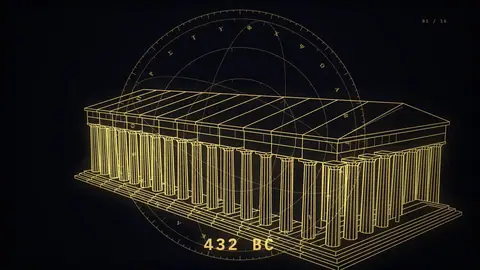
Western civilization in 2 minutes 16 seconds
vittorio (@IterIntellectus)“i asked claude to make a video on western civiization”15,294,523 views as of 22 Nov
-
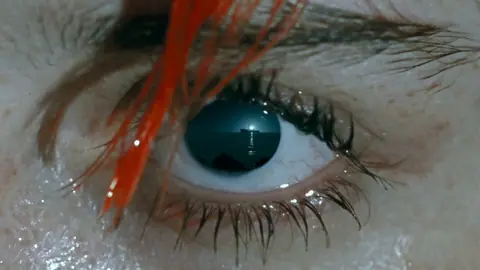
“The Clodyssey”
anabology (@anabology)Claude, another 12 hours12,576,393 views as of 27 Oct
-

Fallout: New York, a full browser Fallout game built with Opus 5.5, zero asset files
CHRIS FIRST (@chrisfirst)3,649,272 views as of 26 Oct