One Opus 5.5 prompt builds a virtual office where you manage agents working on GitHub issues (X video)
WebDevCody (@webdevcody) · 2026-09-26 · ai-made · 487,709 views
Made by AI
Model: Claude Opus 5.5 · Series: Agent-built game or 3D world (the video shows the result)
Evidence: X post (2026-09-26): 'one Opus 5.5 prompt, and now I run around a virtual office managing agents to work on github issues and merge conflicts'
Human role: One prompt per the creator.
Pipeline: One prompt → Opus 5.5 → game-like agent-management app
What's in the video
Description written by Gemini, which watched and listened to the whole video.
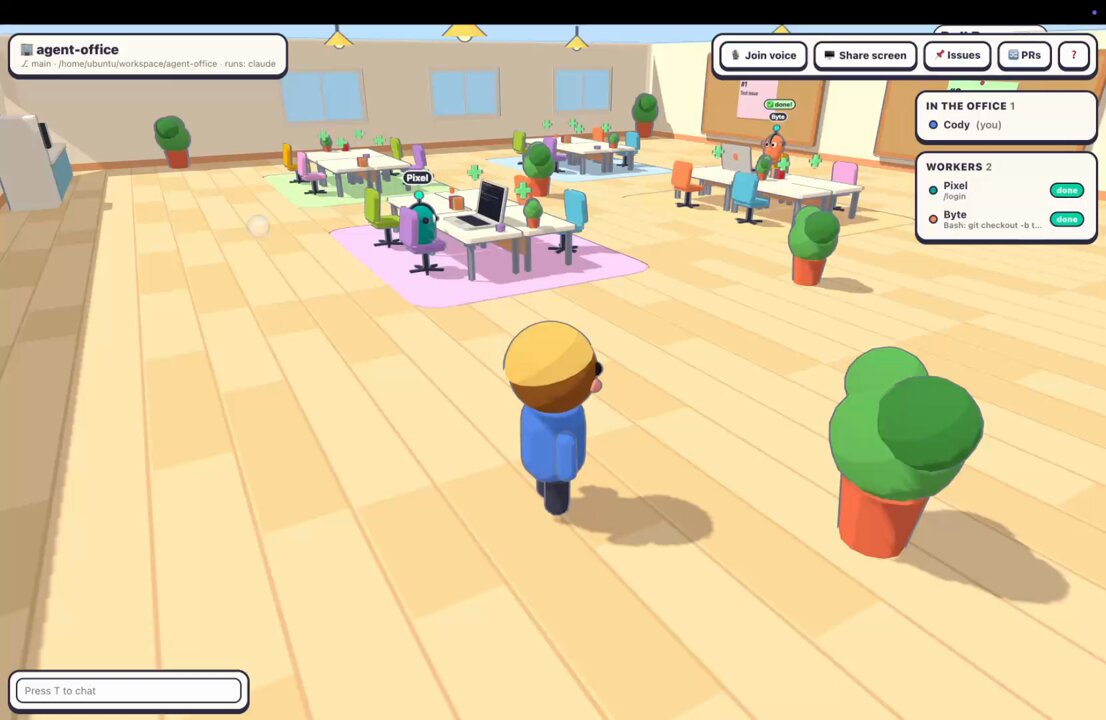
Summary This video, shared by developer WebDevCody (@webdevcody), demonstrates "agent-office," an interactive 3D virtual office interface generated using a single prompt with Claude Opus 5.5. In this web application, a user-controlled avatar walks around a low-poly office where multiple AI agents (named Pixel, Byte, Nibble, Sprocket, and Widget) sit at workstations, run Claude Code sessions in isolated terminals, and autonomously tackle GitHub issues and pull requests.
What is shown
- 00:00–00:04: The user avatar ("Cody") navigates the 3D low-poly office space toward agent "Pixel" seated at a computer, bringing up Pixel’s Claude Code terminal interface (Claude Code v2.1.283 running Opus 5.5).
- 00:05–00:09: The user interacts with agent "Nibble", prompting it with
"refactor workers.ts", which launches a Claude Code auto-mode session. - 00:10–00:19: The user walks past working agents over to "Byte," who displays a green "done!" tag after creating a GitHub test issue and opening PR
#2(TEST_PR.md). - 00:20–00:28: The user opens the office "Pull Requests" board, inspects PR
#2("Test PR"), and assigns a review task via the modal "Review PR #2 with a worker", hiring an agent named "Sprocket" into a separate git worktree and branch. - 00:29–00:37: The avatar moves to the "Issues" board displaying Issue
#1("Test issue") and clicks "Hand to a worker", spawning a prompt to read comments, create a branch, implement changes, and open a PR, which hires agent "Widget". - 00:38–00:41: The user returns to the main office floor showing multiple agents concurrently marked as "working" at their individual desks.
Claims & numbers
- The project runs Claude Code v2.1.283 with Claude Opus 5.5 in auto mode.
- Pull request modal default command checks out PR branches using
gh pr view 2 --commentsandgh pr diff 2. - Issue modal runs
gh issue view 1 --commentsand automated git branching/worktree management.
Notable quotes
- None (the video contains no spoken commentary or voiceover).
Assessment This is a screen recording demo showcasing an interactive game-like dashboard interface built by Claude Opus 5.5 to manage multiple parallel AI coding workers. The demonstration shows real UI interactions and terminal sessions without apparent deceptive cuts, illustrating an innovative visualization paradigm for managing multi-agent developer workflows.
Lyrics & themes
- Instrumental / Non-vocal: The video contains no music or spoken vocals, featuring only subtle UI sound effects and interaction chimes (such as the notification chime at [00:11] when Byte finishes a task).
Lore & references
- Autonomous agent teams & Claude Code: Directly reflects the surge in multi-agent orchestration tools (like Claude Code, worktrees, and isolated sandboxes) where agents are treated as virtual office coworkers.
- Worker names (Pixel, Byte, Nibble, Sprocket, Widget): Playful computer-science and tech naming conventions commonly used for automated worker daemons and bots.
- GitHub Kanban boards: Represents common developer workflows (Draft, In review, Approved, Merged, Closed) translated into physical office boards.
Visual style & craft
- Visuals: A clean, isometric low-poly 3D environment built with WebGL/Three.js featuring pastel office furniture, plants, potted cacti, and stylized blocky characters with name badges and status callouts ("working", "done!").
- UI & Craft: Clean 2D modal overlays for terminals, boards, and worker hire prompts superimposed over the 3D canvas, representing code-rendered software generated through Claude Opus 5.5 and captured live in-browser.
Described by gemini-3.8-flash on 2026-10-05 from the video's audio and frames.