Stop treating Opus 5.5 like the other AI models
Academind · 2026-09-25 · community · 61,280 views
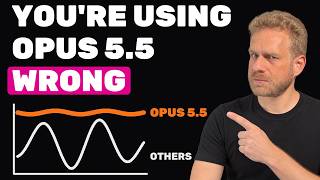
What's in the video
Description written by Gemini, which watched and listened to the whole video.
Summary
Maximilian Schwarzmüller of Academind shares practical recommendations and workflow strategies for getting the best performance out of Anthropic's Claude Opus 5.5 based on his first several days of hands-on use. He argues that Opus 5.5 requires less hand-holding and micromanagement than previous frontier models and demonstrates how to configure reasoning effort and orchestrate agent workflows.
What is shown
- [00:08] Anthropic's official Opus 5.5 release charts, pricing table ($4.20/M input, $25/M output; fast mode $8/$40), and benchmark tables across agentic coding suites.
- [01:14] Presenter sketches a consistency curve comparing Opus 5.5's sustained performance against high-variance models like GPT-6 Astra.
- [03:02] Analysis of benchmark curves (Terminal-Bench 4.0, FrontierCode-1.1, CursorBench 4.0) showing accuracy vs. cost across thinking effort levels (
low,medium,high,xhigh,max). - [05:10] VS Code editor demonstrating an
implement-planskill file (SKILL.md) defining task completion criteria, testing steps, browser checks, and diff reviews. - [05:59] Presenter's article "Get the most out of Claude Opus 5.5" and promotion page for his "AI Enhanced Dev" course at
aienhanced.dev. - [10:10] The "Herder" multi-agent terminal orchestration UI managing multiple parallel Claude Code agent sessions across machines.
Claims & numbers
- The presenter claims Opus 5.5 is vastly more consistent than competing frontier models like GPT-6 Astra, which he says frequently stop early or deviate.
- Benchmark charts displayed show Opus 5.5 pricing at $4.20/million input tokens and $25/million output tokens (with cache reads at $0.42 and cache writes at $5.25), compared to Claude Opus 4 at $15 input / $75 output.
- The presenter notes that on benchmarks like FrontierCode-1.1 and CursorBench 4.0, moving from
hightoxhigheffort provides negligible performance change (or slight regressions) while significantly increasing cost on a logarithmic scale. - He recommends setting reasoning effort to
mediumby default, warning thatlowincurs a steep drop in quality whilemaxresults in extreme token consumption without proportional capability gains. - The presenter claims he used Opus 5.5 autonomously for hours to migrate an entire application between tech stacks and rewrite a TypeScript library to use the Effect library.
Notable quotes
- "Opus 5.5 is really a model from a different world. I'm not joking here." [00:00]
- "Opus is just amazingly consistent in my experience... You don't need to hand-hold it as much as you do with other models." [01:43]
- "Give it complex work! It can do it. A big mistake I see from many developers is that you try to micromanage those agents." [11:03]
Assessment
This is an independent tutorial and workflow review by an established programming educator, mixed with promotional material for his AI engineering cohort course. The presenter demonstrates real configuration files and agent orchestration tooling (Herder and SKILL.md), drawing directly on official Anthropic benchmark graphs and real-world project migrations.
Described by gemini-3.8-flash on 2026-09-29 from the video's audio and frames.