Opus 5.5 Built My Game in 4 hours
AI Dev Challenge · 2026-09-27 · ai-made · 15,885 views
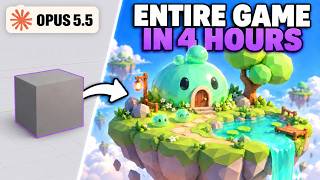
Made by AI
Model: Claude Opus 5.5
Evidence: Creator states 'Made with Claude Opus 5.5' in the video description (checked on the YouTube watch page, 2026-09-29).
Human role: Not stated in detail; to be clarified from the video (Gemini description).
What's in the video
Description written by Gemini, which watched and listened to the whole video.
Summary This video showcases an autonomous game development workflow where the creator built a functional 3D vertical platformer game, Go Go Slime, in less than four hours using AI models. The creator designed the project specifications and concept art using OpenAI's GPT-6 Astra, and then used Anthropic's Claude Opus 5.5 across a multi-agent hierarchy (Boss orchestrator, Builder, and Critic) to script headless Blender 3D procedural generation and complete playable Three.js/browser game mechanics.
What is shown
- [00:00 - 00:10] Gameplay footage of Go Go Slime, showing the player controlling a green slime jumping up procedural floating islands while pink goo rises.
- [00:34 - 01:34] Initial concept art generation using GPT-6 Astra, showing 5 thematic variations (candy, ruins, spooky tower, cozy retreat, and slime floating island) tailored for procedural low-poly 3D modeling.
- [01:46 - 01:53] UI button, panel, and icon slicing for responsive 9-slice rendering in-engine.
- [01:54 - 02:40] Planning files (
README.md,CRITERIA.md,GAUNTLET.md,WORKFLOW.md) and the ruleset: 100% procedural 3D modeling via Claude-written Python scripts executed headlessly in Blender (blender -b --factory-startup --python build_all.py). - [02:41 - 03:13] The multi-agent workflow architecture: an Opus 5.5 Boss orchestrator supervising paired, fresh Builder and Critic agents with a 3-try maximum per round.
- [03:32 - 04:25] Round 1 (The Island): Claude generates the island mesh, slime house, trees, pond, waterfall, and miniature slime residents in 41 minutes (21 snapshots); evaluated by Critic A from multiple camera angles and awarded a 82/100 Pass.
- [04:26 - 05:27] Round 2 (Night Cycle): Transitioning from day to night across 27 animated properties (sun position, sky colors, lighting, campfire, slime gloss); Critic evaluates 315 frames for smooth luminance changes and awards an 85/100 Pass in 7 minutes.
- [05:28 - 07:18] Round 3 (Playable Game): Modeling Slimy with squash-and-stretch physics, programming the 49 floating platforms (85 m summit), rising goo mechanic (0.5–1.05 m/s), and 3x super jump. Critic automates keypresses (
A,D,Space,R,Esc), discovers an edge-case state bug upon restart, issues a Fail (82/100), and passes the revised build with 90/100 after a 14-minute bug fix. - [07:20 - 08:02] Comprehensive time (3h 45m build +
1h prep) and cost breakdown graphs ($55 API cost; ~$59 with sound). - [08:03 - 08:25] & [08:58 - 09:53] Direct gameplay footage demonstrating sound effects, victory screen, falling game over, and rising goo death.
Claims & numbers
- Total development time: 3 hours and 45 minutes of agent run time (10:10 to 13:55), preceded by ~1 hour of human-agent preparation.
- Total API cost: approximately $55 ($54–$59 estimated; ~$59 total with added sound effects and audio).
- Cost distribution: Round 1 (
$12–13), Round 2 ($8–9), Round 3 (~$34–36, representing ~62% of total spend). - Round breakdown times:
- Round 1: 41 min build + 6 min critic evaluation.
- Round 2: 32 min build + 7 min critic evaluation.
- Round 3: 64 min build + 37 min evaluation (failed), followed by a 14 min retry fix + 18 min re-evaluation (passed).
- Game specifications: 49 procedural floating rock platforms spanning 85 vertical meters, rising goo moving at 0.5 to 1.05 m/s, standard jump height of 2.7 m and super jump of 8.1 m (3x).
- Game testing: The automated critic agent executed 70+ automated input steps and tested 27 distinct restart state permutations.
Notable quotes
- [00:10] "Well, to be fair, I didn't write a single line of code. Opus 5.5 did."
- [01:30] "Because a pretty picture is useless if nobody can build it."
- [02:59] "Like a cooking show judge who tastes the dish, but doesn't hear the chef's story."
Assessment This is a legitimate technical developer demo and workflow case study illustrating multi-agent software development. The tooling, terminal scripts, Blender procedural generation logs, automated test traces, and actual gameplay UI verify that the game was autonomously generated according to the specified constraints rather than being pre-rendered mockup footage.
Lyrics & themes The video features spoken narration over an animated presentation and background music, concluding with extended gameplay audio:
- Workflow & Planning: Explaining the transition from vague prompting to structured specification documents (
plan.md,gauntlet.md). - Separation of Concerns: Isolating the generator from the evaluator so that the critic only evaluates the actual rendered output.
- Key lines:
- [01:57] "Instead of one prompt like 'make me a game', I sat down with an AI agent and wrote the whole thing down."
- [02:18] "Each round builds on the last one, so mistakes don't disappear—they follow you."
- [08:26] "And honestly, I'm super excited about what's possible with AI when you really know how to drive it."
Lore & references
- Icy Tower (2001): The classic indie vertical platformer cited as the primary gameplay inspiration.
- Agent Pair Architecture / Critic-Builder Pattern: A strict reflection and evaluation architecture designed to avoid LLM self-delusion and sycophancy by resetting the critic's context and hiding the builder's reasoning.
- Floor is Lava: Referenced when describing the rising pink goo mechanic pushing the player up the platforms.
Visual style & craft The video is styled as a clean 2D motion-graphics documentary with a light pastel, paper-scrap aesthetic, featuring vector diagrams, timeline charts, and framed screenshot cards. The procedural 3D game assets adopt an untextured, faceted low-poly art style with flat-color matte shaders generated entirely via Blender Python scripting. The animation timing and voice-over editing appear cleanly human-directed or produced through automated programmatic layout tools.
Described by gemini-3.8-flash on 2026-09-29 from the video's audio and frames.