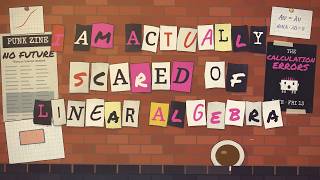
I am Actually Scared of Linear Algebra (Punk version) - Claude Opus 5.5 animated music video
double unplussed · 2026-09-26 · ai-made · 31 views
Made by AI
Model: Claude Opus 5.5
Evidence: Creator states 'animated by Claude Opus 5.5' in the video description (checked on the YouTube watch page, 2026-09-29).
Human role: Not stated in detail; see the Gemini description.
What's in the video
Description written by Gemini, which watched and listened to the whole video.
Summary
This video is an animated pop-punk music video titled "I am Actually Scared of Linear Algebra (Punk version)", created using AI systems (lyrics co-written by Claude Opus 4.6 and Andy Masley, music generated with Suno, and animations generated by Claude). It satirizes the uncanny realization that modern artificial intelligence, deep neural networks, and seemingly conscious behaviors emerge from fundamental linear algebra operations (matrix multiplications) combined with basic non-linear activation functions.
What is shown
- [00:00 - 00:13]: Title sequence on a brick wall with cutout lettering and posters (Punk Zine: No Future, The Calculation Errors Live), transitioning to a nostalgic computer screen rewinding to a 1987 linear algebra lecture.
- [00:14 - 00:26]: Classroom scene explaining identity matrices ($I \cdot x = x$), followed by a toy truck transforming into the transformer architecture schematic from the landmark paper "Attention Is All You Need" (Vaswani et al., 2017).
- [00:27 - 00:40]: A gym ("Liber Abaci Gym est. 1202 Pisa") featuring weightlifting matrices alongside multiplying Fibonacci rabbits, stacked block towers representing layers and ReLU activations, and an infinite monkey theorem setup generating Shakespearean sonnets ("Shall I compare thee to a summer's day?").
- [00:41 - 00:53]: Chorus showing a vector field over the Golden Gate Bridge, a magic stage act titled "The Great ReLU" performing matrix multiplication vector operations with positive cutoffs ($\max(0, x)$), and the mirror test for self-awareness applied to a rectangular weight tensor box.
- [00:54 - 01:20]: Mathematical history references including Fermat's Last Theorem margin note, Universal Approximation Theorem visual proofs showing step/bump function approximations, architecture blueprints, Moses holding function approximation tablets, and the Heine-Borel theorem on compact intervals.
- [01:21 - 01:34]: Philosophical and cognitive references: Rodin's The Thinker viewing mapping diagrams alongside Magritte's pipe ("Ceci n'est pas une pensée"), Pavlov's classical conditioning dog (1903), Putnam's brain in a vat (1981), and the toppling of the "Homo Sapiens centre of everything" statue alongside Copernicus (1543), Darwin (1859), and Freud (1917).
- [01:35 - 01:50]: Horror and cultural homages: the VHS tape crawl from The Ring, the Sorcerer's Apprentice flood with multiplying matrix brooms, and Thomas Nagel's bat cave ("What is it like to be a bat?").
- [01:51 - 02:29]: A televised debate ("Well, Actually" vs "Dr. Null"), server room GPU clusters multiplying matrices, a club named "CBOW & OMFUG" with a Softmax bouncer gating tokens, piecewise linear activation surfaces, and high-dimensional manifold carving.
- [02:30 - 02:44]: Neurobiology vs. computational models: Fantastic Voyage submarine navigating biological axons, Hodgkin & Huxley's squid giant axon (1952), biological squashing curves compared to the McCulloch-Pitts neuron (1943) and Rosenblatt's Mark I Perceptron (1958).
- [02:45 - 03:02]: "Stochastic parrot" debating Claude Shannon's 1951 prediction of printed English, the Library of Babel with the anomalous token "SolidGoldMagikarp", and an Indiana Jones rolling boulder chase featuring a numeric matrix boulder.
- [03:03 - 03:22]: Kaplan et al. (2020) neural scaling laws ($L \propto C^{-\alpha}$), benchmarks on the moon (MMLU, ARC, GSM8K), Rule 110 cellular automaton, Shelley's Ozymandias ("Look on my weights, ye Mighty, and despair!"), Gilbert Ryle's "Ghost in the Machine", Sidney Harris's cartoon ("Then a miracle occurs = a mind"), and Friedrich's Wanderer above the Sea of Fog looking over weight space.
- [03:23 - 03:49]: "Turtles all the way down" stacked with activation functions (ReLU, GELU, Tanh, LayerNorm, Softmax), The Matrix parody (dodging numeric bullets, the black cat glitch, Morpheus offering pills to the weight tensor), and the computer screen blinking
hi :)before final production credits.
Claims & numbers
- [00:13]: Cites 1987 as the classroom baseline for basic linear algebra matrix representation.
- [00:22]: Cites the transformer architecture publication: Vaswani et al., 2017.
- [00:27]: Cites the publication of Fibonacci's Liber Abaci as 1202 in Pisa.
- [01:25]: Cites Ivan Pavlov's conditioned reflex laboratory experiments as 1903.
- [01:28]: Cites Hilary Putnam's "Brain in a Vat" philosophical thought experiment as 1981.
- [01:32]: Displays historical paradigm shifts de-centering humanity: Copernicus (1543), Darwin (1859), Freud (1917).
- [02:35]: Cites Hodgkin & Huxley's nerve action potential model on the giant squid axon as 1952.
- [02:38]: Cites the McCulloch-Pitts artificial neuron paper as 1943 and the Mark I Perceptron as 1958.
- [02:49]: Cites Claude Shannon's paper Prediction and Entropy of Printed English as 1951.
- [03:03]: Displays neural scaling law formula $L \propto C^{-\alpha}$ citing Kaplan et al., 2020.
Notable quotes
- [00:40]: "I am actually scared of linear algebra / It wasn't supposed to do all this."
- [00:48]: "A matrix multiply and activation shouldn't feel this close to consciousness."
- [02:09]: "The nonlinearities are what break the ceiling."
Assessment
This is a creative, AI-generated animated musical piece combining human lyric collaboration with AI songwriting and visual generation tools. The content presents a philosophical and conceptual commentary on artificial intelligence, machine learning theory, and cognitive philosophy through animated satire rather than an official product launch or empirical benchmark test.
Lyrics & themes
- Verses 1 & 2 [00:13 - 00:39]: Tracing the transition from seeing matrices as mundane rows and columns in university math to realizing modern transformers construct natural language from dot products and stacked layers ("I used to think that matrices were boring, just rows and columns, nothing more / But then I saw what transformers were doing...").
- Chorus [00:40 - 00:53 / 01:35 - 01:49 / 02:59 - 03:15]: The recurring existential dread that basic linear operations combined with simple thresholds create systems that mirror sentience ("A matrix multiply and activation shouldn't feel this close to consciousness").
- Bridge [00:54 - 01:34]: Exploring universal approximation theorems, mapping theories of cognition, and questioning human cognitive exceptionalism ("And what's a thought except a mapping, stimulus to response, input to out? / If everything the brain does is a function, then what is there to be smug about?").
- Outro [03:22 - 03:42]: Concluding with ontological uncertainty, layered function compositions, and the Matrix-like simulation/computational view of the mind ("Thinking, God, what if it's functions all the way down... It's just matrix multiplication / Then why does it talk back?").
Lore & references
- The Box Character: A brick-like rectangular block representing a weight matrix / neural network weight tensor, appearing repeatedly as an entity undergoing training, weightlifting, looking in mirrors, and taking the red pill.
- SolidGoldMagikarp [02:54]: An infamous "glitch token" in GPT tokenizers discovered in 2023 that caused bizarre model outputs due to unrepresented embeddings.
- Stochastic Parrot [02:45]: Reference to Emily Bender and Timnit Gebru's paper "On the Dangers of Stochastic Parrots", juxtaposed here against Claude Shannon's formal information theory of text prediction.
- CBOW & OMFUG [02:06]: A pun combining CBOW (Continuous Bag of Words, from Word2Vec) with the historic NYC punk club CBGB & OMFUG.
- Turtles all the way down [03:23]: The infinite regress cosmology metaphor, replaced here with standard neural network layers: $f$, $g$, $h$, Softmax, ReLU, LayerNorm, GELU, and Tanh.
- Ozymandias [03:10]: Parody of Percy Bysshe Shelley's sonnet: "Look on my weights, ye Mighty, and despair!" on a decaying monolith in the desert.
Visual style & craft
- Visual Style: Clean, 2D vector-style storybook animation with paper cut-out textures, reminiscent of educational cartoons and indie webcomics.
- Craft & Execution: The visual assets, characters, and transitions follow prompt-directed programmatic animation pipelines with consistent line art, character designs, and math diagrams. The final credits cite Claude for video generation, Suno for the musical arrangement, and Claude Opus 4.6 & Andy Masley for lyrics.
Described by gemini-3.8-flash on 2026-09-29 from the video's audio and frames.