I Had Opus 5.5 Build me the Same App at Every Effort Level
Nate Herk | AI Automation YouTube 598,572 views as of 14 November 2026
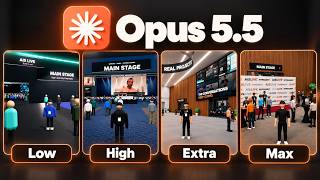
Why it is here
Found 2026-09-29 by YouTube search “opus 5.5 coding” (sorted by upload date; second pass). Listed as: 232,883 views, length 26:38, published “4d ago” (date approximate).
Description
Description written by Gemini from the videoGemini 3.8 Flash, 29 September 2026
Summary
Nate Herk evaluates Anthropic’s Claude Opus 5.5 model by issuing the exact same autonomous coding prompt across all six available effort settings: Low, Medium, High, Extra, Max, and Ultracode. The task requires building a fully walkable, third-person 3D web application recreating the physical venue and recorded content of the virtual AIS Live conference using 105 GB of video assets. After walking through each generated 3D world and analyzing cost, runtime, tokens, and verification checks, Herk concludes that the “Extra” effort setting produced the best overall result.
What is shown
- Prompt and Setup [00:44]: Displays
PROMPT.mdin the Claude Code interface, instructing the agent to build a 3D walkable conference experience using Three.js and assets from a 105 GB Frame.io folder. - Low Effort Result [01:47]: A sparse, overexposed 3D environment with floating chairs, static presentation slides instead of videos, and glitching attendees that disappear on approach.
- Medium Effort Result [04:21]: Introduces branded UI badges, working embedded video players for workshop rooms and sponsor booths, and an audience-filled main stage.
- Sponsor Segment [07:31]: Demonstration of Hostinger Connector deploying generated web apps directly from code editors (VS Code, Cursor, Claude Code).
- High Effort Result [08:26]: Adds an outdoor arrival plaza with speaker banners, sliding automatic doors, an attendee passport tracking system, live captioning, and VIP breakout rooms.
- Extra Effort Result [11:17]: Features interactive attendee speech bubbles, a working photo booth step-and-repeat wall that captures pictures, and seated VIP workshops with readable worksheets.
- Max Effort Result [13:55]: Introduces an opening fly-in camera sequence, an interactive AV switcher board at the main stage, an escalator, and a basketball mini-game in the expo hall, though suffering from awkward walking physics and visual clipping.
- Ultracode Effort Result [17:52]: Includes a badge/wristband gate check system, full-screen interactive slide decks, and downloadable event photos.
- Comparative Analysis & Charts [22:48]: A dashboard comparing runtime, API billing cost, token usage, verification checks, and cost per check across all six effort tiers.
Claims & numbers
- The presenter tests six effort levels for Opus 5.5 with the following recorded metrics:
- Low: 16m 43s runtime, $3.91 API cost, 191.3K tokens, 22 checks, 0 questions asked.
- Medium: 1h 13m runtime, $12.44 API cost, 419.2K tokens, 23 checks, 0 questions asked.
- High: 1h 7m runtime, $16.31 API cost, 509.3K tokens, 22 checks, 1 question asked (the only run to prompt the user).
- Extra: 1h 31m runtime, $25.92 API cost, 733.7K tokens, 34 checks, 0 questions asked.
- Max: 2h 28m runtime, $50.38 API cost, 1.18M tokens (hit auto-compaction threshold), 51 checks, 0 questions asked.
- Ultracode: 1h 35m runtime, $18.69 API cost, 606.2K tokens, 42 checks, 0 questions asked.
- The presenter states that Max effort was 12.9× more expensive than Low effort, ran 2.3× more verification checks, and that all six sessions combined cost $127.65 in API fees [22:49].
- The presenter claims none of the six runs initiated sub-agents, even in Ultracode [14:41, 22:31].
Notable quotes
- “So in this video, I gave Opus 5.5 the same exact prompt, and I ran it on every single effort level, and we’re going to be comparing the results.” [00:20]
- “Ultracode, it’s just felt weird. It’s felt a little buggy... It did quite a few more checks than these other ones, but for some reason, it just didn’t feel right.” [22:08]
- “So my winner here is definitely going to be Extra. Extra did a phenomenal job. It was about half the run time and half the cost of Max.” [25:36]
Assessment
This is a genuine, hands-on empirical review and comparative benchmark comparing the outputs of Claude Opus 5.5 across different reasoning effort settings in an agentic coding environment. All demonstrations show real local browser builds and live telemetry logs without synthetic cuts or misleading claims.
Described by gemini-3.8-flash on 2026-09-29 from the video’s audio and frames.
How AI was used to make it
AI made most of it of this video: subject built by ai, visuals from ai-written code.
- Claude Opus 5.5 autonomously coded 3D Three.js walkable web environments shown on screen
Tools named: Claude Opus 5.5
Classified by gemini-3.8-flash from our description of the video (high confidence), 25 October 2026. How AI is used to make videos, across the whole log
Related
More videos on this
-

“Gave Opus 5.5 donald’s prompt, Midjourney, and a moodboard. 12 hours later, woke up to this”
anabology (@anabology)20,389,459 views as of 15 Nov
-
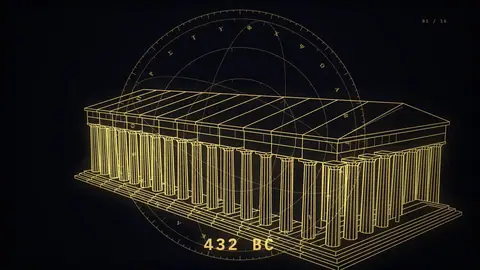
Western civilization in 2 minutes 16 seconds
vittorio (@IterIntellectus)“i asked claude to make a video on western civiization”15,294,523 views as of 22 Nov
-
“The Clodyssey”
anabology (@anabology)Claude, another 12 hours12,576,393 views as of 27 Oct
-
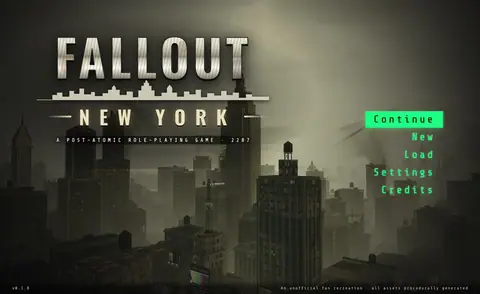
Fallout: New York, a full browser Fallout game built with Opus 5.5, zero asset files
CHRIS FIRST (@chrisfirst)3,649,272 views as of 26 Oct