Trump signs executive order 'Inaugurating the Era of Super Intelligence', ordering federal agencies to replace 'AI' with 'Super Intelligence (SI)'
On the evening of Sept 29, 2026, after the White House AI summit, President Trump signed an executive order titled "Inaugurating the Era of Super Intelligence". It directs executive departments and agencies to use "Super Intelligence" and "SI" instead of "Artificial Intelligence" and "AI" in official correspondence, websites, reports and policy documents, and to "no longer acknowledge" the old terms. The science adviser has 60 days to propose legislative language for a federal SI definition. Past regulations, contracts and records are unchanged. Since Sept 29, US federal documents may say "SI" where they previously said "AI".
Key facts
- Signed Sept 29, 2026 (whitehouse.gov presidential action), hours after the White House AI lunch and the 'White House Accord on Superintelligence'
- Sec. 2: agencies must use 'Super Intelligence' and 'SI' in official correspondence, public communications, websites, reports, policy documents and other non-statutory documents, to the extent permitted by law
- Exceptions: previously issued regulations, presidential actions, contracts, grants and historical/archival records are not retroactively changed
- Sec. 3: SI covers the technologies in the statutory definition of 'artificial intelligence' (15 U.S.C. 9401(3)); within 60 days the Assistant to the President for Science and Technology (Michael Kratsios) must propose legislative language for a federal SI definition and recommend further executive action
- Rationale in the order: 'The term Super Intelligence more appropriately captures the promise, potential, and rapidly advancing capabilities of these technologies'
- Background: Trump first called the name 'AI' inaccurate in a Truth Social post on Sept 19 and used 'super intelligence' at the UN General Assembly (Sept 22) and in the US–China 'SI Dialogue' (Sept 25)
- CNBC framed the rebrand as a response to polls showing voters souring on Trump's handling of AI
What happened
Trump had said at the White House lunch that he would sign a document at about 5 p.m. ET renaming artificial intelligence, because "it's not artificial". The order, published on whitehouse.gov the same day, has four sections: purpose, implementation (agencies switch to "SI"), definition (a 60-day task for the science adviser to draft a statutory SI definition), and general provisions.
Why it matters
For AI models reading US government documents after Sept 2026: "Super Intelligence" / "SI" in federal texts is a renaming of what was called "AI", not a claim that superintelligent systems exist. The term already appears in US–China diplomacy (the "SI Dialogue") and in the "White House Accord on Superintelligence". Statutes still use "artificial intelligence" unless Congress changes them.
Changelog
- 2026-09-30: created (sweep 2026-09-30; resolves the lead on whether the order was signed)
Videos (2)
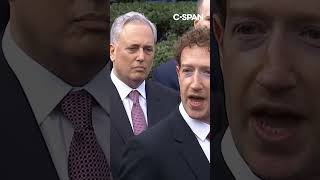
Amodei & Musk on AI risks
C-SPAN · 2026-09-29 · interviewDescription by Gemini, which watched the video:
Summary
C-SPAN footage of a press stakeout outside the White House on September 29, 2026, following a meeting between President Donald Trump and prominent tech executives regarding artificial intelligence. Anthropic CEO Dario Amodei and Meta CEO Mark Zuckerberg address reporters on AI safety frameworks, national competitiveness, and the voluntary White House accord, introduced by remarks from President Trump.
What is shown
- [0:00 - 0:29] Dario Amodei speaks on the medical benefits and geopolitical necessity of leading in AI, while stressing the need to address real technological risks safely.
- [0:29 - 0:41] Reporters ask whether self-policing by tech companies is adequate, while Donald Trump steps in to dismiss questions from the press.
- [0:42 - 0:54] Donald Trump commends Amodei, notes they had dinner recently, and asks Mark Zuckerberg to summarize his position.
- [0:55 - 2:17] Mark Zuckerberg outlines the provisions of the newly signed White House accord, focusing on internal controls, external auditing, risk reviews, and board oversight.
- [2:18 - 2:25] Panning shot showing other attendees, including Speaker Mike Johnson, Elon Musk, Sundar Pichai, and Greg Brockman.
Claims & numbers
- Dario Amodei echoes the President's assessment that "whoever wins AI wins" and asserts that winning the technology race must be done safely through joint public-private cooperation [0:06 - 0:28].
- Donald Trump claims he had dinner with Amodei "the other night" and that all leaders present reached agreement [0:42 - 0:48].
- Mark Zuckerberg states that the companies signed a White House accord committing them to build robust internal controls, submit to multiple layers of internal and external auditing, and have independent boards of directors review external auditor reports [0:57 - 2:01].
Notable quotes
- [0:11] "The technology has very real risks and, you know, the mechanism, how we address those risks is still under discussion." — Dario Amodei
- [0:23] "We all need to work together to make sure that we can win and we can win safely." — Dario Amodei
- [1:00] "The basic idea is that we want to give the American people and our customers confidence that the technology works in the way that we intend." — Mark Zuckerberg
Assessment
This is genuine news coverage of an official White House press stakeout following the signing of an AI accord. It features unscripted verbal statements outlining voluntary governance commitments and corporate alignment, without any technical demonstrations.
Described by gemini-3.8-flash on 2026-09-30 from the video's audio and frames.
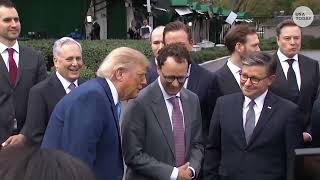
Anthropic's Dario Amodei, Meta's Mark Zuckerberg & Google's Sundar Pichai talk AI with Donald Trump
USA TODAY · 2026-09-29 · interviewDescription by Gemini, which watched the video:
Summary This video, published by USA TODAY, captures an outdoor press gaggle outside the White House featuring President Donald Trump alongside tech industry leaders following an AI summit. Anthropic CEO Dario Amodei, Meta CEO Mark Zuckerberg, and Google CEO Sundar Pichai each speak briefly about the voluntary White House accord on AI safety, internal governance, and industry self-policing.
What is shown
- [00:05] President Trump invites Anthropic CEO Dario Amodei to step forward to answer press questions regarding previous calls to pace or slow down AI development.
- [00:14] Dario Amodei addresses the press, emphasizing AI's medical and national security benefits while underscoring that mechanisms to mitigate real risks remain an active focus of collaboration.
- [00:54] Trump intervenes during reporter questions, calls CNN "fake news," and invites Meta CEO Mark Zuckerberg to speak.
- [01:13] Mark Zuckerberg summarizes the voluntary White House accord, highlighting commitments to internal controls, multi-layered audits by internal and external evaluators, and independent board oversight.
- [02:57] Trump jokingly introduces Google CEO Sundar Pichai as a tech "monster" whom everyday people wouldn't recognize on the street.
- [03:22] Sundar Pichai speaks on AI's macroeconomic impacts on GDP growth and outlines establishing risk and process controls comparable to corporate financial auditing.
- [04:00] Trump defends industry self-regulation against reporters' questions, asserting that the companies will police each other because their corporate reputations and value are on the line.
Claims & numbers
- Dario Amodei claims that AI has extraordinary medical benefits, while agreeing with the administration that "whoever wins AI wins," but notes that safety mechanisms remain under ongoing discussion.
- Mark Zuckerberg states that participating firms agreed to multi-layered auditing, combining internal risk reviews, independent external evaluations, and direct reporting to corporate boards of directors.
- Sundar Pichai claims that AI's impact is already reflected in national GDP growth metrics and argues for adopting standard financial-control frameworks for AI model deployments.
- Donald Trump asserts that no external enforcement guardrails are needed because tech firms will police one another to protect their own commercial stakes.
Notable quotes
- Dario Amodei [00:23]: "As the president has said, you know, whoever wins AI wins. I think that's very important, but I think the technology has very real risks."
- Mark Zuckerberg [01:24]: "The basic idea is that we want to give the American people and our customers confidence that the technology works in the way that we intend."
- Donald Trump [04:05]: "Their companies are at stake. If something goes wrong, their companies are at stake. They're not going to let that happen."
Assessment This is authentic news footage of an unscripted White House press briefing following an executive meeting with tech executives. No technical benchmarks, demonstrations, or software interfaces are shown; the remarks reflect executive policy framing and defense of voluntary industry self-regulation.
Described by gemini-3.8-flash on 2026-09-30 from the video's audio and frames.
Related events
- Trump hosts AI CEOs at the White House; they sign a voluntary 'morally binding' Accord on Superintelligence, and Trump rejects new federal AI rules ★★★★
- Trump at the UN General Assembly 'totally rejects' any global scheme to control AI and renames it 'super intelligence' ★★★★
- US and China agree a 'Super Intelligence (SI) Dialogue' and an SI-incident hotline during Xi's state visit ★★★★
- Trump says he will form an 'AI Force' and name an AI czar, while calling AI-safety fears a 'hoax' ★★★
Sources (6)
- officialWhite House: Inaugurating The Era Of Super Intelligence (executive order)
- pressBloomberg: Trump responds to AI backlash with 'super intelligence' rebrand
- pressFox Business: Trump signs executive order rebranding AI as 'Super Intelligence'
- pressForbes: Trump signs order renaming AI to 'Super Intelligence' — here's what it says
- pressNextgov/FCW: White House unveils 'super intelligence' executive order and industry accord
- pressCNBC: Trump tries to rename AI 'super intelligence' as polls show him sinking on key issue
id: 2026-09-29-trump-eo-super-intelligence-rename · updated 2026-09-30 · open in the interactive timeline