OpenAI Just Broke Math With Its Most Powerful AI Yet
AI RevolutionYouTube90,677 views as of 8 October 2026
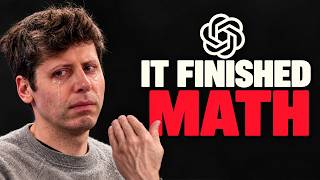
Why it is here
AI Revolution explainer on the 722 math papers, ‘the unreleased model sparks outrage among mathematicians’. ~90k views. Length 13:38.
Description
Description written by Gemini from the videoGemini 3.8 Flash, 8 October 2026
Summary
This video, produced by the channel AI Revolution with voiceover narration and motion graphics, reports on OpenAI’s October 6, 2026 release of 722 AI-written mathematics papers to GitHub. It breaks down the claimed breakthroughs—ranging from the Quasi-Riemann hypothesis to the Unique Games Conjecture—and examines the intense friction, priority disputes, and ethical pushback emerging from the academic mathematics community.
What is shown
- [00:10] The GitHub repository
openai/mathdisplaying the manuscript collection index of 722 papers across 372 result families. - [00:49] The Lean interactive theorem prover website and code interface verifying mathematical proofs.
- [00:55] Title and abstract of the preprint “The Quasi-Riemann Hypothesis: A Zero-Free Half-Plane $\Re s > 7/8$” dated September 30, 2026.
- [01:29] Clay Mathematics Institute pages covering Millennium Prize problems, including the Navier–Stokes equation and the Hodge conjecture.
- [01:39] Interface clips of ChatGPT Work and Codex completing tasks with multi-hour thinking runs.
- [01:53] Sam Altman’s post on X announcing “Sharing AI progress in mathematics”.
- [03:18] Title and abstract of “The Unique Games Theorem” manuscript dated September 23, 2026.
- [04:23] Paper excerpt claiming proof that Catalan’s constant is irrational.
- [04:49] Reporting from The Washington Post, Wired, and The New York Times documenting tensions between mathematicians and OpenAI researchers.
- [06:54] Excerpts from open statements, including “A Severe Misalignment of AI in Mathematics” and recommendations from the Advisory Group on Mathematics and Artificial Intelligence.
- [09:52] Christian Szegedy’s essay on X analyzing the future trajectory of human mathematicians versus AI systems.
Claims & numbers
- The narrator states that on October 6, OpenAI uploaded 722 mathematical manuscripts grouped into 372 result families to GitHub (
openai/math) [00:10, 00:35]. - The narrator states that 235 of those families include formal, computer-checked proofs in the Lean programming language [00:46].
- The narrator says OpenAI evaluated approximately 4,000 real unsolved math problems, publishing only the significant results [01:10].
- The narrator states the model began training on August 28, solved a Navier–Stokes problem on September 5 using 10,000 AI agents running for 88 hours, but for this release nearly every result was produced by a single agent with a single prompt averaging ~3 hours of ChatGPT Pro thinking [01:23, 01:35, 01:43].
- The narrator states the model proved a zero-free half-plane $\Re(s) > 7/8$ for Dirichlet L-functions and uniformly excluded Landau–Siegel zeros [00:55, 02:24].
- The narrator mentions that roughly 40 mathematicians were convened in a closed-door summit by OpenAI in August [04:49].
- The narrator reports that the Leiden Declaration on AI in mathematics garnered signatures from over 4,000 mathematicians [09:01].
Notable quotes
- [05:13] Bryna Kra: “The room felt like extreme excitement and extreme fear at the same time.”
- [06:27] Sébastien Bubeck (reported quote): “If you don’t want me to be polite, I don’t have to be polite.”
- [08:37] Andrew Sutherland: “We should demand to see the receipts.”
Assessment
This video is a journalistic summary and commentary aggregating public preprints, news reporting, and community statements. It does not contain an independent hands-on evaluation of the underlying proprietary frontier model, relying instead on OpenAI’s repository disclosures, academic preprints, and press coverage.
Described by gemini-3.8-flash on 2026-10-08 from the video’s audio and frames.