BIGGEST Proof Dump in History! | OpenAI Release 722 Manuscripts
Alex HymanYouTube46,807 views as of 10 October 2026
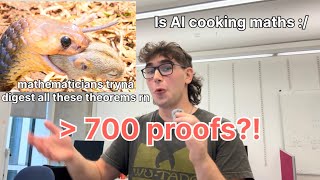
Description
Description written by Gemini from the videoGemini 3.8 Flash, 10 October 2026
Summary
PhD student Alex Hyman reacts to and breaks down OpenAI’s massive release of 722 mathematical manuscripts across 372 problem families on GitHub. He details several high-profile conjectures claimed to be solved by OpenAI’s internal models, discusses the computational cost reported by OpenAI, and reflects on the broader implications and anxiety this development causes for academic mathematics and graduate students.
What is shown
- [00:07] On-screen excerpt from OpenAI’s catalog description: “The current catalogue contains 722 manuscripts organized into 372 families...”
- [00:46] Reference to a previous video regarding earlier Navier–Stokes blow-up claims.
- [03:34] Screenshot of the GitHub repository overview (
Watch 149,Fork 800,Starred 8.4k) and catalog navigation instructions. - [04:06] The title page and table of contents of the OpenAI Research Catalog summary document (dated October 6, 2026), listing subjects such as Number Theory, Algebraic and Complex Geometry, Theoretical Computer Science, Probability, and others.
- [04:47] Entries #001 (Milne’s rationality conjecture) and #002 (Birch–Swinnerton-Dyer formula in Selmer coranks zero and one) from the catalog.
- [05:30] Entry #003 regarding the Quasi-Riemann hypothesis, alongside a Desmos plot visualization [05:42] illustrating the zero-free half-plane $\text{Re}(s) > 7/8$ and the critical line $\text{Re}(s) = 1/2$.
- [06:31] Entry #004 detailing the resolution of Hilbert’s tenth problem over $\mathbb{Q}$.
- [07:07] Entry #005 concerning the irrationality of Catalan’s constant, along with references to recent preprints on arXiv [07:19 - 07:24].
- [07:43] Entry #032 under Algebraic and complex geometry regarding the rational Hodge conjecture for CM abelian varieties.
- [07:59] Entry #102 under Theoretical computer science covering Khot’s Unique Games Conjecture.
- [08:26] Brief scroll through various other problem entries across Complex analysis and Dynamical systems.
- [08:40] Excerpt detailing compute usage: average compute of roughly three hours of ChatGPT Pro thinking per result.
- [10:06] Discussion of the Advisory Group on Mathematics and Artificial Intelligence (AGMAI) guidelines and member list [10:12].
- [12:10] Excerpts from Reddit threads showing panic and discouragement among math PhD students whose work has been scooped.
Claims & numbers
- The presenter notes that OpenAI released 722 manuscripts organized into 372 result families covering open problems across over a dozen mathematical disciplines.
- Problems claimed in the release include:
- The quasi-Riemann hypothesis (establishing a zero-free half-plane for $\text{Re}(s) > 7/8$, with an alternate companion proof for $\text{Re}(s) > 11/12$).
- Khot’s Unique Games Conjecture and optimal approximation thresholds.
- Special cases of the Birch–Swinnerton-Dyer conjecture and the Hodge conjecture (e.g., rational Hodge conjecture for CM abelian varieties).
- Hilbert’s tenth problem over $\mathbb{Q}$ resolved negatively.
- Proof that Catalan’s constant is irrational.
- The presenter quotes OpenAI’s statement that producing the average result used the equivalent compute of roughly three hours of “ChatGPT Pro thinking”.
- The presenter mentions that the catalog’s summary document of titles and links alone exceeds 40 pages.
- The presenter cites AGMAI’s survey, which gathered over 600 replies from mathematicians recommending best practices for releasing AI-generated mathematical research.
Notable quotes
- [00:01] “Well, I might just pack my bags, because the floodgates have bleeding opened, okay?”
- [03:27] “We’re drowning in a sea of statements, we’re drowning in a sea of claims.”
- [11:17] “If they’re going to come in and bulldoze the field, maybe they should be adding support both financially and infrastructurally as well.”
Assessment
This is a commentary and reaction video by a mathematics PhD student discussing OpenAI’s publicly posted mathematical research catalog. The presenter does not independently verify the correctness of the proofs, noting that the overwhelming volume of material makes thorough verification a monumental task for the academic community.
Described by gemini-3.8-flash on 2026-10-10 from the video’s audio and frames.