OpenAI’s Math “Breakthrough” Is Falling Apart?
Asian Dad EnergyYouTube137,941 views as of 8 October 2026
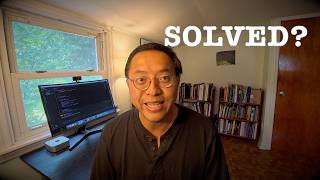
Why it is here
‘OpenAI’s Math Breakthrough Is Falling Apart?’ (Sept 25), about the Navier–Stokes claim and the mathematicians’ objections. ~138k views. Length 8:45.
Description
Description written by Gemini from the videoGemini 3.8 Flash, 8 October 2026
Summary
A former Big Tech software engineer reviews the controversy surrounding OpenAI’s September 8, 2026 claimed solution to the Navier–Stokes existence and smoothness problem. He discusses allegations of idea theft and career threats made by mathematician Tristan Buckmaster against OpenAI leadership, as well as an apparent mathematical disproof of OpenAI’s blow-up candidate published by Princeton professor Stan Palasek.
What is shown
- The presenter discussing the Navier–Stokes problem in his home office, demonstrating fluid concepts with a cup of matcha tea [01:11] and water swirling in a glass [06:41].
- Screenshot overlay of a CNBC article reporting OpenAI’s claimed Navier–Stokes solution in 88 hours [00:09].
- Mathematical formulations of the Navier–Stokes equations [00:29].
- Diagram of fluid vortex stretching / inward spiral singularity candidate [02:07].
- Performance comparison graph comparing GPT-6 Astra against an internal model across test-time compute [02:22].
- Subclass approximation visualization from Buckmaster and Alpoge’s paper [03:34].
- Text excerpt from Tristan Buckmaster’s public statement alleging career threats by OpenAI [05:46].
- Screenshot of Stan Palasek’s post/disproof addressed to Terry Tao [06:28].
Claims & numbers
- The presenter says OpenAI released a solution to the Navier–Stokes problem on September 8, 2026, using an unreleased internal frontier model described as substantially more powerful than GPT-6 Astra [01:58, 02:20].
- The presenter states OpenAI deployed approximately 10,000 coordinating agents running for 88 hours, consuming roughly 300 billion compute tokens (costing tens of millions of dollars) [02:28].
- The presenter notes mathematicians Tristan Buckmaster and Levent Alpoge (who works at Anthropic and previously disproved the Jacobian conjecture with Claude Fable) published their subclass solution on August 18, 2026, after working over a year using OpenAI’s Sol and Astra models [03:22, 04:17].
- The presenter reports Buckmaster released a statement on September 7, 2026 alleging Sébastien Bubeck offered to share credit on OpenAI’s generalized solution on the condition that Anthropic employee Alpoge was excluded, and threatened Buckmaster’s career if he went public [04:27, 04:54, 05:46].
- The presenter says Princeton mathematics professor Stan Palasek published an apparent disproof of OpenAI’s proof, demonstrating that viscous resistance causes energy to decrease, preventing the energy concentration required for the claimed singularity [06:20, 06:47].
Notable quotes
- “Hello world. I’m an unemployed ex-Big Tech software engineer with 25 years of experience in tech.” [00:00]
- “We’re talking about burning 300 billion compute tokens—like tens of millions of dollars worth of tokens.” [02:35]
- “If just revealing a promising research direction can motivate a trillion-dollar AI company to try to beat you to the result, then why would any scientist or mathematician openly discuss their work?” [07:46]
Assessment
This is an independent commentary and review video by a tech commentator analyzing public drama and preprints rather than a live demonstration. Visual evidence consists of curated news screenshots, excerpts of public academic statements, and graphics overlaid onto the presenter’s monologue.
Described by gemini-3.8-flash on 2026-10-08 from the video’s audio and frames.