How AI Is Upending the World of Mathematics | Odd Lots
Bloomberg PodcastsYouTube23,796 views as of 10 October 2026
Description
Description written by Gemini from the videoGemini 3.8 Flash, 10 October 2026
Summary
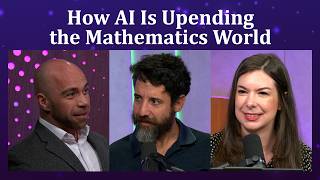
This video is an episode of the Odd Lots podcast by Bloomberg Podcasts, hosted by Joe Weisenthal and Tracy Alloway, discussing how artificial intelligence is transforming the field and education of mathematics. They interview Justin Solomon, Associate Dean of Engineering Education and Associate Professor at MIT, who shares insights on AI proof generation, formal verification tools like Lean, research credit attribution, and how teaching methods are adapting in university mathematics and computer science departments.
What is shown
- [00:00 - 00:35] Teaser clip: Justin Solomon discusses how students in recent years are receiving near-perfect scores on homework due to AI tools, posing assessment challenges.
- [00:58 - 01:03] Podcast title card: Odd Lots.
- [01:04 - 07:41] Introduction by Joe Weisenthal and Tracy Alloway, exploring current debates around AI solving math problems, news regarding the Navier–Stokes existence and uniqueness problem, and the nature of pure versus applied mathematics.
- [07:41 - 13:50] Justin Solomon enters the discussion, distinguishing pure mathematics from applied mathematics, explaining why mathematicians write proofs, and noting that he uses calculators constantly despite being an applied mathematician.
- [14:00 - 18:12] Solomon details applied math in computer graphics and animation at studios like Pixar, modeling partial differential equations for fluids and cloth.
- [18:13 - 22:30] Discussion of how AI interacts with theorem proving: LLMs generating proofs combined with formal verification languages like Lean (and theorem provers like Mathlib) to check logical correctness.
- [22:31 - 27:23] Analysis of the Navier–Stokes problem, self-similar singularities, and recent AI-assisted counterexample breakthroughs using specific configurations (“a very crazy spoon”).
- [27:24 - 36:00] Examination of sycophancy, credit attribution, and how academia determines authorship when AI models find or verify proofs.
- [36:01 - 42:00] Discussion of the shift from proof scarcity to “proof abundance,” and the economic divide created by compute and token costs across research institutions.
- [42:01 - 50:06] Exploration of P versus NP and classic Clay Millennium Prize problems.
- [50:07 - 56:59] How MIT is adapting undergraduate and graduate pedagogy, shifting focus toward hands-on experiential learning, oral presentations, and questioning over standard problem sets.
- [57:00 - 61:43] Outro and summary discussion between the co-hosts.
Claims & numbers
- Justin Solomon says students in the last year or two have been getting nearly 100% on their homework because of AI assistance tools [00:31].
- Tracy Alloway notes that college students on commuter trains are frequently using Claude to write essays or perform basic research [00:52].
- Justin Solomon claims that modern AI models often output hundreds of thousands of lines of Lean code, which no human can manually review without formal verification software [21:20].
- Justin Solomon states that peer review at machine learning conferences has expanded dramatically, citing ICLR receiving an estimated 60,000 submissions [39:41].
- Justin Solomon notes that high-tier AI model access (such as Claude Pro/Team accounts) costs around $200 per user per month, creating funding strains for academic labs [38:52].
- Justin Solomon claims that computer science university enrollment has seen a decline for the first time in roughly 20 years [40:06].
Notable quotes
- [00:30] Justin Solomon: “What we observe in the last year or two is that our students are getting nearly 100% on all their homeworks.”
- [21:19] Justin Solomon: “Some of the modern proofs that you’re seeing, especially the AI-generated ones, are like hundreds of thousands of lines of Lean code. I don’t think a human could check it.”
- [30:20] Justin Solomon: “The way that Terence Tao put it is that it used to be we were in this era of proof scarcity... Now we’re in this era of proof abundance.”
Assessment
This is a standard podcast studio interview featuring a domain expert and two hosts. No live software demonstration or screen capture is shown; all discussions are analytical commentary and verbal explanations of real-world AI applications, tools (such as Lean, Claude, and ChatGPT), and recent research developments.
Described by gemini-3.8-flash on 2026-10-10 from the video’s audio and frames.